

Webinar news coverage services turn webinar content into publishable news stories and distribute those stories across 15 UK media sites. The service combines editorial preparation, media distribution, publication tracking, and coverage reporting for measurable visibility.
A webinar news coverage service converts a live or recorded webinar into a structured media story. The source material includes presentations, expert comments, audience questions, research findings, product announcements, and sector developments.
The resulting article focuses on news value rather than simply reproducing the webinar. A 60-minute fintech webinar, for example, can become an article focused on new payment trends, regulatory developments, or expert commentary.
The 15 UK sites represent a defined media distribution target. Coverage across multiple publications increases the number of locations where the webinar story appears and creates a broader UK media footprint.
For businesses using webinars as part of their content strategy, this process connects event content with earned-style media visibility.
How does a webinar become a UK news article?
A webinar becomes a UK news article through content extraction, news-angle development, editorial writing, fact checking, optimisation, distribution, and publication tracking. Each stage converts event material into a concise story that fits UK media publishing requirements.
1. Webinar content is reviewed
The first stage identifies information with genuine editorial value. Key statements, statistics, announcements, expert opinions, and market developments are extracted from the webinar.
A property webinar, for example, can contain rental-market data, construction trends, housing policy commentary, or development announcements.
2. A news angle is selected
The article needs a clear reason for publication. The angle defines what makes the webinar relevant to a UK audience.
Common angles include:
- New research findings
- Industry trends
- Business announcements
- Expert commentary
- Regulatory developments
- Consumer behaviour
- Technology developments
- Market data
3. The article is prepared
The webinar transcript is not simply copied into an article. Editorial structure separates the main news point from supporting information.
A strong article normally establishes the key development early. Supporting evidence, expert commentary, and company information then provide context.
4. The article is checked
Names, figures, dates, quotations, company details, and claims require accuracy checks. This protects the published article from factual inconsistencies.
What does a 15-site UK webinar distribution service include?
A 15-site webinar distribution service typically includes webinar content assessment, news-angle development, article preparation, UK media distribution, publication monitoring, coverage verification, and reporting. The exact inclusions depend on the provider, distribution network, editorial process, and selected package.
Content conversion
Content conversion transforms webinar material into a news-focused article. It identifies information that works for a media audience instead of treating the webinar recording as the final content asset.
UK media distribution
Distribution places the finished article across the selected UK publication network. A 15-site package provides a defined distribution scope.
The publications can include business, technology, regional, lifestyle, financial, or specialist media depending on the network and campaign requirements.
Publication monitoring
Monitoring checks where the article appears after distribution. It records publication URLs, publication names, dates, and other available coverage information.
Coverage reporting
A coverage report gives the client a consolidated record of published placements. This provides a practical reference for marketing, communications, sales, and internal reporting teams.
How do you choose the right webinar news coverage service?
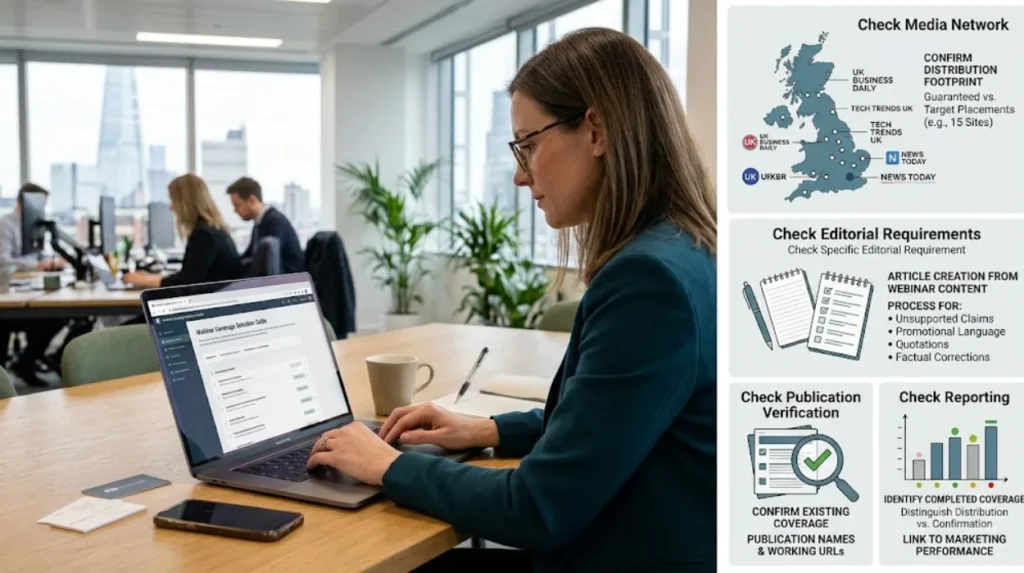
The right webinar news coverage service has a defined UK media network, transparent deliverables, clear editorial standards, publication verification, measurable reporting, and pricing that matches the required coverage volume and campaign objective.
Check the media network
Ask for the names or categories of publications included in the distribution. A claim of “UK media coverage” does not define the actual distribution footprint.
A 15-site service has a specific numerical scope. Confirm whether the 15 sites represent guaranteed publication placements or a target distribution network.
Check editorial requirements
Ask how the provider determines newsworthiness. Strong services explain how webinar material becomes an editorial article.
The provider also needs a process for handling unsupported claims, promotional language, quotations, and factual corrections.
Check publication verification
Publication verification confirms that coverage exists on the stated websites. The report needs publication names and URLs for each confirmed placement.
Check reporting
A useful report identifies the completed coverage rather than simply stating that distribution occurred. This distinction matters when media activity is linked to wider marketing performance.
What makes webinar coverage different from ordinary press release distribution?
Webinar coverage starts with event content and converts discussion into a news story. Ordinary press release distribution starts with a prepared announcement. Webinar coverage therefore requires content extraction and editorial interpretation before media distribution begins.
A conventional press release normally contains a defined announcement. The writer works from information already structured around a news event.
A webinar contains more information. Speakers discuss several subjects, answer questions, explain data, and introduce different viewpoints. The editorial task involves identifying the strongest story.
For example, a cybersecurity webinar can cover ransomware, employee training, cloud security, and regulatory compliance. The resulting article can focus on one specific development rather than summarising every discussion point.
This creates a more focused media asset.
How can webinar news coverage support UK brand visibility?
Webinar news coverage expands the number of UK media locations associated with a company, executive, campaign, or event. Published articles also create reusable media assets for websites, social channels, sales materials, investor communications, and future campaigns.
Brand visibility
Publication across 15 sites creates multiple online locations containing the organisation’s name and relevant story. This extends visibility beyond the original webinar audience.
Executive visibility
Webinars often contain specialist speakers. Their comments provide material for expert-led coverage.
For example, a technology company executive discussing artificial intelligence governance can gain visibility through an article centred on that specific expertise.
Content reuse
Published coverage provides additional content assets. Marketing teams can reference the coverage in campaign materials and communications.
Search visibility
Published articles can create additional indexed references to a company, executive, product, or topic. Search performance depends on publication indexing, article quality, relevance, competition, and other technical factors.
How does webinar coverage help turn event content into measurable media output?
Webinar coverage creates measurable output by converting one event into identifiable media placements. Teams can track the number of published articles, publication names, URLs, dates, coverage themes, and campaign-level results across the selected UK media network.
A webinar normally exists as one event asset. Its recording, slides, and registration page serve the original audience.
News coverage creates additional assets after the event. The campaign can then be measured through completed publications.
Useful reporting metrics include:
- Number of confirmed publications
- Number of UK media sites
- Publication dates
- Article URLs
- Coverage themes
- Named speakers
- Headline topics
- Estimated audience metrics where reliably available
- Referral traffic where tracking is available
These metrics provide a clearer record of media activity than webinar attendance alone.
Which businesses benefit from webinar news coverage?
Businesses with expert-led webinars, research presentations, industry announcements, or educational events benefit most when their sessions contain information with clear UK news relevance. Typical users include technology firms, professional services companies, financial businesses, healthcare organisations, and B2B brands.
Technology companies
Technology webinars frequently contain product developments, artificial intelligence research, cybersecurity findings, and software market analysis.
Financial and fintech businesses
Financial webinars provide material around payments, investment markets, financial technology, regulation, and consumer finance.
Professional services firms
Consultancies, legal firms, accounting firms, and advisory businesses use webinars to present specialist knowledge and market commentary.
Healthcare organisations
Healthcare webinars can provide coverage opportunities around research, patient trends, healthcare technology, professional education, and sector developments, subject to applicable editorial and regulatory requirements.
B2B companies
B2B organisations use webinars to communicate industry findings and specialist expertise. News coverage extends this content beyond registered attendees.
How should you prepare a webinar for media coverage?
Prepare the webinar with media extraction in mind by defining the central announcement, recording factual evidence, capturing expert quotations, documenting statistics, and identifying UK relevance. This preparation gives the editorial team stronger material for accurate post-webinar coverage.
Identify the central story
Define the main development before the event. This gives the editorial process a clear starting point.
Record supporting evidence
Keep research, statistics, reports, presentation slides, and source information available. These materials support factual accuracy.
Capture expert statements
Strong speaker comments provide usable editorial material. Record the exact wording and speaker identity.
Highlight UK relevance
UK-specific statistics, regulations, consumer behaviour, business developments, and market conditions provide stronger regional context.
What should you ask before buying webinar news coverage services?
Before purchasing webinar news coverage services, confirm the 15-site media scope, publication criteria, editorial process, delivery timeline, reporting format, pricing, correction policy, and distinction between distribution targets and confirmed published articles.
Ask these questions before selecting a provider:
- Which 15 UK sites are included?
- Are the sites guaranteed publication destinations?
- How is webinar content converted into an article?
- Who writes and edits the article?
- What information does the client need to provide?
- How are factual claims verified?
- What happens if a publication does not accept the article?
- When is coverage reporting supplied?
- Does the report include live publication URLs?
- What additional services are included in the package?
These questions establish the actual scope of the service.
For teams comparing the educational process behind webinar-to-news conversion,
Webinar coverage provides useful context. For teams evaluating a purchase, webinar news coverage services connects the content process with service selection.
What outcomes can a 15-site webinar coverage campaign deliver?
A 15-site webinar coverage campaign can deliver a defined UK media footprint, multiple published article URLs, broader exposure for webinar insights, stronger executive visibility, reusable media assets, and a documented record of campaign distribution and publication activity.
The most important outcome is verified coverage. A distribution report without confirmed publication information provides limited evidence of media exposure.
The second outcome is content multiplication. One webinar becomes an editorial article distributed across a defined media network.
The third outcome is sustained visibility. Published articles remain available after the webinar ends, giving teams additional assets for communications and marketing activity.
The final outcome is measurable media activity. A structured report gives businesses a record of where the story appeared and when publication occurred.
Explore More Expert Insights:
Hybrid Event Coverage: Get Published on 15 News Sites
Virtual Event News Coverage Across 15 UK News Sites
How can businesses choose a webinar coverage package?
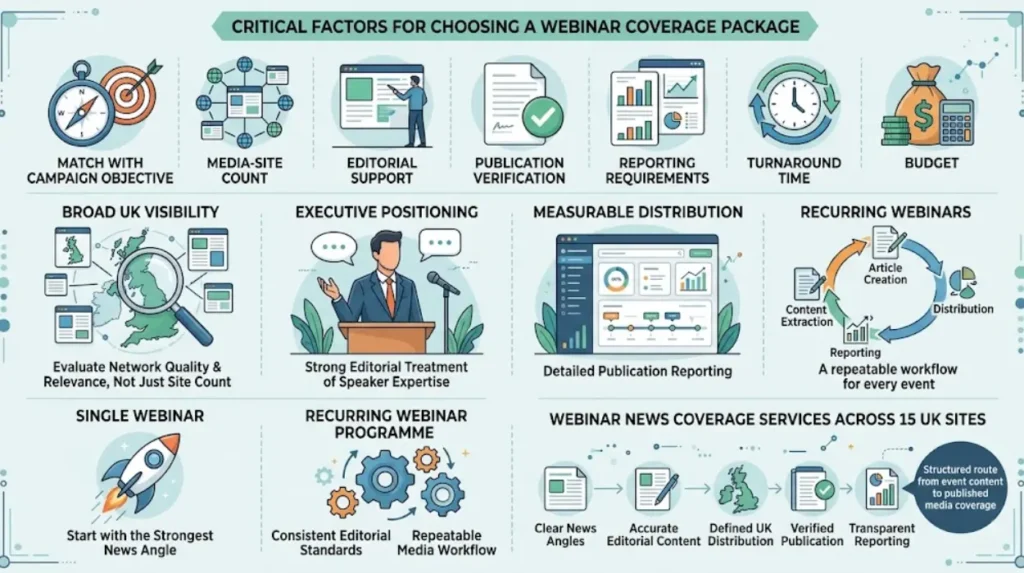
Businesses can choose a webinar coverage package by matching media-site count, editorial support, publication verification, reporting requirements, turnaround time, and budget with the campaign objective. A 15-site package fits campaigns requiring a defined UK distribution footprint.
A business seeking broad UK visibility needs to evaluate the quality and relevance of the publication network rather than focusing only on site count.
A business prioritising executive positioning needs strong editorial treatment of speaker expertise.
A business prioritising measurable distribution needs detailed publication reporting.
A business running recurring webinars needs a repeatable workflow that handles content extraction, article creation, distribution, and reporting for every event.
For a single webinar, the process begins with the strongest news angle. For a recurring webinar programme, consistent editorial standards create a repeatable media workflow.
Webinar news coverage services across:
15 UK sites provide a structured route from event content to published media coverage. The strongest campaigns combine clear news angles, accurate editorial content, defined UK distribution, verified publication, and transparent reporting.



