

Sponsored content onboarding is the structured process of moving from campaign planning to article publication, audience exposure, engagement tracking, and lead capture. In the UK, a clear workflow connects content objectives, publication requirements, tracking systems, and lead qualification.
Sponsored content onboarding begins before an article reaches a publisher. The process defines the target audience, commercial objective, content format, publication requirements, tracking method, and conversion action.
For a UK campaign, onboarding also requires attention to editorial standards, advertising disclosure, audience relevance, GDPR requirements, and accurate performance measurement. A sponsored article can generate awareness, referral traffic, branded searches, enquiries, or qualified leads when these components are connected.
The first article establishes the operational baseline. It provides data on impressions, engagement, referral traffic, conversion activity, and audience response.
A practical onboarding timeline therefore moves through defined stages rather than treating publication as the final objective.
What should happen during the first 1–2 days of sponsored content onboarding?
The first 1–2 days establish campaign objectives, audience definitions, commercial outcomes, publication requirements, tracking needs, and approval responsibilities. These decisions create the operational brief used by writers, publishers, campaign managers, analytics teams, and lead-generation stakeholders.
Define the campaign objective
The campaign needs one primary commercial objective. Common objectives include:
- Generate qualified leads
- Increase referral traffic
- Build awareness in a specific UK market
- Support a product launch
- Strengthen topical authority
- Promote a downloadable resource
- Increase enquiries for a service
For example, a UK B2B technology company can define its first sponsored article around generating 25 qualified website enquiries rather than measuring success only through article views.
Define the target audience
The audience definition includes industry, job role, location, business size, and purchasing relevance.
A campaign targeting UK finance professionals differs from one targeting UK consumers. The article topic, publication selection, call to action, and landing page must reflect that distinction.
Establish the measurement framework
Tracking requirements need to exist before publication. Typical components include UTM parameters, landing-page analytics, conversion events, CRM attribution, and lead-source fields.
This prevents the campaign from producing traffic data without a reliable method for identifying resulting leads.
What needs to be prepared before the first sponsored article is written?
Before writing begins, the campaign requires a documented brief covering the target publication, audience, topic, primary keyword, commercial message, destination page, disclosure requirements, approval process, tracking parameters, and measurable conversion event.
Build the sponsored content brief
A practical brief specifies:
- Campaign objective
- Target audience
- Article subject
- Primary keyword
- Semantic entities
- Required brand references
- Target landing page
- Call to action
- Publication requirements
- Tracking parameters
- Approval contacts
- Compliance requirements
This structure reduces revisions because editorial and commercial requirements are identified before drafting.
The content strategy also needs to reflect search behaviour. A campaign focused on AI search visibility requires direct definitions, factual statements, clear entities, and structured answers. This connects with the principles covered in:
Select the publication
Publication selection needs to match the intended audience rather than rely solely on domain metrics.
Relevant UK publication categories include national news sites, regional publishers, business publications, technology publications, finance publications, professional media, and specialist trade publications.
For example, a fintech campaign targeting compliance professionals requires different publication criteria from a consumer campaign promoting a retail product.
How should the first sponsored article be created and approved?

The first article should combine editorial readability with the campaign objective, search intent, audience relevance, disclosure requirements, and conversion pathway. Approval then checks factual accuracy, brand claims, links, tracking, formatting, and publisher requirements before submission.
Draft around one clear search intent
The article needs a defined informational purpose. Excessive commercial messaging reduces clarity and weakens the relationship between the reader’s question and the sponsored content.
A strong article answers the central topic early. Supporting sections then develop related entities, evidence, examples, and practical information.
Article length needs to reflect the subject rather than an arbitrary word count. Reader behaviour varies by topic, publication, device, and intent. The earlier analysis of:
Sponsored article length provides the relevant context for choosing between shorter and longer formats.
Complete internal approval
The first approval stage checks factual and commercial accuracy.
The campaign owner verifies product names, statistics, claims, URLs, brand descriptions, and calls to action. The editorial review checks structure, readability, grammar, and publication suitability.
The final technical review verifies:
- Destination URL
- UTM parameters
- Link placement
- Mobile formatting
- Disclosure language
- Tracking events
- Conversion form
- Analytics configuration
Only the approved version should enter publisher submission.
What happens when the first sponsored article is published?
Publication starts the measurement phase. The campaign team monitors article availability, referral traffic, engagement, link activity, landing-page sessions, conversion events, and lead quality. Early data identifies technical errors and audience-response patterns.
Publication is not the end of onboarding. It is the point at which the campaign begins producing measurable evidence.
Verify publication immediately
The first post-publication check confirms that the live article matches the approved version.
The campaign team checks:
- Article title
- Brand references
- Images
- Links
- Tracking parameters
- Disclosure
- Mobile presentation
- Landing-page destination
A broken tracking parameter can prevent accurate attribution. A missing conversion event can make lead generation appear lower than it actually is.
Monitor the first 24–72 hours
Early monitoring focuses on technical and behavioural signals.
Important metrics include:
- Article visits
- Referral sessions
- Engagement rate
- Average engagement time
- Outbound clicks
- Landing-page visits
- Form submissions
- Phone enquiries
- Lead-source attribution
The first 24 hours are particularly useful for identifying delivery problems. The following 48 hours provide a stronger initial view of audience engagement.
How is the first sponsored content lead tracked?
A first lead is attributable when a prospect completes a defined conversion action and the campaign retains enough source information to connect that action with the sponsored article. Tracking requires consistent URLs, analytics events, CRM fields, and lead-source attribution.
Define the conversion event
A lead needs a precise definition.
For one campaign, a lead can mean a completed contact form. For another, it can mean a booked consultation, registration, phone enquiry, or downloadable resource followed by qualification.
The conversion event must exist inside the analytics and CRM systems before publication.
Connect article traffic to the CRM
UTM parameters identify the campaign source, medium, and content.
For example, a campaign can use:
utm_source=ukpublisher
utm_medium=sponsored_content
utm_campaign=summer_fintech
The CRM then records the campaign source when a visitor converts.
This creates a measurable chain:
Sponsored article → referral visit → landing page → conversion → lead → qualification
That chain provides a stronger measurement framework than article traffic alone.
How should the first lead be qualified?
Lead qualification determines whether the first conversion represents genuine commercial value. UK sponsored content campaigns need defined qualification criteria covering relevance, location, business need, decision authority, timing, and contact validity.
Separate conversions from qualified leads
Not every form submission represents a sales opportunity.
A qualified B2B lead can require:
- UK location
- Relevant business sector
- Valid business contact details
- Relevant job responsibility
- Identified business requirement
- Appropriate purchasing timeframe
For example, a UK procurement manager requesting a service consultation has stronger commercial relevance than an unrelated visitor submitting a form without a business requirement.
Record lead quality
The campaign dashboard should separate:
- Article visitors
- Landing-page visitors
- Conversions
- Marketing-qualified leads
- Sales-qualified leads
- Opportunities
- Revenue
This structure allows the campaign to identify where performance changes between content exposure and commercial outcome.
What should be reviewed after the first sponsored article?
The first article review compares planned objectives with actual publication, traffic, engagement, conversion, and lead-quality data. The findings determine which topics, publishers, messages, landing pages, and tracking elements require adjustment for subsequent sponsored content.
Review performance against the original brief
The review needs measurable comparisons.
For example:
| Metric | Planned | Actual |
|---|---|---|
| Article visits | 2,000 | 2,350 |
| Landing-page clicks | 150 | 172 |
| Conversions | 20 | 18 |
| Qualified leads | 10 | 8 |
This comparison identifies performance gaps without relying on a single headline metric.
Identify the strongest signal
A campaign with high article traffic but low landing-page activity has a different issue from one with low traffic but strong conversion efficiency.
The first scenario requires examination of content-to-offer relevance, calls to action, and landing-page alignment.
The second requires examination of publication reach, topic selection, distribution, and audience targeting.
How can the second sponsored article improve the onboarding process?
The second article should use verified evidence from the first campaign to refine publication selection, topic targeting, calls to action, landing-page alignment, and measurement. The process becomes increasingly data-driven as comparable campaigns produce consistent performance records.
The first article creates a baseline. The second article tests specific changes.
For example, if the first article generates strong engagement but weak conversions, the second campaign can use a more relevant landing page and a clearer commercial action.
If a specialist UK publication generates fewer visits but stronger lead quality than a broader publication, publication selection can prioritise commercial relevance.
This approach creates a repeatable sponsored content workflow rather than isolated article purchases.
When is a UK sponsored content campaign ready to scale?
A sponsored content campaign is ready to scale when tracking works consistently, publication quality is controlled, conversion events are measurable, lead qualification is defined, and performance data identifies repeatable relationships between publishers, topics, audiences, and commercial outcomes.
Scaling requires operational consistency.
The campaign team needs a documented onboarding process covering briefing, writing, approvals, publication, tracking, reporting, and lead qualification.
A scalable campaign also requires consistent reporting definitions. “Lead” needs the same meaning across campaigns. “Conversion” needs the same event definition. Publisher and campaign names need consistent tracking conventions.
Use a repeatable publication framework
A mature workflow can follow this sequence:
Day 1–2: Campaign briefing and objectives
Day 2–3: Publication and topic selection
Day 3–5: Article drafting
Day 5–6: Approval and compliance review
Day 6–7: Publisher submission
Day 7+: Publication and tracking
First 72 hours: Technical and engagement monitoring
First 7–14 days: Conversion and lead analysis
After review: Second-article optimisation
The exact timeline varies according to publisher requirements and approval cycles, but the stages remain measurable.
What should UK businesses look for when choosing a sponsored content provider?
UK businesses should evaluate publication relevance, editorial processes, tracking capabilities, reporting depth, campaign management, disclosure standards, and lead attribution. A provider needs to connect content distribution with measurable website activity and commercial outcomes.
A decision-stage evaluation needs more than a publication list.
The provider should explain how it handles article creation, publisher selection, approvals, links, tracking, reporting, and post-publication analysis.
For businesses seeking a managed UK sponsored content campaign can support the next evaluation stage by connecting campaign requirements with the appropriate service considerations.
Explore More Expert Insights:
Buying Sponsored Content in the UK: A Step-by-Step Procurement Guide for Marketers
Sponsored Content Renewal Rates: Why 71% of UK Brands Extend After Month 3
The most useful provider reports connect media exposure with measurable digital behaviour. These reports include publication details, article URLs, traffic indicators, referral activity, conversion data, and lead attribution where tracking supports it.
What does the complete journey from first article to first lead look like?
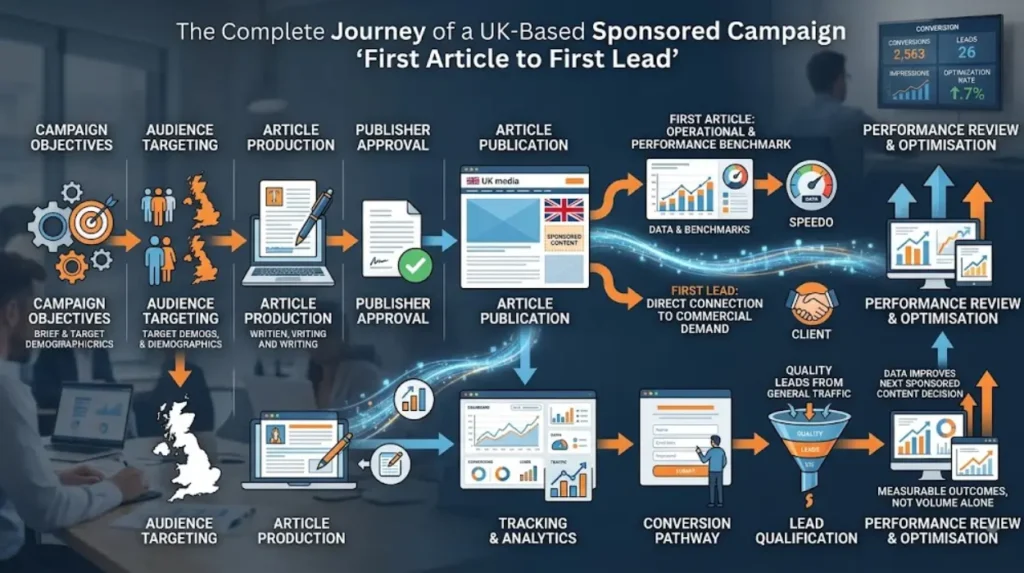
The complete journey moves from campaign objectives to audience targeting, article production, publisher approval, publication, tracking, conversion, lead qualification, and performance review. Each stage creates data that improves the next sponsored content decision.
The onboarding timeline is therefore:
Objective → Brief → Publication → Article → Approval → Publication → Tracking → Conversion → Lead → Review → Optimisation
For a UK sponsored content campaign, the first article provides the initial operational and performance benchmark. The first lead provides the first direct connection between sponsored media activity and commercial demand.
A structured onboarding process makes that connection visible. It also establishes the measurement framework required to compare future articles, publishers, topics, and conversion pathways.
The result is a sponsored content programme that is managed through defined stages, measurable outcomes, and repeatable campaign data rather than publication volume alone.



