Sponsored articles are paid editorial-style content published by a media outlet for a commercial partner. Their effectiveness depends on reader behaviour, article format, topic, device, and distribution. UK news consumption data shows a digital-first audience, continued preference for reading, and growing platform fragmentation.
The central question is not simply whether short or long sponsored articles perform better. UK audience research shows that news consumption is increasingly online and mobile-first, while attention is distributed across websites, search, social platforms, video, and aggregators. Article length therefore needs to match the reader’s information need and consumption context.
What does sponsored article length mean?
Sponsored article length describes the amount of editorial content a paid article contains, usually measured by word count. Short articles prioritise rapid information delivery, while long articles provide greater context, evidence, explanation, and topic coverage for readers.
A short sponsored article commonly focuses on one announcement, finding, product development, event, interview, or defined news angle. Its structure usually contains a headline, introduction, several supporting paragraphs, and a clear conclusion.
A long sponsored article covers a broader information requirement. It can include background information, multiple sections, statistics, expert commentary, examples, definitions, and supporting evidence.
Length is therefore a structural characteristic rather than a direct measure of quality. A 600-word article can answer a focused question completely, while a 1,500-word article can provide the context required for a complex subject.
The distinction becomes important because digital news readers do not consume every article in the same way. Reader behaviour changes according to age, device, platform, topic, and motivation.
How do UK readers consume news online?
UK readers increasingly access news through online sources, with Ofcom reporting that 70% of UK adults consumed news online in 2025. Reuters Institute research also identifies the UK as a market where reading remains a strong preference.
Ofcom’s 2025 News Consumption Survey shows that online news consumption increased from 64% in 2018 to 70% in 2025. Online news now operates alongside television, on-demand services, radio, print, social media, and other digital sources.
The UK market is also mobile-first. Reuters Institute’s 2025 United Kingdom report describes a news environment where traditional television and print reach have declined substantially over the previous 12 years while online consumption has expanded.
This environment creates several reading contexts.
Direct website reading
A reader enters a publisher’s website or application and selects an article. This behaviour provides more opportunity for sustained reading because the user has actively chosen a news destination.
Search-led reading
A reader searches for a specific question or subject and selects an article from the results. The article needs to answer the search intent quickly before expanding into supporting information.
Social discovery
A reader encounters a headline, excerpt, image, or video on a social platform and then decides whether to continue reading. The initial information supplied by the headline and opening paragraphs becomes particularly important.
Mobile consumption
A smartphone provides a smaller reading surface and encourages scanning, scrolling, and selective attention. Subheadings, short paragraphs, lists, and clear information hierarchy support this environment.
Do UK readers prefer short or long news articles?
UK news data does not establish a universal word-count preference. It shows that UK audiences retain a strong preference for reading online news, while younger groups increasingly favour video, making relevance, structure, and context more important than length alone.
The 2025 Digital News Report found that 55% of respondents across its markets preferred reading online news, while the United Kingdom remained among the countries where a large majority still preferred reading news online.
The same research identifies an important generational distinction. Younger audiences, particularly people aged 18–24, are more likely to prefer watching or listening to news than older groups.
This does not mean that long written content has become irrelevant. It means that written sponsored content competes within a wider information environment.
A long article therefore needs a clear information purpose. Length without additional information does not create additional reader value.
A short article needs the opposite discipline. It must deliver the essential information without removing facts required to understand the subject.
The appropriate length depends on the information density required by the topic.
When is a short sponsored article more suitable?
Short sponsored articles suit focused subjects that require rapid information delivery. They work particularly well for announcements, event updates, single developments, concise interviews, and topics where readers need one clearly defined piece of information.
A short format supports a narrow editorial scope.
For example, an article announcing a new UK business partnership can explain the organisations involved, the purpose of the partnership, the relevant date, and its immediate significance without requiring extensive historical context.
A short article can also suit time-sensitive subjects. Readers arriving from search, social media, newsletters, or news aggregators often need the central fact before deciding whether further information is relevant.
Typical short-form structure
A focused sponsored article can contain:
- A specific headline
- A concise introduction
- The central development
- Supporting facts
- One or two relevant examples
- A short conclusion
The format reduces unnecessary information and makes the primary subject immediately identifiable.
However, short content becomes weak when the subject requires explanation. Removing context from a complex financial, technological, healthcare, regulatory, or professional topic can leave readers with incomplete information.
When is a long sponsored article more suitable?
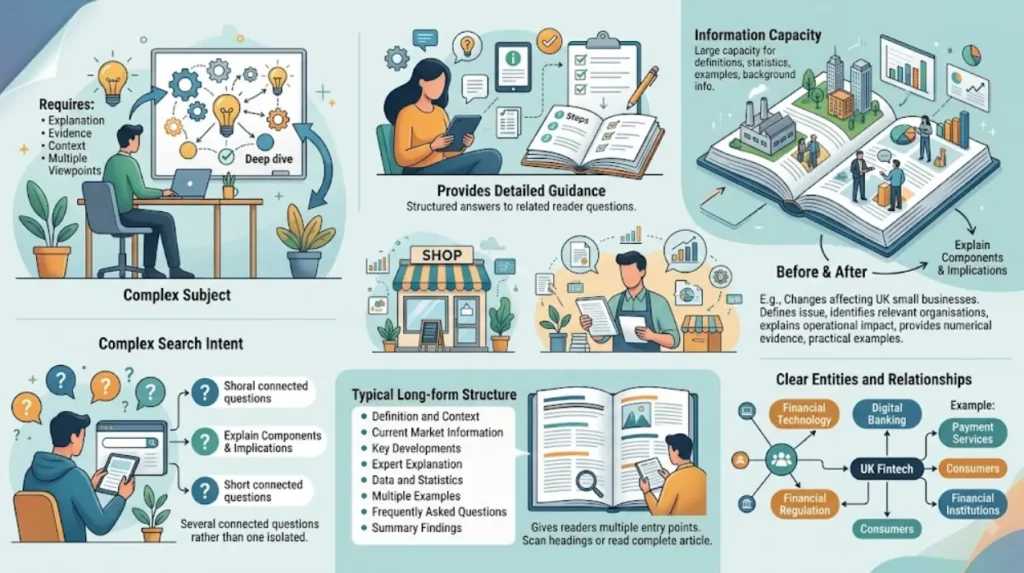
Long sponsored articles suit subjects requiring explanation, evidence, context, multiple viewpoints, or detailed guidance. Their additional space supports definitions, statistics, examples, background information, and structured answers to related reader questions.
Long-form sponsored content has a larger information capacity. It can establish the subject before explaining its components and practical implications.
For example, an article explaining changes affecting UK small businesses can define the issue, identify the relevant organisations, explain the operational impact, provide numerical evidence, and present several practical examples.
Long content also supports complex search intent. A reader searching for an unfamiliar topic often has several connected questions rather than one isolated question.
Typical long-form structure
A detailed sponsored article can include:
- Definition and context
- Current market information
- Key developments
- Expert explanation
- Data and statistics
- Multiple examples
- Frequently asked questions
- Summary findings
This structure gives readers multiple entry points. A reader can scan the headings to find one section or read the complete article.
The additional length also provides more opportunities to establish clear entities and relationships. For example, an article about UK fintech can distinguish financial technology, digital banking, payment services, financial regulation, consumers, and financial institutions rather than treating them as one broad category.
What does UK news behaviour reveal about attention?
UK news behaviour shows that attention is increasingly distributed across digital channels. Online news reached 70% of UK adults in 2025, while social platforms and video increasingly influence discovery, particularly among younger audiences.
Ofcom reports that online news consumption has increased while traditional formats have declined in relative reach. Social media also forms an important part of the UK’s news environment.
Reuters Institute research adds another dimension. Across its international sample, social video consumption increased from 52% in 2020 to 65% in 2025. The report also identifies substantial generational differences in preferred news formats.
For sponsored articles, this means reader attention starts before the article itself.
The headline, publication context, preview text, image, search result, and social post can all influence whether a reader enters the article.
Once inside, information architecture becomes important. A reader encountering a long article needs visible signals that explain what information appears next.
This is why article length and article structure need to be considered together.
How should short and long sponsored articles be structured?
Short sponsored articles need concentrated information, while long sponsored articles need layered information architecture. Both formats require clear headlines, strong openings, concise paragraphs, relevant evidence, descriptive subheadings, and a direct relationship between the headline and content.
Short articles benefit from immediate clarity. The first paragraphs establish the central fact and answer the primary question.
Long articles require progressive disclosure. The opening establishes the subject, later sections explain its components, and examples provide concrete applications.
The distinction can be represented through information density.
| Format | Primary purpose | Typical structure |
|---|---|---|
| Short | Deliver one focused message | Introduction, development, evidence, conclusion |
| Long | Explain a complex subject | Context, sections, evidence, examples, implications, conclusion |
Neither format automatically creates stronger reader engagement.
The content must satisfy the reader’s reason for opening the article.
A short article that fails to answer the reader’s question creates an information gap. A long article that repeats the same point creates unnecessary reading effort.
Does article length affect sponsored content credibility?
Article length alone does not determine credibility. Credibility comes from identifiable sources, accurate information, transparent sponsorship, relevant evidence, clear claims, and editorial structure. Longer content provides more space for evidence but also creates more opportunities for repetition or unsupported claims.
Sponsored content operates within an editorial environment. Readers need to understand that the content has a commercial relationship while also receiving useful information.
The distinction between information and promotion is important. Research into sponsored content has found that excessive brand mentions can reduce reader engagement, while one appropriately placed brand mention performed better in one study than repeated mentions. The study is not UK-specific, so it does not establish a UK-wide rule.
The principle is relevant to both formats: information needs to remain central.
A 700-word sponsored article can contain substantial evidence when every paragraph serves the topic. A 1,500-word article can lose reader attention when additional length consists primarily of repeated promotional claims.
How should publishers and advertisers choose between short and long formats?
The correct format starts with the reader’s information requirement. Choose short content for a narrow factual purpose and long content for complex subjects requiring context, evidence, definitions, examples, or multiple related questions.
A useful decision process begins with five questions:
- What is the reader trying to understand?
- How complex is the subject?
- How much evidence is required?
- How many related questions need answers?
- Where will readers discover the article?
A focused event announcement has a narrow information requirement. A technical explanation has a broader requirement.
Explore More Expert Insights:
Why UK Audiences Reject Overtly Promotional Content and What to Write Instead
How Sponsored Editorial Became a Top-3 B2B Awareness Format in the UK in 2026
Distribution also matters. Search-led readers often enter with a defined question. Social readers frequently encounter the subject through a headline or short preview. Direct readers already have an established relationship with the publication.
These contexts do not create fixed word-count rules. They define different information environments.
What should readers expect from effective sponsored articles?
Effective sponsored articles match content depth to reader intent. Short articles provide focused answers quickly. Long articles provide structured context. Both formats depend on relevance, factual accuracy, transparent sponsorship, a readable presentation, and evidence supporting the subject.
UK news consumption data confirms that online reading remains central to the country’s news ecosystem. Ofcom recorded 70% online news consumption among UK adults in 2025, while Reuters Institute research identified the United Kingdom as a market where reading remains strongly preferred.
At the same time, news consumption is becoming more fragmented. Search, social networks, smartphones, aggregators, websites, video platforms, and direct publisher relationships all contribute to how audiences discover information.
That environment makes article length a content-planning decision rather than a standalone performance metric.
Readers interested in how sponsored content is structured for AI-driven discovery can explore:
Readers evaluating the transition from publication to measurable commercial outcomes can explore:
Sponsored Content Onboarding Timeline.
The key distinction is simple: short sponsored articles concentrate information, while long sponsored articles expand information. The stronger format is the one that provides the level of detail required to answer the reader’s actual information need without adding unnecessary material.