Virtual event coverage is the process of turning an online event into a newsworthy story, preparing verified information, distributing it to relevant media, and securing publication across suitable UK news websites through editorially relevant content.
A virtual event takes place online through platforms such as webinars, digital conferences, livestreams, virtual launches, and online panels. News coverage begins when the event contains information with relevance beyond its attendees.
UK news sites assess the story through factors such as news value, audience relevance, timeliness, evidence, geographic relevance, and editorial fit.
Coverage differs from simply publishing an event announcement. A published news article requires a clear story angle. It identifies what happened, why it matters, who is affected, and what evidence supports the claims.
For organisations evaluating media options, understanding this process helps separate event promotion, press release distribution, editorial coverage, and syndicated news publication.
Readers can also explore:
Virtual event coverage to understand how online events become suitable stories for UK media.
How does a virtual event become a publishable UK news story?
A virtual event becomes publishable when its strongest factual development is converted into a clear news angle supported by evidence, relevant people, specific numbers, timely information, and content that matches the editorial focus of UK news audiences.
Identify the news angle
The news angle defines the central reason a journalist or publication would cover the event.
Common angles include:
- A major industry announcement
- New research presented during the event
- A significant partnership
- New investment or funding
- Changes affecting a defined UK audience
- A public policy discussion
- New technology or business development
- A measurable event outcome
For example, a virtual fintech conference with 3,000 UK attendees provides a stronger story when it announces a new payment technology than when the story only states that the conference occurred.
Build the story around evidence
Specific facts increase editorial clarity.
A release can include attendance figures, research findings, launch dates, investment values, survey results, speaker credentials, customer numbers, or geographical information.
Claims require accurate sourcing. Names, organisations, statistics, dates, and quotations require verification before distribution.
What happens before a virtual event story is sent to UK media?
Before distribution, the event story is researched, structured, fact-checked, and matched with relevant media categories. The process establishes the headline, lead, supporting evidence, quotations, metadata, images, links, and target publication types.
Create the headline and lead
The headline identifies the primary development. The lead explains the most important fact immediately.
A strong structure answers:
- What happened?
- Who is involved?
- Where is the relevance?
- When did it happen?
- Why does it matter?
The story then develops supporting information in descending order of importance.
Prepare supporting assets
A virtual event news package commonly contains:
- Press release
- Event photographs or approved screenshots
- Speaker information
- Research data
- Company background
- Quotations
- Relevant website links
- Contact information
Visual assets need clear ownership and usage permissions. Screenshots from an online event require appropriate rights before publication.
Verify every factual element
Fact checking protects the credibility of both the organisation and the media outlet.
A publication receiving a release expects accurate names, dates, statistics, job titles, company descriptions, and quotations. Incorrect information creates editorial friction and can prevent publication.
How do UK news sites decide where virtual event stories fit?
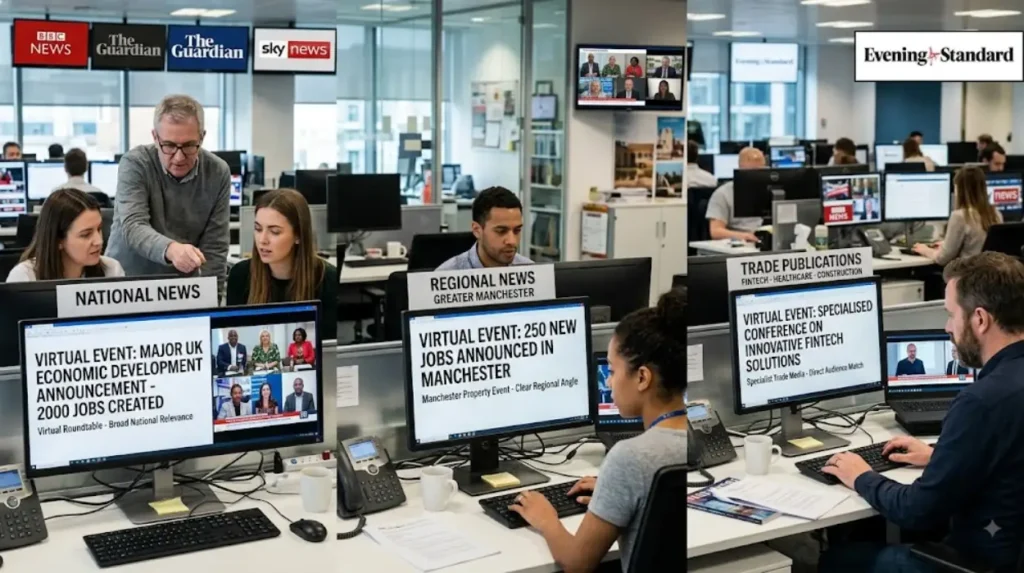
UK news sites classify virtual event stories according to subject, geography, audience, editorial format, and news value. A business announcement fits business media, while technology research fits technology publications and relevant specialist news channels.
National news publications
National websites generally require broad public or business relevance.
A virtual event involving a major UK economic development has stronger national relevance than a small internal company webinar.
Regional publications
Regional media focuses on geographical relevance.
For example, a virtual property event announcing 250 new jobs in Manchester provides a clear regional angle for publications serving Greater Manchester audiences.
Trade publications
Trade media focuses on specific professional sectors.
Examples include:
- Fintech
- Healthcare
- Construction
- Technology
- Education
- Property
- Retail
- Energy
A specialised virtual conference often has stronger relevance for trade publications because its subject directly matches the publication’s audience.
How is a virtual event press release distributed to UK news sites?
Distribution begins after the story is finalised and the target media categories are defined. The release enters selected distribution channels, where publication opportunities depend on editorial relevance, content quality, timing, and network availability.
Distribution is not identical to guaranteed editorial coverage.
A distribution network can place a release before participating publications and news platforms. Individual publishers then apply their own editorial processes.
This distinction matters when comparing media solutions.
Direct media outreach
Direct outreach targets specific journalists or editorial teams.
The pitch identifies the story, explains its relevance, and provides the essential facts. It avoids sending identical messages without audience consideration.
News distribution networks
Distribution services provide access to groups of media outlets and publishing platforms.
The practical value depends on the network’s UK reach, publication categories, reporting capabilities, and suitability for the target audience.
Hybrid distribution
A hybrid approach combines structured distribution with targeted media outreach.
For example, a virtual technology event can use distribution for broad visibility while separately approaching technology editors with a research-led angle.
What content components help virtual event stories get published?
The strongest virtual event stories contain a news-led headline, concise opening paragraph, verified facts, meaningful quotations, relevant statistics, clear attribution, useful context, and supporting media assets that help editors understand the story quickly.
Headline
The headline communicates the development rather than simply promoting the event.
“UK retailers report 28% increase in digital payment adoption at virtual industry summit” communicates more news value than “Successful Virtual Retail Conference Held Online.”
Lead paragraph
The lead delivers the central fact.
It avoids lengthy event descriptions and places the most important information first.
Quotations
A quotation adds an identifiable human perspective.
The speaker’s name, role, and organisation establish attribution. Quotes need to provide substantive commentary rather than generic promotional statements.
Data
Numbers improve specificity.
Examples include:
- 2,500 attendees
- 42% survey response rate
- £8 million investment
- 15 participating organisations
- 37% increase in demand
Each figure requires a clear source and context.
How does timing affect publication of virtual event coverage?
Timing determines how closely a virtual event story connects with current news cycles, audience interest, search demand, and editorial schedules. Immediate post-event distribution preserves freshness while planned pre-event announcements support awareness before the event begins.
Pre-event coverage
Pre-event stories focus on what is about to happen.
They can highlight confirmed speakers, research releases, major announcements, registration figures, or industry issues addressed during the event.
Post-event coverage
Post-event stories provide evidence of what actually happened.
They can include attendance results, new findings, announcements, partnerships, quotes, and measurable outcomes.
Post-event content often provides more factual material because the event has already produced verifiable developments.
News cycle alignment
UK media operates around daily editorial schedules.
A release connected to a current industry development has greater contextual relevance than an event story distributed after the subject has lost immediate attention.
How can organisations compare virtual event media coverage options?
Organisations comparing coverage options need to assess media relevance, UK publication reach, editorial treatment, distribution method, reporting quality, turnaround, content requirements, and whether the solution provides visibility, syndication, targeted outreach, or confirmed publication.
A useful comparison separates the type of media outcome rather than comparing services only by the number of websites listed.
Distribution reach
Reach measures where content enters a media network.
A larger outlet count does not automatically establish stronger relevance. A targeted set of UK business, regional, and trade publications can provide more contextual value for a specialised event.
Editorial relevance
Relevance measures how closely publications match the event’s subject and audience.
A cybersecurity event requires technology, business, cybersecurity, and relevant professional media rather than unrelated general-interest websites.
Reporting
A useful media report identifies published URLs, publication names, dates, headlines, and other available performance information.
Reporting enables organisations to verify where coverage appeared.
Coverage format
Organisations also need to distinguish between:
- Full editorial articles
- Press release republication
- News syndication
- Event listings
- Journalist mentions
- Search-indexed publication pages
These formats represent different media outcomes.
For decision-stage research, readers can examine:
Virtual event news coverage to compare how coverage appears across multiple UK news sites.
What types of virtual events generate UK media coverage?
Virtual conferences, webinars, product launches, research briefings, industry panels, investor events, and online summits generate different coverage opportunities when they contain specific developments that match the interests of UK national, regional, business, technology, or trade publications.
Virtual conferences
Large conferences provide multiple potential story angles.
Research announcements, speaker statements, industry statistics, partnerships, and policy discussions can each become separate editorial developments.
Product launches
A virtual product launch creates a clearer news story when it contains specific information about availability, pricing, technology, investment, market entry, or customer impact.
Research webinars
Research-led events can generate coverage when the underlying findings contain measurable results.
For example, a webinar presenting survey results from 1,500 UK consumers provides a data-based angle for business and consumer media.
Executive panels
Executive discussions become more newsworthy when participants address a current market development and provide attributable statements supported by relevant evidence.
What should organisations measure after virtual event coverage is published?
Post-publication measurement tracks where stories appeared, which publications carried them, how closely outlets matched the target audience, what content was indexed, and which coverage outcomes support broader communications, search visibility, stakeholder awareness, or campaign reporting.
Publication tracking
Track each confirmed placement by publication, URL, publication date, headline, and coverage type.
Audience relevance
Evaluate whether published stories reached the intended UK audience.
For a B2B event, specialist business and trade publications often provide more relevant exposure than unrelated high-volume websites.
Search visibility
Published coverage can also create discoverable pages containing the organisation, event, speakers, research, or announcement.
Search performance requires separate measurement from publication count.
Campaign reporting
A structured report connects event activity with media outcomes.
The reporting framework can compare planned targets against actual publication results across national, regional, business, technology, and trade media.
Explore More Expert Insights:
How Festival Coverage Runs Across 15 UK News Websites
How Sports Event Coverage Spreads Across 15 News Sites
How does the full UK virtual event coverage process work?

The complete process moves from event identification to news-angle development, content production, verification, media targeting, distribution, publication tracking, and performance reporting. Each stage determines whether the final coverage remains relevant, accurate, measurable, and suitable for UK audiences.
The process can be summarised as:
- Identify the event’s strongest news development.
- Define the target UK audience.
- Select relevant publication categories.
- Develop the headline and lead.
- Add verified facts, statistics, and quotations.
- Prepare supporting media assets.
- Fact-check the complete release.
- Select distribution and outreach methods.
- Submit the story to relevant media channels.
- Monitor confirmed publication.
- Record publication URLs and dates.
- Evaluate relevance and campaign outcomes.
This framework helps organisations understand what happens between a virtual event and its appearance on UK news websites.
The key distinction is between having an online event and having a publishable news story. Publication depends on a clear development, factual evidence, editorial relevance, appropriate distribution, and measurable media outcomes.