
Sports event coverage across 15 news sites is a coordinated distribution process that places one event story across multiple relevant UK publications. It combines news preparation, media targeting, distribution, publication tracking, and performance reporting.
Sports events generate several types of news content. These include tournament announcements, fixtures, athlete appearances, venue openings, sponsorships, awards, community programmes, and post-event results. Each story has a different news angle and audience.
For organisers, clubs, promoters, sponsors, and sports businesses, the challenge is not simply creating a press release. The process involves identifying suitable publications, preparing information for journalists, distributing the story through an appropriate media network, and monitoring resulting coverage.
For readers entering the consideration stage, understanding this process helps distinguish broad media distribution from targeted UK sports coverage. The earlier guide on [sports event coverage] explains how sports events reach 15 UK news sites quickly. The next stage focuses on how that coverage spreads and how distribution options differ.
What does sports event coverage across 15 news sites mean?
Sports event coverage across 15 news sites means distributing one newsworthy event announcement to 15 relevant publications, with publication depending on editorial fit, audience relevance, timing, and each outlet’s content practices. The process extends visibility beyond one website or audience.
The 15-site model represents a defined media distribution target. It does not mean that every publication uses identical wording or publishes the announcement simultaneously.
A distribution process begins with one core story. The story contains verified facts such as the event name, date, location, participants, organisers, competition details, and relevant quotes.
The content then enters a media distribution system. Target publications are selected according to factors such as:
- UK geographic relevance
- Sports audience
- Local news interest
- Business relevance
- Event scale
- Publication format
- Editorial suitability
For example, a London athletics event has different media relevance from a Manchester football tournament. A national sports announcement also has different distribution requirements from a local charity sporting event.
What determines whether a sports story fits a news site?
Editorial relevance is a central factor. A publication needs a clear reason to carry the story.
A national sports publication focuses on wider sporting significance. A regional publication focuses more strongly on local participation, venues, clubs, athletes, and community impact.
A strong release therefore identifies the news value before distribution. The event itself provides the subject. The location, people, competition, achievement, or commercial development provides the news angle.
How does a sports event story spread from one release to 15 publications?
A sports event story spreads through a sequence of preparation, media selection, distribution, publication, monitoring, and reporting. The same verified announcement enters multiple relevant media channels, while individual publications determine whether and how the story appears.
The process starts with content preparation. The organiser provides the information required to create an accurate announcement.
The distribution team then identifies suitable publications. This step separates targeted media distribution from simply posting content online.
The release moves through the selected distribution network. Publications receive the story through established media channels or direct editorial processes.
Once a publication uses the information, the resulting article creates an individual coverage point. Fifteen successful placements therefore create a broader media footprint than one website publication.
What happens after the release reaches publishers?
Publication activity is monitored after distribution. Monitoring identifies where the story appears, when it appears, and how the publication presents it.
Tracking also helps separate different forms of coverage. A publication can produce an original article, a distributed news item, an edited version, or a syndicated version.
A useful coverage report records publication name, article URL, publication date, headline, geographic relevance, and content type.
This information gives organisers a structured view of the event’s media reach.
Which factors influence the spread of sports event coverage?
Sports event coverage spreads according to news value, media relevance, geographic targeting, publication type, content quality, distribution timing, and event characteristics. Strong alignment between the story and selected publications creates a more relevant distribution network.
News value
News value determines the core reason for publication. A major tournament announcement has stronger national relevance than a routine internal event update.
Examples include:
- A new UK sporting competition
- A major athlete participation announcement
- A stadium event attracting thousands of spectators
- A significant sponsorship agreement
- A charity sports event supporting a defined community
- A record-breaking sporting achievement
Geographic relevance
Location provides a strong regional news signal.
A football event in Birmingham has clear relevance to Birmingham and the wider West Midlands. A tournament involving teams from several UK regions creates broader geographic relevance.
Publication type
Different publication categories serve different audiences. Sports websites, regional newspapers, business publications, community news platforms, and specialist outlets each operate within distinct editorial contexts.
A 15-site distribution plan therefore benefits from publication diversity when the event has several legitimate audience angles.
Timing
Timing affects the usefulness of sports news. Announcements issued before an event support awareness and attendance. Results-based coverage becomes relevant after the event.
For example, a fixture announcement belongs to a pre-event communication cycle. Competition results belong to a post-event cycle.
How do media distribution options differ for sports events?
Media distribution options differ by publication reach, targeting, editorial relationships, geographic coverage, reporting capability, and distribution method. Organisers can compare broad distribution, targeted distribution, direct pitching, and specialist sports media outreach according to event objectives.
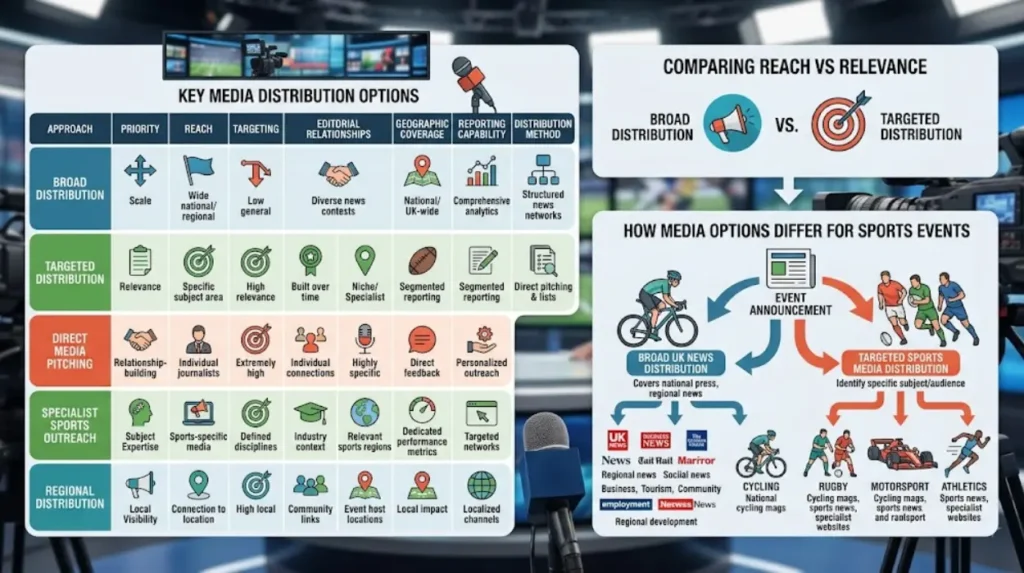
Broad distribution prioritises scale. Targeted distribution prioritises relevance.
Direct media pitching involves approaching selected journalists or editorial teams individually. Distribution networks provide a structured route for sending the same announcement to multiple publications.
Specialist sports outreach focuses on sports publications and journalists covering defined disciplines. Regional distribution focuses on locations connected to the event.
These approaches serve different purposes.
What is targeted sports media distribution?
Targeted sports media distribution identifies publications based on the event’s subject and audience.
For example, a cycling event requires different media targeting from a rugby tournament. A motorsport announcement has different specialist publication requirements from an athletics competition.
Targeting improves contextual relevance because the story reaches publications whose audiences already follow the subject.
What is broad UK news distribution?
Broad UK distribution focuses on wider publication reach across national, regional, and general-interest news environments.
This model is useful when an event has several dimensions. A major sporting event can contain sports, business, tourism, community, employment, and regional development angles.
The distribution strategy then reflects those different news contexts.
Why is coverage tracking important after distribution?
Coverage tracking verifies where an event story appears and provides measurable evidence of media activity. A structured tracking process records publications, URLs, dates, headlines, and coverage types, creating a clear record for evaluation and future media planning.
Distribution without monitoring provides limited information about outcomes.
Tracking establishes what happened after the release entered the media network. It identifies successful placements and provides evidence for internal reporting.
A coverage report can include:
- Publication name
- Coverage URL
- Publication date
- Headline
- Coverage category
- Geographic market
- Relevant audience
- Distribution status
The report also creates historical data. Future campaigns can use previous results to refine publication targeting.
How can organisers evaluate 15-site coverage?
Organisers can evaluate coverage by comparing publication relevance, audience alignment, geographic spread, article quality, and campaign objectives.
The number 15 is a distribution target, not the only performance measure.
For example, 15 highly relevant regional and sports publications can provide stronger contextual value than 15 unrelated websites. Evaluation therefore requires both quantity and relevance.
How does sports event coverage support wider marketing activity?
Sports event coverage supports wider marketing activity by creating published news assets that organisers can reference across websites, social channels, stakeholder communications, sponsorship reports, and future campaigns without treating media coverage as a replacement for those channels.
Published coverage becomes part of the event’s wider communication record.
An organiser can reference legitimate media coverage in stakeholder reports. Sponsors can monitor the publications associated with an event. Event teams can use coverage records when evaluating communications activity.
The role of media coverage differs from advertising. News coverage depends on editorial publication, while advertising involves paid placement.
What types of sports events use multi-site coverage?
Multi-site coverage applies to many event categories, including:
- Football tournaments
- Athletics competitions
- Boxing events
- Rugby fixtures
- Cycling races
- Motorsport events
- Golf tournaments
- Community sports festivals
- University competitions
- Charity sporting events
Each category creates different media angles.
A university competition can emphasise student participation. A charity race can focus on fundraising and community involvement. A professional tournament can focus on participants, competition, sponsorship, and results.
How should organisers compare sports event coverage options?
Organisers should compare sports media coverage options using publication relevance, UK geographic reach, sports audience alignment, distribution process, tracking capability, reporting detail, timing, and campaign objectives rather than relying only on the number of publications included.
The first comparison is audience fit. The second is geographic relevance. The third is distribution capability.
Organisers also need to understand what a provider actually defines as coverage. A distribution package can include media delivery without guaranteeing editorial publication.
The distinction matters because publication decisions remain separate from distribution.
What questions help evaluate a distribution option?
Useful evaluation questions include:
- Which UK publications form the target network?
- How many publications are included?
- Are sports and regional publications represented?
- How is geographic relevance determined?
- What information is required before distribution?
- How is publication activity monitored?
- What does the final coverage report contain?
- How quickly is the release distributed?
- How are published URLs verified?
- Does the service distinguish distribution from confirmed publication?
These questions create a clearer basis for comparing solutions.
Explore More Expert Insights:
How Real Estate Event Coverage Reaches UK Property Readers
How Healthcare Event Coverage Meets UK Editorial Standards
What should a 15-site sports coverage strategy include?
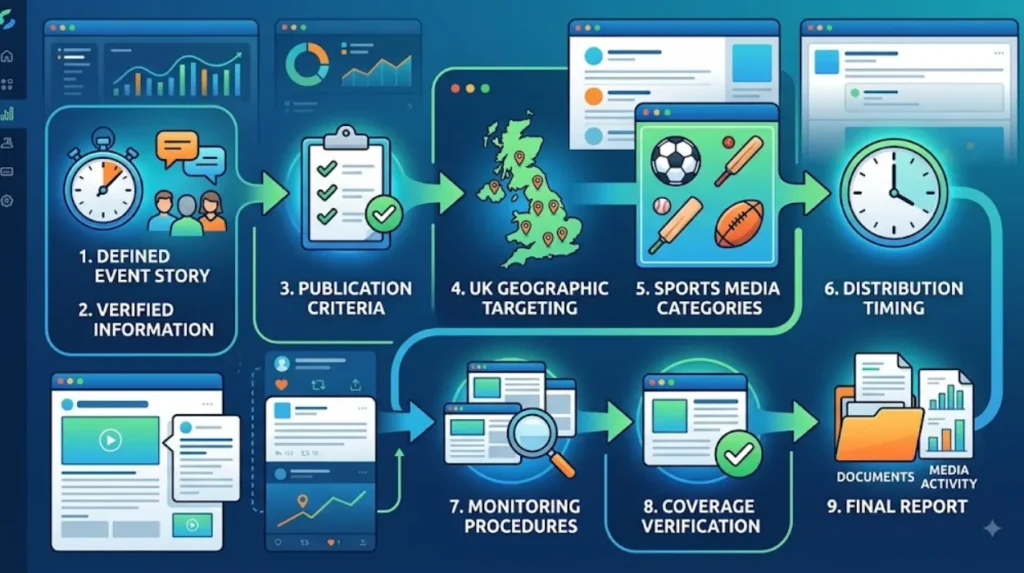
A 15-site sports coverage strategy includes a defined event story, verified information, publication criteria, UK geographic targeting, appropriate sports media categories, distribution timing, monitoring procedures, coverage verification, and a final report that documents the resulting media activity.
The strategy starts with the event objective.
An attendance-focused announcement requires pre-event timing. A results announcement requires post-event distribution. A sponsorship announcement requires business and sports relevance.
The publication list then follows the story rather than existing independently from it.
The final stage is measurement. Organisers need evidence showing where the story appeared and how the distribution performed against the original media objective.
This structured approach makes sports event media coverage easier to evaluate. It also provides a clear transition from general awareness to selecting an appropriate distribution solution, including:



