

Virtual events have become established formats for conferences, webinars, product launches, panel discussions, industry briefings, public forums, and educational sessions. Their online delivery does not prevent them from becoming news stories. UK journalists assess the information produced by an event in the same way they assess other potential stories: through relevance, evidence, timing, public interest, and editorial value.
A virtual event becomes newsworthy when it contains information that matters beyond the event itself. A new research finding, a major industry announcement, a policy discussion, a significant business development, or original expert analysis provides material for reporting.
Understanding how virtual events get real UK news coverage requires separating the event from the news story. The event is the source of information. The news article is the journalistic output created from information that has sufficient relevance and evidence.
What makes a virtual event newsworthy in the UK?
Virtual events get real UK news coverage when organisers present a newsworthy event, provide verifiable information, and connect the story to clear public or industry interest. Coverage depends on editorial relevance, credible details, timely distribution, and evidence supporting journalistic reporting.
What does newsworthiness mean for a virtual event?
Newsworthiness describes the characteristics that make information relevant to a publication’s audience. A virtual event itself is not automatically newsworthy because it happened online.
Journalists look for a specific development, result, announcement, conflict, trend, expert perspective, or public-interest issue.
For example, a virtual technology conference announcing a new cybersecurity research report has a stronger news angle than a routine online networking session.
Common news values include:
- Timeliness: The information relates to a current development.
- Relevance: The subject affects a defined audience.
- Impact: The event produces consequences for organisations, industries, consumers, or communities.
- Novelty: The event presents new information or an unusual development.
- Authority: Recognised experts or institutions provide credible information.
- Evidence: Claims are supported by data, research, documents, or attributable statements.
Why does the event topic matter?
The topic determines the potential audience for the story. UK business publications focus on commercial developments. Technology publications focus on innovation and digital trends. Education publications focus on learning, institutions, policy, and research.
A virtual event about changes affecting UK employment regulations therefore has a different editorial audience from a virtual event discussing software engineering trends.
The subject needs a defined information need. This gives journalists a reason to investigate, explain, or report the development.
How does a virtual event become a UK news story?
UK news coverage of virtual events follows an editorial process. Journalists assess the event’s news value, audience relevance, evidence, timing, and available information. A story then moves through research, verification, editorial selection, publication, and follow-up reporting when the subject develops.
What happens before the event?
News potential often begins during event planning. Organisers identify the central subject, participating speakers, expected announcements, research findings, and relevant data.
The event title and description establish the basic context. Speakers provide authoritative perspectives. Supporting research establishes factual evidence.
A strong news foundation answers five questions:
- What is happening?
- Why is it happening now?
- Who is affected?
- What new information does the event provide?
- What evidence supports the information?
These questions also help separate event promotion from news reporting.
What happens during the event?
During the virtual session, speakers generate information that journalists can use. Statements, research findings, statistics, announcements, demonstrations, and expert responses can all become reporting material.
For example, a virtual healthcare conference can reveal new survey results about NHS workforce pressures. A virtual finance forum can discuss changes affecting UK businesses. A digital education summit can publish findings about online learning participation.
The information needs to be attributable. Journalists need to know who made a statement and what evidence supports it.
What happens after the event?
After the event, journalists evaluate available information and determine whether it supports a report. They can review recordings, transcripts, research documents, speaker statements, datasets, and supporting materials.
The resulting article does not simply reproduce the event agenda. It identifies the most relevant development and places it within a wider context.
This creates the transition from event content to news content.
The article can then appear as a news report, industry update, interview, analysis, research story, or announcement-based article depending on editorial treatment.
For readers who want to understand the next stage,
Virtual event coverage explains how this information progresses toward publication on UK news sites.
What information helps journalists cover a virtual event?
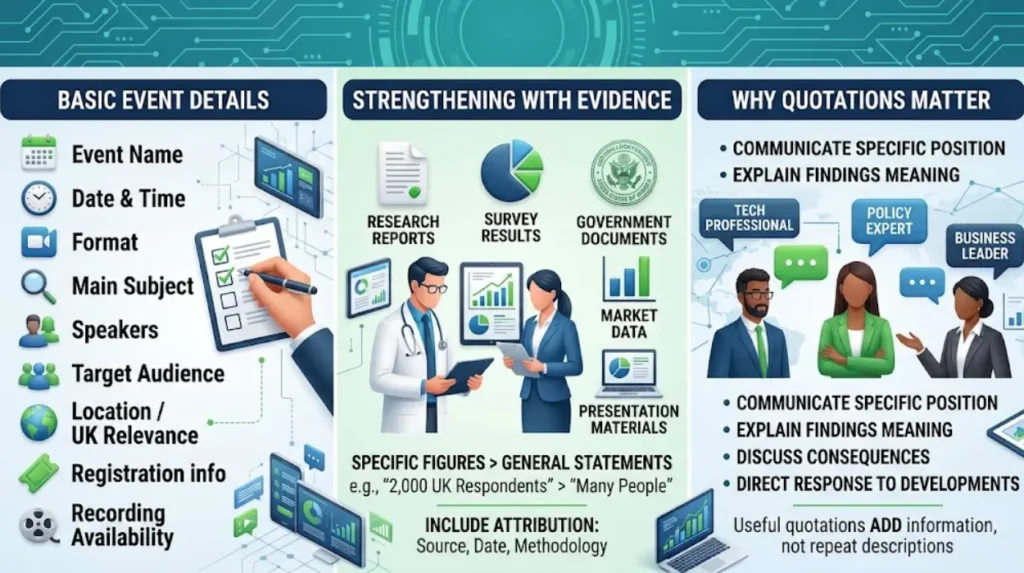
Effective virtual event news coverage contains specific information that helps journalists understand and verify the story. Key components include the event purpose, speakers, date, audience, results, data, quotations, supporting assets, organisational context, and an explanation of why the event matters.
What basic event details are required?
Basic information establishes factual context. It includes:
- Event name
- Date and time
- Event format
- Main subject
- Speaker names and roles
- Target audience
- Location or UK relevance
- Registration or attendance information
- Recording availability
These details help establish what happened and who participated.
What evidence strengthens a news story?
Evidence gives journalists material for verification. Examples include research reports, survey results, government documents, market data, published studies, official statistics, presentation materials, and event transcripts.
Specific figures are more useful than general statements.
For example, reporting that a survey involved 2,000 UK respondents provides stronger factual context than saying a survey involved “many people.”
Evidence also needs attribution. Journalists need to identify the source, methodology, publication date, and relevant context.
Why are quotations important?
Quotations provide attributable statements from speakers. A useful quotation communicates a specific position, finding, response, or explanation.
A speaker discussing a new industry report can explain what the findings mean. A policy expert can explain the practical consequences of a proposed change. A business leader can provide a direct response to a market development.
The quotation becomes more useful when it adds information rather than repeating the event description.
How do UK journalists decide whether virtual event information is publishable?
Journalists assess virtual event information against editorial standards covering accuracy, relevance, originality, attribution, evidence, timing, and audience interest. Publication depends on whether the available material supports a useful story that fits the publication’s subject area and readership.
How does editorial relevance affect publication?
Every publication serves a defined audience. A national business publication, regional newspaper, specialist technology website, and professional trade journal operate within different editorial contexts.
A virtual event about UK manufacturing investment has relevance for business and industrial publications. A virtual education conference about university admissions has relevance for education publications.
The same event can therefore produce different news angles for different audiences.
How does verification affect publication?
Verification establishes whether claims can be supported. Journalists check figures, names, dates, quotations, research sources, and statements.
Claims without supporting evidence create additional verification work. Clear source material allows journalists to assess information efficiently.
This is particularly important when an event discusses research, financial performance, regulation, public policy, health, technology, or other subjects where factual accuracy has significant consequences.
Why does timing matter?
News operates within a time-sensitive editorial environment. Information connected to a current announcement, report, policy change, market development, or public debate has stronger relevance when presented promptly.
Timing also affects whether an event represents new information. A report published six weeks after an event contains different editorial value from a report based on information released immediately after the session.
What benefits can real UK news coverage create for virtual events?
Real UK news coverage gives virtual events visibility beyond the event platform. Published stories create searchable records, provide third-party reporting, extend audience reach, support public information, and preserve event outcomes for people who did not attend the original online session.
How does news coverage extend the event’s lifespan?
A virtual event has a defined broadcast period. News coverage creates additional content after the live session ends.
A published article can continue appearing in search results and news archives. Readers can discover the event through the reported development rather than through the original registration page.
This creates a second information layer around the event.
How does coverage support discoverability?
News articles can create searchable references to speakers, topics, findings, announcements, and event outcomes.
For example, someone searching for a newly published UK industry report can discover an article discussing findings revealed during a virtual conference.
The article becomes an independent information source that documents the development.
Why does third-party reporting matter?
Journalistic coverage separates reporting from the original event material. The publication evaluates information independently and presents it within an editorial context.
This distinction is important because an event programme describes what organisers planned to discuss, while news coverage identifies what was considered significant enough to report.
Which types of virtual events can generate UK news coverage?
Virtual events across business, technology, education, healthcare, culture, and public policy use different news angles. Examples include a technology summit announcing research, a university webinar publishing findings, or a public forum reporting policy commitments that affect a defined UK audience.
Can virtual business events become news?
Yes. Business events can produce stories about investment, mergers, employment, market trends, financial results, leadership changes, innovation, and industry research.
A virtual business conference announcing a new investment programme provides a specific commercial development. A leadership webinar presenting new workforce research provides a research-based angle.
Can virtual technology events attract coverage?
Technology events frequently generate news through product announcements, research findings, cybersecurity developments, artificial intelligence applications, software releases, and technical demonstrations.
The strongest stories contain identifiable developments and supporting evidence.
Can educational and public-sector events become news?
Educational webinars and virtual conferences can generate coverage through research, policy discussions, institutional announcements, examination changes, teaching developments, and student-related findings.
Public-sector virtual forums can produce stories about policy commitments, consultations, service changes, infrastructure plans, and community issues.
Can cultural and entertainment events receive coverage?
Virtual cultural events can produce news through programme announcements, new research, artist participation, historical discoveries, digital exhibitions, and audience data.
The editorial angle depends on what is new and relevant rather than simply the fact that the event occurred online.
How should virtual event coverage be understood across the UK news ecosystem?
Virtual event coverage forms part of a wider UK media process in which event information is evaluated, verified, contextualised, and converted into publication-ready stories. Different publications select different angles according to audience, subject, geography, editorial priorities, and news value.
A single virtual event can therefore produce several forms of coverage.
A national publication can focus on the wider economic or social impact. A regional publication can focus on its local relevance. A trade publication can examine technical implications. A specialist website can concentrate on research or professional developments.
This creates a distinction between event distribution and news distribution.
Event distribution makes people aware of the session. News distribution makes relevant developments discoverable through journalism.
The same principle applies when a virtual event generates research, announcements, expert commentary, or data that remain relevant after the live broadcast.
The next stage is understanding how this material moves from an event into specific publications through:
What is the overall process for getting real UK news coverage from a virtual event?
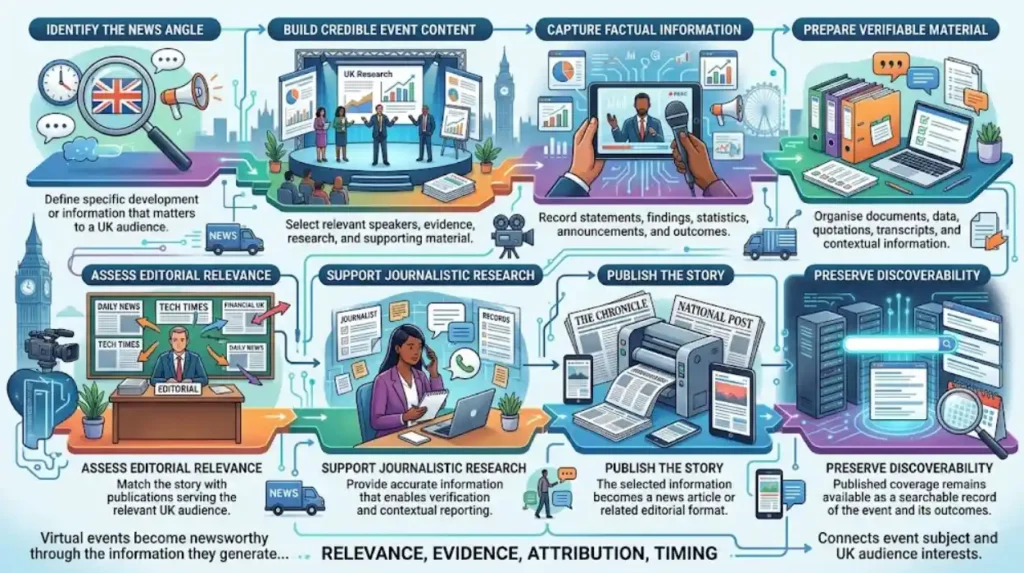
The process begins with a newsworthy subject, develops through credible event content, produces verifiable information, and continues through editorial assessment, journalistic research, publication, and post-event discovery. Each stage connects the original virtual event with a defined UK news audience.
The complete process can be summarised as:
- Identify the news angle. Define the specific development or information that matters.
- Build credible event content. Select relevant speakers, evidence, research, and supporting material.
- Capture factual information. Record statements, findings, statistics, announcements, and outcomes.
- Prepare verifiable material. Organise documents, data, quotations, transcripts, and contextual information.
- Assess editorial relevance. Match the story with publications serving the relevant UK audience.
- Support journalistic research. Provide accurate information that enables verification and contextual reporting.
- Publish the story. The selected information becomes a news article or related editorial format.
- Preserve discoverability. Published coverage remains available as a searchable record of the event and its outcomes.
Explore More Expert Insights:
Why Festivals Need Multi-Site News Coverage in 2026
How Sports Events Reach 15 UK News Sites Fast
Virtual events therefore become newsworthy through the information they generate, not through their digital format alone. A successful news story requires relevance, evidence, attribution, timing, and a clear connection between the event’s subject and the interests of a UK audience.



