Booking sports event coverage on 15 UK news sites means arranging coordinated publication or distribution of a sports announcement across 15 relevant UK media outlets. The process combines story preparation, outlet selection, distribution, publication tracking, and coverage reporting.
Sports event coverage is media exposure created around an event, announcement, result, launch, partnership, tournament, or related development. UK news sites provide access to national, regional, business, sports, and specialist audiences.
A 15-site campaign creates a defined media distribution target. It also creates measurable coverage across multiple publishing environments.
For example, a football tournament announcement can target sports publications, regional news sites, and business-focused outlets when the event has commercial relevance.
The objective is not simply to publish one press release. The objective is to create structured media visibility across selected UK publications.
Why book coverage across 15 UK news sites?
Booking coverage across 15 UK news sites gives an event a defined distribution target, broader audience exposure, measurable media activity, and a structured publication process. It also creates multiple opportunities for journalists, readers, search engines, and industry audiences to discover the event.
A multi-site campaign provides greater distribution than relying on one publication.
Different UK news sites serve different audiences. A national publication reaches a broad readership. A regional publication reaches audiences connected to a location. A sports publication focuses on fans and sporting communities. A business publication serves commercial decision-makers.
The 15-site structure also simplifies campaign planning. The campaign has a fixed publication objective and a defined reporting scope.
Which types of UK news sites can carry sports event stories?
Suitable outlets depend on the subject, location, sport, audience, and news value.
Common categories include:
- National news publications
- Regional UK news sites
- Sports news publications
- Business and finance publications
- Trade and industry media
- Local community publications
- Specialist sporting websites
For example, a London-based tennis event has relevance to London regional media, sports publications, business outlets, and national news platforms.
Outlet relevance remains important. Fifteen unrelated websites do not provide the same strategic value as fifteen outlets aligned with the event.
How does a 15-site sports event coverage campaign work?
A 15-site sports event coverage campaign starts with event information and news-value assessment, followed by release preparation, media targeting, distribution, publication monitoring, and reporting. Each stage connects the event message with relevant UK media audiences and measurable coverage outcomes.
The process begins with the event itself.
Key information includes the event name, date, venue, sport, participating organisations, speakers, teams, athletes, sponsors, tickets, purpose, and relevant announcements.
The information then becomes a media-ready story.
What information belongs in the sports event release?
A strong release contains factual information that allows editors and readers to understand the announcement quickly.
Essential elements include:
- A specific headline
- A concise introduction
- Event date and location
- Organiser information
- Key participants
- Relevant statistics
- Supporting quotations
- Ticket or registration information
- Contact information
- Website or event page
The release also needs a clear news angle.
For example, “Manchester hosts a new national youth athletics competition in September” provides a clearer editorial angle than “Exciting sports event announced”.
How do you choose the right 15 UK news sites?
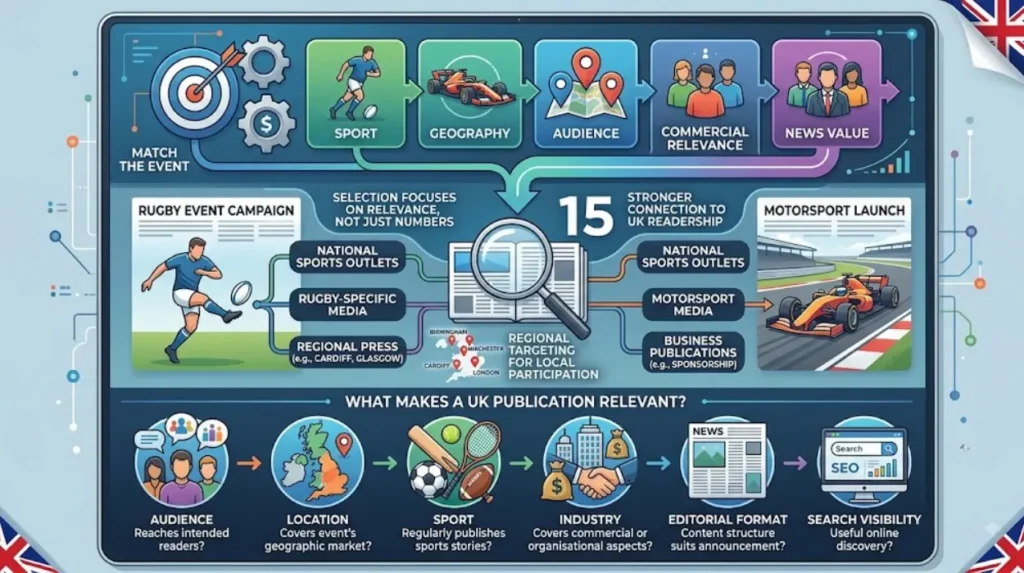
The right 15 UK news sites match the event’s sport, geography, audience, commercial relevance, and news value. Selection focuses on publication relevance rather than simply increasing outlet numbers, creating a stronger connection between the announcement and its intended UK readership.
Outlet selection is one of the most important parts of sports PR distribution.
A campaign for a rugby event requires different media priorities from a motorsport launch. A London event requires different regional targeting from an event in Glasgow, Cardiff, Birmingham, or Manchester.
Geographic relevance also matters for local participation.
What makes a UK publication relevant?
Relevance can be assessed through several factors:
- Audience: Does the publication reach the intended readers?
- Location: Does it cover the event’s geographic market?
- Sport: Does it regularly publish sports-related stories?
- Industry: Does it cover commercial or organisational aspects of sport?
- Editorial format: Does its content structure suit the announcement?
- Search visibility: Does its published content provide useful online discovery?
For example, a professional cycling event can target cycling media, regional news sites near the route, national sports outlets, and business publications covering sponsorship or tourism.
This approach creates a more precise distribution strategy.
For a broader explanation of how distribution develops across multiple publications, see:
What should you check before booking sports event coverage?
Before booking sports event coverage, confirm the number of target publications, publication categories, geographic scope, release requirements, expected turnaround, reporting format, link policy, and campaign deliverables. Written confirmation prevents misunderstandings about the exact media distribution service purchased.
A buyer needs clear deliverables before approving a campaign.
The phrase “15 UK news sites” requires definition. The agreement needs to state whether the 15 sites represent guaranteed publication destinations, distribution targets, syndicated placements, or a mixture of media outcomes.
Which deliverables need confirmation?
Confirm these points before purchase:
- Number of UK publications included
- Named publications, where applicable
- Sports and regional media categories
- Press release editing requirements
- Distribution timeframe
- Publication monitoring
- Published URL reporting
- Coverage screenshots or evidence
- Hyperlink inclusion
- Image inclusion
- Follow-up support
- Additional publication charges
The distinction between distribution and guaranteed publication is particularly important.
Distribution sends a release to selected media channels. Publication means the story appears on a specific website. These are different outcomes.
A professional booking process defines the service precisely.
How much does sports event coverage across 15 UK news sites cost?
The cost of sports event coverage across 15 UK news sites depends on outlet quality, publication guarantees, campaign preparation, distribution scope, reporting, turnaround, and additional services. A fixed quotation becomes meaningful only when every included deliverable is clearly defined.
Pricing varies because media campaigns contain different levels of service.
A basic distribution package can differ significantly from a campaign involving editorial preparation, targeted media outreach, named publication placements, monitoring, and detailed reporting.
What affects the final price?
Important pricing factors include:
- Number of publications
- Publication authority and audience
- National versus regional targeting
- Guaranteed versus non-guaranteed placements
- Press release writing
- Media list development
- Campaign management
- Speed of distribution
- Coverage monitoring
- Reporting requirements
A buyer comparing two prices needs to compare the included outputs rather than the headline fee alone.
For example, a £X package covering distribution and basic reporting is not directly comparable with a £Y package containing named publication targets, release writing, monitoring, and campaign management.
What outcomes can a 15-site sports event campaign deliver?
A 15-site campaign can deliver broader event awareness, multiple online publication references, increased access to relevant audiences, searchable coverage, and measurable media activity. Actual results depend on editorial acceptance, publication relevance, story quality, timing, and campaign execution.
Sports event coverage creates several measurable outputs.
The most immediate output is published media coverage.
Additional outcomes include referral opportunities, branded search discovery, audience exposure, stakeholder visibility, and a documented media footprint.
How can coverage be measured?
A campaign report can record:
- Publication name
- Publication date
- Article headline
- Published URL
- Media category
- Geographic relevance
- Estimated audience metrics where available
- Included links
- Images
- Coverage status
These records create an auditable campaign history.
For an organisation running several sporting events each year, consistent reporting also makes campaigns easier to compare.
When is booking 15-site sports event coverage useful?
Booking 15-site sports event coverage is useful when an event requires structured UK awareness across several audience groups. Typical applications include tournaments, sporting launches, competitions, sponsorship announcements, venue openings, charity events, and major participation campaigns.
The campaign format suits events with a clear news angle and defined UK audience.
Which sports events benefit from multi-site coverage?
Examples include:
- Football tournaments
- Rugby competitions
- Athletics events
- Cricket matches
- Cycling events
- Motorsport launches
- Boxing events
- Tennis competitions
- Golf tournaments
- Community sports festivals
The same approach also supports announcements connected to sport.
Examples include sponsorship agreements, athlete partnerships, new sports facilities, event expansions, tournament schedules, and charitable sports initiatives.
The strongest campaigns connect the event to a specific fact that matters to UK audiences.
How can businesses choose a UK sports media coverage provider?
Choose a UK sports media coverage provider by checking publication relevance, transparent deliverables, distribution methodology, reporting quality, campaign experience, turnaround, pricing, and publication evidence. Compare providers using identical requirements so the final decision reflects measurable service differences.
A provider needs to explain exactly what the buyer receives.
The evaluation process starts with the campaign objective.
If the objective is exposure across 15 UK news sites, the provider needs to explain how those sites are selected, how distribution works, what publication evidence is supplied, and which outcomes are guaranteed.
What questions should you ask a provider?
Ask:
- Which 15 UK news sites are included?
- Are placements guaranteed?
- Is the campaign distributed through a media network?
- Are regional and sports publications included?
- Who writes or edits the release?
- How quickly is distribution completed?
- How are published articles monitored?
- What reporting is supplied?
- Are links included where publishers permit them?
- Are additional charges applied?
Clear answers allow buyers to compare services on operational criteria rather than promotional claims.
Explore More Expert Insights:
Real Estate Event Coverage Across 15 UK News Sites
Healthcare Event News Coverage on 15 Trusted UK Sites
What is the best next step for booking sports event coverage?
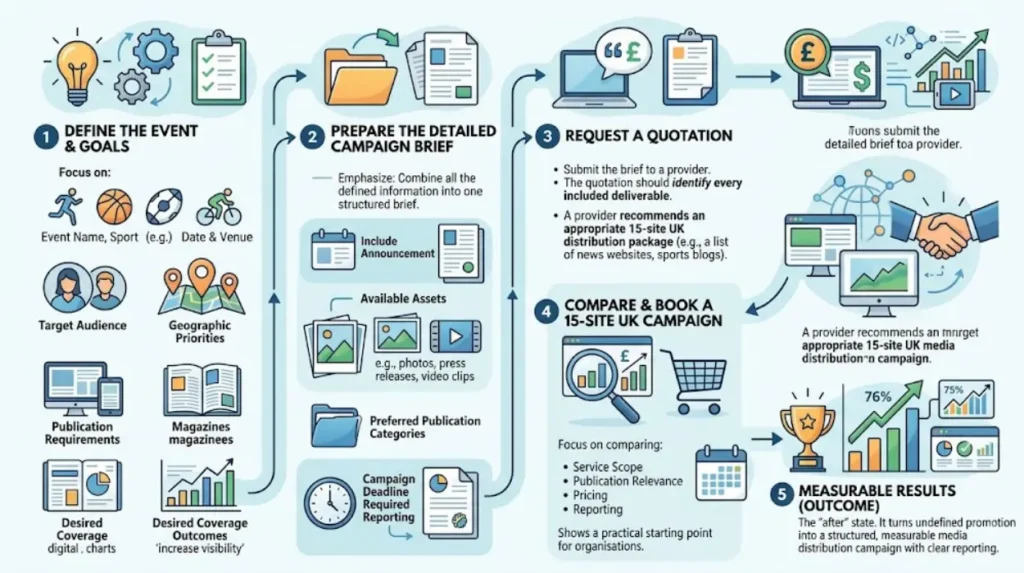
The next step is to define the event, audience, publication requirements, timing, and desired coverage outcomes before requesting a campaign quotation. A detailed brief allows the provider to recommend an appropriate 15-site UK distribution package and reporting structure.
Prepare the campaign brief before contacting a provider.
Include the event name, sport, date, venue, target audience, geographic priorities, announcement details, available assets, preferred publication categories, campaign deadline, and required reporting.
Then request a quotation that identifies every included deliverable.
For organisations ready to purchase structured UK distribution, a defined 15-site campaign provides a practical starting point for comparing service scope, publication relevance, pricing, and reporting.
A clear booking process turns:
Sports event coverage from an undefined promotional activity into a measurable media distribution campaign.