
Sports events reach 15 UK news sites through coordinated news distribution, timely event information, relevant editorial angles, and publication-ready content. The process connects one sports announcement with multiple UK news audiences while preserving accurate facts, names, dates, and locations.
Sports event coverage is the publication of news about competitions, tournaments, fixtures, athlete performances, club announcements, sporting venues, and related developments. UK news sites publish this information when it has clear relevance to their audiences.
Fast coverage depends on the movement of information from an event organiser or source to journalists, editors, newsrooms, and digital publications. The process starts with a newsworthy event and continues through content preparation, distribution, editorial review, and online publication.
A single event can generate several forms of news. Examples include a football tournament announcement, a boxing event result, a rugby fixture, or the opening of a new sports venue.
The phrase15 UK news sites describes a multi-publication coverage target. It does not mean that every publication uses identical content or publishes at the same time. Each newsroom applies its own editorial standards, audience priorities, and publishing processes.
What happens before sports event news reaches UK publications?
Before distribution begins, sports event information is organised into a clear news story containing verified details, a strong headline, essential facts, relevant context, and media assets. Accurate preparation reduces editorial friction and supports faster publication across multiple outlets.
What information forms a sports news story?
A sports news story normally contains several core entities:
- Event name
- Sport and competition type
- Date and time
- Venue and location
- Teams, athletes, clubs, or organisers
- Competition status
- Relevant result or announcement
- Supporting quotes
- Contact or source information
- Images or other approved media assets
For example, a UK athletics event announcement identifies the competition, participating athletes, venue, event date, and key announcement before distribution.
These details create a structured information base. Journalists can identify the central news point quickly. Search engines can also associate the story with identifiable people, organisations, places, competitions, and dates.
Why does accuracy affect publication speed?
Sports journalism relies heavily on precise factual information. Incorrect player names, fixture dates, scores, venues, or competition details create additional editorial work.
A publication-ready story removes unnecessary uncertainty from the initial information. It gives editors enough context to understand the event without searching for basic facts.
Accuracy also supports consistent coverage. When the same event appears across multiple UK publications, core facts remain aligned even when headlines, introductions, and editorial framing differ.
How is sports event news distributed across 15 UK news sites?
Sports event news reaches multiple UK publications through a structured distribution process that moves information from the source into editorial networks. Each publication then assesses relevance, verifies details, applies editorial standards, and publishes according to its own workflow.
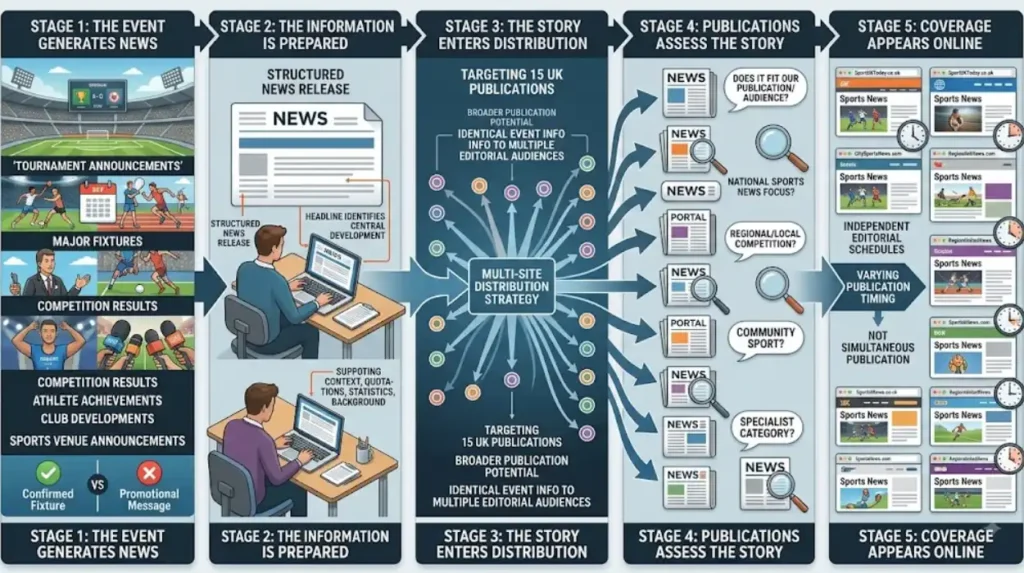
The distribution process has several stages.
Stage 1: The event generates news
The process starts with a defined news event. This can include a tournament announcement, major fixture, competition result, athlete achievement, club development, or sports venue announcement.
The event needs a clear factual development. A simple promotional message does not provide the same editorial information as a confirmed fixture, competition result, or official announcement.
Stage 2: The information is prepared
The core information is converted into a structured news release or media story. The content includes the facts required for editorial assessment.
The headline identifies the central development. The opening paragraph explains what happened. Supporting paragraphs provide context, quotations, statistics, and relevant background.
Stage 3: The story enters distribution
Distribution sends the prepared information toward multiple media destinations. A multi-site distribution strategy targets a defined group of UK publications rather than relying on one publication.
The 15-site model provides broader publication potential. It places the same underlying event information in front of multiple editorial audiences.
Stage 4: Publications assess the story
News sites operate independently. Editors evaluate whether a story fits their publication, audience, location, sport, timing, and editorial priorities.
Some publications focus on national sports news. Others cover regional competitions, local clubs, business developments, community sport, or specialist sporting categories.
Stage 5: Coverage appears online
Accepted stories are published through individual publication websites. Publication timing differs because each newsroom controls its own editorial schedule.
This explains why rapid distribution does not mean simultaneous publication across all 15 sites.
Which factors help sports event coverage move quickly?
Fast sports event coverage depends on newsworthiness, accurate information, timely distribution, clear editorial structure, relevant media targeting, and efficient newsroom processing. These factors reduce delays between an event announcement and potential publication across UK digital news outlets.
Does timing matter for sports news?
Timing is central to sports journalism because sporting information becomes less useful as events progress.
A fixture announcement has maximum relevance before the match. A match result becomes relevant immediately after completion. An athlete record becomes newsworthy when the performance occurs.
Distribution therefore needs to match the news cycle.
For example, a confirmed football fixture distributed weeks before the match serves a different editorial purpose from a match result distributed immediately after the final whistle.
Does the headline affect speed?
The headline communicates the story’s news value. A specific headline helps editors identify the subject, event, location, and development.
A headline such as “Manchester Club Announces New Championship Fixture” communicates more information than a generic headline such as “Major Sports News Announced.”
Specific wording also improves search interpretation because it connects the story with identifiable entities.
Do images affect sports coverage?
Images provide visual context for digital publications. Useful assets include approved action photographs, athlete portraits, team images, venue photographs, and event branding.
Images need accurate captions and rights information. Publications require confidence that visual content is legitimate and usable.
How do UK news sites differ in sports coverage?
UK news sites differ by audience, geography, editorial focus, and sporting interest. National publications prioritise broad-interest stories, while regional and specialist outlets focus on local teams, competitions, athletes, venues, and sports communities.
What do national news sites cover?
National news publications focus on stories with broad UK relevance. Major football competitions, international tournaments, prominent athletes, national sporting events, and significant organisational announcements fit this category.
A national sports story often requires a strong public-interest element or recognisable sporting entity.
What do regional publications cover?
Regional news sites focus on geographical relevance. A local football club, athletics competition, rugby fixture, swimming event, or sports facility opening has greater relevance when connected to the publication’s coverage area.
For example, a county-level athletics competition has a stronger regional news angle when participating athletes, organisers, or venues belong to that area.
What do specialist sports publications cover?
Specialist publications concentrate on particular sports or sporting communities. Examples include cycling, motorsport, cricket, equestrian sport, athletics, rugby, and boxing.
Specialist relevance allows an event to reach an audience with a direct interest in its subject.
How does sports event coverage support search visibility?
Sports event coverage creates additional online references to an event, its participants, organisations, locations, and dates. Consistent factual information helps search systems connect these entities and understand the event across multiple digital publications.
Search engines process relationships between entities. A sports event story can connect an athlete with a team, venue, competition, city, and date.
For example, a rugby event article can establish relationships between the competition, participating clubs, stadium, match date, and result.
Multiple publications also create separate online documents about the same event. Their headlines and editorial wording differ, but the underlying facts can remain consistent.
This creates a broader digital footprint for the event.
Search visibility does not depend only on the number of publications. Relevance, factual accuracy, content quality, technical accessibility, and editorial context also influence how search systems interpret online coverage.
What types of sports events can receive UK news coverage?
Many sports events generate UK news coverage when they contain a clear announcement, result, achievement, competition development, or community impact. Examples include tournaments, fixtures, athlete milestones, club announcements, venue openings, and sporting initiatives.
Which competitive events generate coverage?
Competitive events include:
- Football tournaments
- Rugby competitions
- Cricket matches
- Athletics meetings
- Boxing events
- Cycling races
- Motorsport competitions
- Tennis tournaments
- Swimming championships
- Equestrian competitions
Each event provides different editorial information. Results, fixtures, rankings, records, participants, and venues create distinct news angles.
Can community sports events receive coverage?
Community sport also produces news. Local competitions, youth tournaments, charity sporting events, school competitions, grassroots clubs, and regional sporting initiatives provide stories with defined geographical relevance.
The strength of the story depends on the factual development and its relevance to the intended audience.
Why does multi-site sports coverage matter?
Multi-site sports coverage expands the number of UK audiences exposed to the same event information. It also creates coverage across different editorial environments, including national, regional, local, business, community, and specialist sports publications.
A single publication reaches one defined audience. Fifteen publications create multiple opportunities for discovery.
The value comes from audience diversification rather than simple repetition. A sports event can interest supporters, athletes, clubs, sponsors, venue operators, local communities, and sports professionals.
Coverage also creates a record of the event across different websites. This supports discoverability when people search for the competition, participating organisations, athletes, or venue.
The distribution model becomes particularly relevant when an event has both national and regional dimensions.
For readers exploring how coverage develops after distribution,
Sports event coverage spreads across UK news sites provides the next stage of understanding.
What can sports event organisers learn from the coverage process?
Sports event organisers can improve media readiness by preparing verified information, identifying relevant audiences, understanding publication differences, and distributing news in line with the event timeline. These practices create a clearer pathway from event development to potential UK media coverage.
Organisers benefit from treating media information as a structured dataset rather than an informal announcement.
Key information includes names, dates, locations, results, competition details, quotes, statistics, and approved images.
They also need to understand that distribution and publication are separate stages. Distribution places information in front of media outlets. Editorial teams decide whether and when to publish.
This distinction explains why reaching 15 UK news sites involves more than sending identical information to 15 websites.
The process combines news value, accurate preparation, appropriate targeting, timely distribution, and independent editorial decisions.
For readers evaluating the practical next step after understanding this process,
Book sports event coverage on 15 UK news sites addresses the decision-stage side of multi-publication sports coverage.
What is the overall process for reaching 15 UK news sites fast?
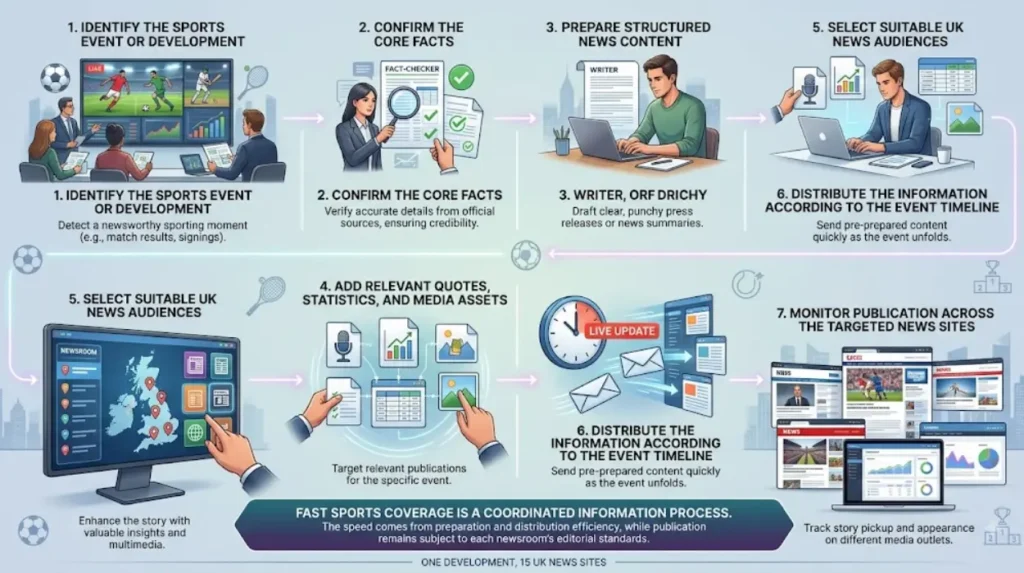
Reaching 15 UK news sites quickly involves identifying a genuine sports news event, preparing verified information, selecting relevant publications, distributing the story at the correct time, and allowing each newsroom to apply its own editorial review and publishing process.
The complete process can be summarised in seven steps:
- Identify the sports event or development.
- Confirm the core facts.
- Prepare structured news content.
- Add relevant quotes, statistics, and media assets.
- Select suitable UK news audiences.
- Distribute the information according to the event timeline.
- Monitor publication across the targeted news sites.
Fast sports coverage is therefore a coordinated information process. The speed comes from preparation and distribution efficiency, while publication remains subject to each newsroom’s editorial standards.
Explore More Expert Insights:
What News Coverage Adds to UK Real Estate Events
How Healthcare Events Earn Trusted UK News Coverage
For UK sports events, the strongest coverage structure connects the event to clear facts, identifiable entities, relevant audiences, and timely news value. This framework explains how one sporting development can move from an event announcement to potential coverage across 15 UK news sites.