

Healthcare events generate news coverage when their content contains verified information, clear public relevance, credible speakers, measurable developments, and timely announcements. UK news editors assess evidence, accuracy, relevance, independence, and audience value before deciding whether an event warrants publication.
Healthcare conferences, medical exhibitions, health technology summits, research forums, policy events, and professional meetings all produce potential news stories. Their coverage extends beyond event attendance. News reports can focus on research findings, regulatory developments, healthcare policy, clinical innovation, investment, workforce issues, patient outcomes, and sector trends.
Trusted UK news coverage depends on the quality of information presented to journalists and the relevance of that information to their audiences. An event itself does not automatically qualify as news. The information emerging from the event determines its editorial value.
What makes a healthcare event newsworthy in the UK?
A healthcare event becomes newsworthy when it produces verified information with clear relevance to patients, professionals, organisations, policy, research, technology, or public health, supported by credible sources, specific evidence, timely developments, and an identifiable consequence for UK audiences.
Public relevance
Public relevance is a central characteristic of healthcare news. A development affecting NHS services, patient access, medical research, healthcare costs, workforce capacity, or public health has a clear audience.
For example, an event announcement about a new diagnostic technology becomes more newsworthy when it includes evidence about its intended clinical application, development stage, research results, or regulatory status.
Timeliness
News coverage prioritises recent developments. Healthcare events provide a defined publication opportunity because announcements, speeches, research presentations, product demonstrations, and policy discussions occur at specific times.
A new clinical research result presented at a conference has stronger immediate news value than an old finding repeated without additional evidence.
Evidence
Healthcare reporting requires factual support. Relevant evidence includes published research, clinical data, official statistics, regulatory information, institutional statements, and named expert commentary.
Specific evidence allows journalists to distinguish substantive developments from promotional claims.
How do UK news editors assess healthcare event information?
UK news editors assess healthcare event information through accuracy, relevance, evidence, timeliness, source credibility, editorial independence, public interest, and clarity, while separating factual developments from promotional claims, unsupported statements, commercial messaging, and exaggerated healthcare conclusions.
Accuracy and verification
Healthcare information requires precise terminology. Claims about treatments, diagnoses, medical devices, clinical outcomes, research findings, and patient populations require careful wording.
Editors examine whether statistics have identifiable sources. They also assess whether claims accurately describe the available evidence.
For example, reporting that a study “found an association” differs materially from stating that it “proved a treatment works”. Scientific language affects editorial accuracy.
Source credibility
A healthcare event can involve multiple sources, including researchers, clinicians, universities, NHS organisations, regulators, professional bodies, technology companies, investors, and policymakers.
Named and identifiable sources provide stronger foundations for reporting than anonymous promotional claims.
Editorial relevance
Editors assess whether information matters to their audience. A highly technical development requires a clear explanation of its significance.
A medical technology announcement becomes more relevant when its implications for clinicians, patients, healthcare providers, or service delivery are clearly established.
What information helps journalists report healthcare events accurately?
Journalists need concise event information, verified statistics, named speakers, research evidence, institutional affiliations, relevant dates, regulatory context, quotations, and clear explanations of significance to produce accurate healthcare coverage for UK audiences.
Event details
Basic event information establishes the factual context. Important details include:
- Event name
- Location
- Date
- Organising body
- Healthcare sector
- Speakers
- Main topics
- Research or announcements presented
- Relevant institutions
- Supporting evidence
These details help journalists establish what happened and who was involved.
Speaker information
Speaker credentials provide context for expert commentary. A clinical researcher, NHS leader, academic, regulator, or healthcare policy specialist has an identifiable professional role.
For example, a consultant discussing clinical practice requires different contextual treatment from a technology executive discussing a commercial healthcare platform.
Supporting documentation
Research papers, reports, datasets, official statements, and regulatory documents provide evidence for healthcare claims.
Documentation also allows journalists to check terminology and verify quantitative statements before publication.
Why does scientific evidence matter in healthcare event coverage?
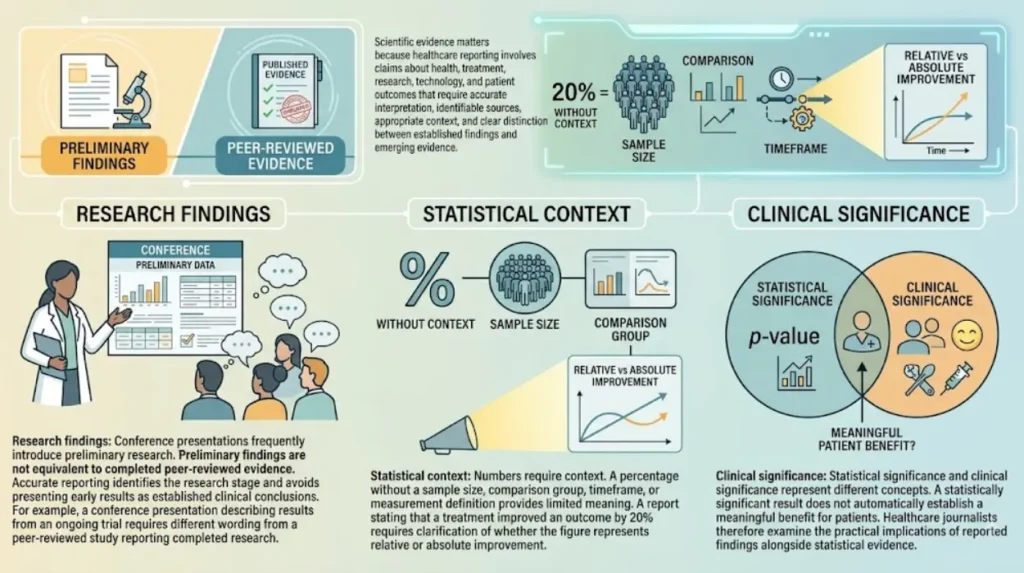
Scientific evidence matters because healthcare reporting involves claims about health, treatment, research, technology, and patient outcomes that require accurate interpretation, identifiable sources, appropriate context, and clear distinction between established findings and emerging evidence.
Research findings
Conference presentations frequently introduce preliminary research. Preliminary findings are not equivalent to completed peer-reviewed evidence.
Accurate reporting identifies the research stage and avoids presenting early results as established clinical conclusions.
For example, a conference presentation describing results from an ongoing trial requires different wording from a peer-reviewed study reporting completed research.
Statistical context
Numbers require context. A percentage without a sample size, comparison group, timeframe, or measurement definition provides limited meaning.
A report stating that a treatment improved an outcome by 20% requires clarification of whether the figure represents relative or absolute improvement.
Clinical significance
Statistical significance and clinical significance represent different concepts. A statistically significant result does not automatically establish a meaningful benefit for patients.
Healthcare journalists therefore examine the practical implications of reported findings alongside statistical evidence.
How do healthcare events generate different types of UK news stories?
Healthcare events generate news stories through research announcements, policy discussions, clinical developments, technology launches, investment activity, workforce issues, regulatory updates, institutional announcements, and expert commentary that provide distinct editorial angles for different UK audiences.
Research and clinical developments
Medical conferences often present research findings, clinical trial results, treatment developments, diagnostic methods, and healthcare studies.
A research announcement can support coverage when its methodology, findings, researchers, and implications are clearly documented.
Health technology
Healthcare technology events feature digital health platforms, artificial intelligence applications, medical devices, data systems, and remote care technologies.
Technology coverage requires factual descriptions of the system, its intended use, development stage, evidence base, and regulatory position.
Policy and regulation
Healthcare events also address NHS policy, healthcare regulation, workforce planning, public health programmes, and changes in professional standards.
These subjects have strong editorial relevance because they connect event discussions with broader institutional and public developments.
Investment and business activity
Healthcare business events can produce stories about funding, partnerships, acquisitions, expansion, market entry, and commercial development.
For example, an investment announcement becomes a business news story when it identifies the organisations involved, transaction value where available, purpose, and expected business impact.
What role do credible speakers play in healthcare news coverage?
Credible speakers strengthen healthcare event coverage by providing identifiable expertise, professional context, evidence-based commentary, and direct explanations of complex developments, while their qualifications and institutional affiliations help journalists establish authority and distinguish expert analysis from commercial promotion.
Clinical expertise
Clinicians provide practical perspectives on healthcare developments. Their professional roles help explain how research or technology relates to clinical practice.
Academic expertise
Researchers and academics provide methodological and scientific context. Their contributions help explain study design, evidence quality, research limitations, and areas requiring further investigation.
Policy expertise
Healthcare policy specialists explain regulatory, organisational, and public-sector implications. Their commentary connects event discussions with wider healthcare systems.
Institutional representation
Speakers representing NHS organisations, universities, professional bodies, regulators, charities, and healthcare companies provide organisational perspectives. Accurate reporting distinguishes the speaker’s personal analysis from the formal position of their institution.
How does UK audience relevance affect healthcare event coverage?
UK audience relevance determines how healthcare event information connects with NHS services, patients, clinicians, researchers, policymakers, businesses, professional organisations, and communities, making local consequences, national policy, regulation, and healthcare priorities important editorial considerations.
National relevance
Developments affecting UK healthcare policy, NHS operations, regulation, medical research, or public health have broad potential audiences.
National relevance also depends on whether an announcement represents a substantial development rather than a routine organisational update.
Regional relevance
Healthcare events can generate regional stories when their developments affect specific cities, NHS trusts, universities, hospitals, research centres, or local communities.
For example, a healthcare research partnership involving a university and NHS trust can provide a regional news angle when the participating institutions and local impact are clearly identified.
Sector relevance
Trade publications focus on specific professional audiences. Healthcare technology, pharmaceuticals, medical devices, research, dentistry, nursing, care services, and health policy each have distinct editorial interests.
This creates different forms of healthcare event coverage across UK media.
Why does editorial independence matter in healthcare event reporting?
Editorial independence matters because trusted healthcare journalism separates independently relevant facts from promotional messaging, identifies commercial interests, attributes claims to appropriate sources, and presents evidence without allowing event organisers or sponsors to determine editorial conclusions.
Fact versus promotion
A promotional statement describes an organisation’s preferred message. Editorial reporting examines the underlying facts.
For example, saying a new platform is “revolutionary” is promotional language. Reporting its functionality, evidence, regulatory status, adoption figures, and development stage provides factual context.
Commercial interests
Healthcare events often involve commercial organisations. Sponsorship, product launches, partnerships, and investments can create legitimate news stories.
Journalists identify commercial relationships where they affect the interpretation of an announcement.
Balanced context
Healthcare developments benefit from contextual reporting. Relevant context includes previous research, regulatory requirements, competing evidence, industry standards, and statements from independent experts.
This approach supports accurate interpretation rather than simple reproduction of event messaging.
How can healthcare event coverage support trusted news reporting?
Trusted healthcare event coverage combines accurate facts, credible sources, evidence, public relevance, timely information, transparent attribution, and appropriate context, allowing UK journalists to report developments clearly while protecting audiences from unsupported medical, scientific, commercial, or policy claims.
Healthcare events become stronger sources of news when organisers and speakers provide information that meets established editorial requirements. Clear documentation reduces ambiguity. Precise statistics improve factual accuracy. Named experts strengthen attribution. Relevant evidence supports claims.
The same principles apply across healthcare conferences, medical exhibitions, research meetings, digital health events, policy forums, and professional summits.
Healthcare event coverage also varies according to publication type. National news organisations focus on developments with broad public significance. Regional publications focus on local consequences. Trade publications prioritise specialist developments affecting healthcare professionals and organisations.
Readers who want to understand the next stage of editorial evaluation can explore:
Those researching publication-scale distribution can explore:
What are the key factors behind trusted UK healthcare event coverage?
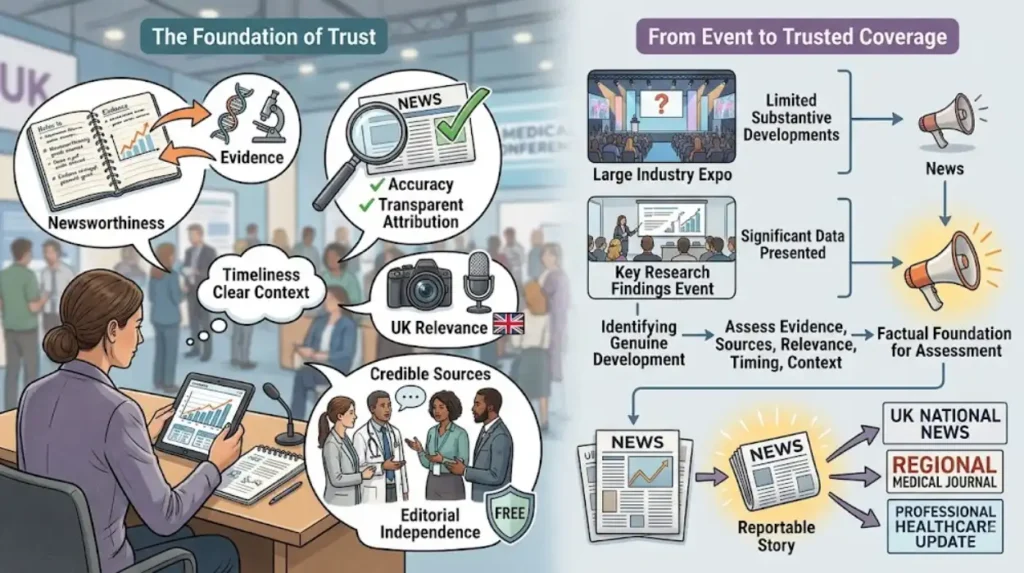
The strongest factors are newsworthiness, evidence, accuracy, credible sources, timeliness, UK relevance, transparent attribution, editorial independence, and clear context, giving journalists the factual foundation required to assess healthcare developments and produce reliable coverage for defined audiences.
Healthcare events earn trusted news coverage through the information they generate rather than simply through their size or profile. A large conference without substantive developments provides limited news value. A focused research event presenting significant findings can produce stronger coverage.
The essential process starts with identifying a genuine development. Journalists then assess its evidence, source credibility, public or professional relevance, timing, and context. These factors determine whether an event produces a reportable story.
Explore More Expert Insights:
Why Fintech Events Get Stronger News Coverage in 2026
How Conference News Coverage Reaches 15 UK Publications
Trusted UK healthcare journalism therefore depends on factual quality at every stage. Accurate event information supports accurate reporting. Verified evidence supports credible claims. Relevant expert commentary provides context. Clear UK implications establish audience value.
These principles explain why healthcare events can become important sources of UK news coverage across national, regional, specialist, and professional publications.



