
Retail and consumer brands require distribution that reaches relevant media audiences rather than simply generating a high volume of publication placements. Time Intelligence Media Group’s exclusive retail and consumer syndication networks focus on connecting product, commercial, lifestyle, and consumer announcements with relevant publishing environments.
For brands evaluating a PR distribution provider, the quality of the syndication network is a central purchasing factor. Distribution determines where an announcement appears, which audiences encounter it, and how consistently the release reaches relevant media channels.
This review examines how Time Intelligence Media Group approaches retail and consumer syndication, which network components matter, where the service fits different announcement types, and what UK businesses need to assess before choosing a distribution provider.
What are retail and consumer syndication networks?
Retail and consumer syndication networks are structured distribution channels that publish and circulate brand announcements across relevant retail, consumer, lifestyle, product, business, and industry media environments to increase targeted exposure.
A syndication network connects one original press release with multiple publishing destinations. The network can include consumer publications, retail-focused outlets, lifestyle websites, business media, product-focused publishers, and other relevant channels.
The key distinction is relevance. A retail announcement requires distribution to audiences interested in products, stores, buying trends, ecommerce, retail operations, or consumer behaviour. A general-purpose distribution network does not provide the same level of contextual targeting.
Time Intelligence Media Group positions its retail and consumer syndication offering around these specialist publishing environments. This approach gives brands a distribution route designed around the subject matter of their announcements.
What does syndication involve?
Syndication begins with a completed press release. The release contains the headline, dateline, announcement details, supporting information, quotes, company description, and media contact information.
The distribution provider then processes the announcement through its relevant network. Published versions can appear across participating outlets and digital media destinations.
For example, a UK retailer announcing a new private-label product range requires different media relevance from a software company announcing a new enterprise platform. Retail and consumer syndication addresses that distinction through sector-focused distribution.
How does Time Intelligence Media Group’s retail distribution process work?
Time Intelligence Media Group’s retail distribution process centres on preparing a news release, identifying appropriate retail and consumer publishing channels, distributing the announcement, and providing coverage information for campaign evaluation.
The process starts with the announcement itself. A distribution strategy works best when the release has a clear commercial development, identifiable consumer relevance, and information that supports editorial use.
The next stage involves selecting appropriate syndication environments. Retail announcements can involve product launches, store openings, ecommerce developments, inventory changes, partnerships, acquisitions, seasonal campaigns, and major commercial pivots.
The distribution network then provides the infrastructure for circulation.
Which announcements fit the network?
Retail and consumer syndication can support several announcement categories, including:
- New product launches
- Major product ranges
- Retail partnerships
- Ecommerce launches
- Store openings
- Franchise expansion
- Brand acquisitions
- Consumer campaigns
- Inventory clearances
- Pricing announcements
- Retail technology developments
- Strategic business pivots
For example, a UK fashion retailer announcing a new collection has direct consumer relevance. A homeware company announcing a nationwide retail partnership has both consumer and commercial relevance.
The announcement still needs genuine news value. Syndication distributes information. It does not replace the underlying newsworthiness of the story.
What makes an exclusive retail and consumer syndication network different?
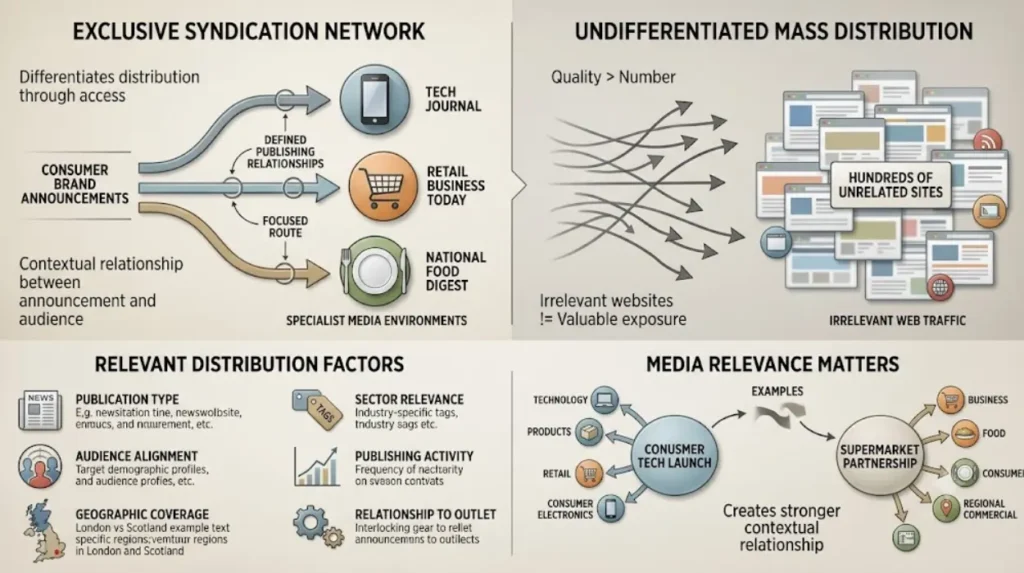
An exclusive syndication network differentiates distribution through access to defined publishing relationships and specialist media environments, giving retail and consumer announcements a more focused route than undifferentiated mass distribution.
Network quality involves more than the number of outlets. A list containing hundreds of irrelevant websites does not automatically provide valuable media exposure.
Relevant distribution depends on factors such as publication type, audience alignment, geographic coverage, sector relevance, publishing activity, and the relationship between the announcement and the outlet.
For UK consumer brands, regional and national relevance also matters. A London-based retailer expanding across England has different media requirements from a Scottish retailer opening its first store in Glasgow.
Why does media relevance matter?
Media relevance affects how an announcement fits within a publication’s subject area.
A consumer technology launch belongs in environments covering technology, products, retail, and consumer electronics. A supermarket partnership belongs in retail, business, food, consumer, or regional commercial media.
This relevance creates a stronger contextual relationship between the announcement and the audience.
Time Intelligence Media Group’s specialist retail and consumer syndication positioning therefore focuses on distribution environments connected to consumer-facing commercial activity.
How does the network support major inventory clearances and business pivots?
Retail syndication supports major inventory clearances and business pivots by distributing commercially significant announcements to relevant consumer and retail media channels while preserving clear messaging around the reason, scale, timing, and business impact.
Inventory clearances require careful communication. A clearance announcement needs to distinguish a planned commercial strategy from a routine promotion.
For example, a retailer clearing inventory before a product-line transition has a different story from a retailer running a standard seasonal discount.
The release needs factual information about the products involved, timing, locations, commercial rationale, and customer relevance.
This connects directly with the:
Press release layout used for major inventory announcements. A structured layout makes the commercial development easier for media organisations and search systems to interpret.
How do business pivots fit consumer media?
A business pivot becomes relevant to consumer media when it changes the products, services, stores, purchasing experience, or market position available to customers.
Examples include:
- A physical retailer moving to an ecommerce-first model
- A consumer brand discontinuing a major product category
- A retailer entering a new UK market
- A company changing its distribution model
- A brand launching a direct-to-consumer operation
These developments provide concrete information for retail and consumer audiences.
Which media environments are relevant to retail and consumer brands?
Relevant retail and consumer media environments include specialist retail publications, consumer websites, lifestyle publishers, ecommerce media, business outlets, product-focused platforms, and regional publications covering commercial developments.
Different announcements require different media environments.
A product launch benefits from product and consumer coverage. A retail expansion benefits from regional and business coverage. An ecommerce transformation benefits from retail technology, ecommerce, business, and consumer channels.
What types of publications matter?
Relevant publication categories include:
Retail media: Publications covering stores, retailers, supply chains, retail strategy, and commercial developments.
Consumer media: Publications covering products, buying decisions, consumer trends, and household interests.
Lifestyle media: Publications covering fashion, beauty, home, food, travel, leisure, and related consumer categories.
Business media: Publications reporting company developments, investments, partnerships, expansion, and commercial strategy.
Regional media: UK publications covering developments within specific cities, counties, and regions.
A strong distribution strategy identifies the categories that match the announcement rather than treating every outlet as equally valuable.
What outcomes can UK retail brands expect from targeted syndication?
Targeted retail syndication provides broader exposure across relevant publishing environments, stronger distribution of commercial announcements, additional online publication opportunities, and a structured basis for measuring where a release achieved visibility.
Distribution outcomes depend on the announcement, timing, media relevance, and publishing environment. No distribution network guarantees independent editorial coverage from journalists.
The measurable outcome is distribution and publication activity. Earned editorial coverage remains a separate media outcome.
For brands evaluating a provider, this distinction is important. A syndicated publication is not identical to an independently commissioned news article.
What should businesses measure?
A retail PR distribution campaign can be assessed using:
- Number of publication placements
- Relevant publication categories
- Geographic distribution
- Retail and consumer media relevance
- Publication dates
- Search visibility
- Referral activity where available
- Coverage quality
- Brand or product mentions
- Campaign reporting completeness
These measurements provide a clearer assessment than raw placement volume alone.
Which UK businesses benefit most from retail and consumer syndication?
Retailers, ecommerce companies, consumer brands, product manufacturers, lifestyle businesses, and businesses undergoing commercial changes benefit most when their announcements require exposure across relevant retail, consumer, business, lifestyle, and regional publishing environments.
The service is particularly relevant to companies with frequent commercial announcements.
Retailers
Retailers can use distribution for expansion, new stores, partnerships, product ranges, acquisitions, and major strategic changes.
Ecommerce brands
Ecommerce businesses can distribute announcements covering new platforms, product launches, fulfilment developments, partnerships, and market expansion.
Consumer product companies
Product businesses can use syndication for launches, major range updates, manufacturing developments, retail agreements, and distribution milestones.
Lifestyle brands
Fashion, beauty, home, food, leisure, and related brands require consumer-facing media environments where product and lifestyle announcements have clear relevance.
How should businesses evaluate Time Intelligence Media Group before purchasing distribution?
Businesses should evaluate Time Intelligence Media Group by reviewing network relevance, retail and consumer coverage, distribution scope, reporting standards, turnaround times, geographic reach, campaign requirements, and the specific media environments available for their announcements.
A purchasing decision needs measurable criteria.
Start by identifying the type of announcement being distributed. Then determine which audiences and publication categories matter.
Next, assess whether the provider’s network aligns with those requirements.
Which questions should buyers ask?
A practical evaluation includes these questions:
- Which retail publications are included?
- Which consumer media environments are covered?
- Does the network include UK regional media?
- What types of lifestyle publishers receive releases?
- How is distribution relevance determined?
- What reporting is provided after publication?
- What is the expected turnaround time?
- Which content formats are supported?
- How are major commercial announcements handled?
- Does the service support recurring campaigns?
The answers establish whether the distribution service matches the company’s actual PR requirements.
When is Time Intelligence Media Group’s retail and consumer syndication service the right choice?
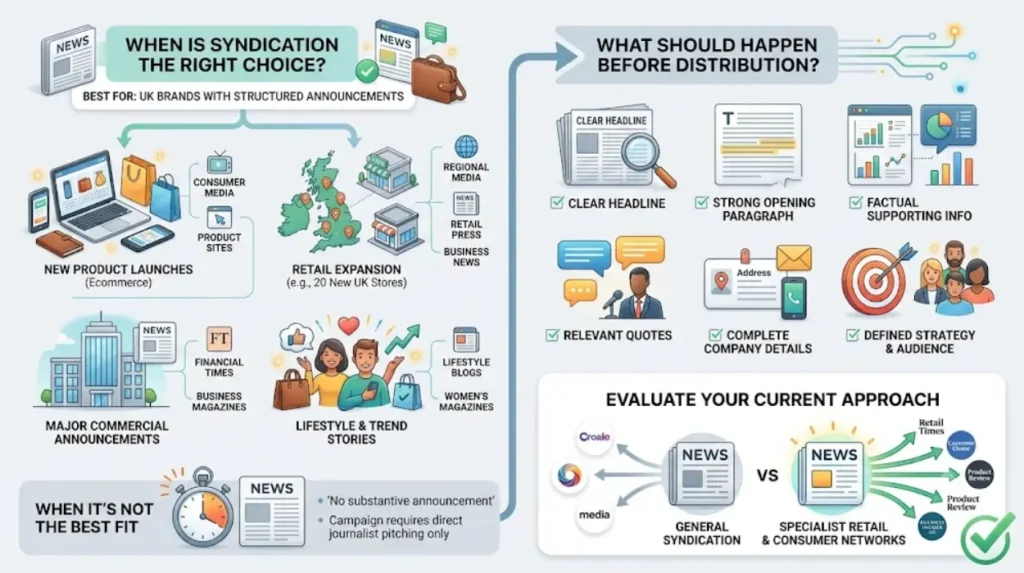
Time Intelligence Media Group’s retail and consumer syndication service fits UK brands that need structured distribution for product, retail, lifestyle, ecommerce, consumer, and major commercial announcements across relevant publishing environments.
The strongest use case is a brand with a clear announcement and a defined media audience.
For example, a retailer launching 20 new stores across the UK needs distribution aligned with retail, business, consumer, and regional media. An ecommerce brand launching a major product range requires consumer and product-focused exposure.
A distribution network becomes less relevant when there is no substantive announcement or when the campaign requires only direct journalist pitching rather than broad syndication.
Explore More Expert Insights:
Best Press Release Distribution Networks for Launching Niche Boutique Brands on a Budget
Time Intelligence Media Group Service Guide: Custom PR Distribution for D2C Innovators
What should happen before distribution?
The release needs a clear headline, strong opening paragraph, factual supporting information, relevant quotes, and complete company details.
The distribution strategy then needs to reflect the announcement’s audience.
For brands evaluating their current approach, comparing existing distribution against specialist retail and consumer networks provides a practical starting point. The objective is to identify whether the current provider reaches the media categories that matter commercially.
How can a UK brand decide whether this network fits its next announcement?
A UK brand can assess network fit by matching its announcement type, target audience, geographic requirements, publication categories, campaign timing, and reporting needs against the distribution capabilities offered by Time Intelligence Media Group.
The decision process is straightforward.
First, define the announcement. Second, identify the relevant media audience. Third, assess the required UK geographic and sector coverage. Fourth, review the available syndication network. Fifth, establish the reporting requirements.
This approach prevents distribution decisions based solely on outlet quantity.
For a retailer managing an inventory clearance, product launch, ecommerce expansion, or strategic pivot, the network needs to reflect the commercial importance of the announcement.
Time Intelligence Media Group’s exclusive retail and consumer syndication networks provide a specialist distribution option for these campaigns. Businesses can evaluate the service against their required publication categories, target audiences, campaign frequency, and reporting requirements before committing to a distribution programme.
For organisations already planning a major commercial announcement, reviewing the:
Product Pitches provides the next practical step toward selecting an appropriate UK distribution route.