
Launching a niche boutique brand in the UK requires targeted visibility, controlled spending, and measurable media distribution. A press release distribution network helps a brand place launch news across relevant publications, business platforms, regional outlets, and search-indexed media channels.
For small fashion labels, independent beauty brands, specialist food companies, artisan retailers, and emerging lifestyle businesses, distribution decisions directly affect the value generated from each announcement. A low-cost service with poor targeting creates limited visibility. A focused network delivers stronger relevance without requiring a large PR budget.
What is a press release distribution network for a boutique brand?
A press release distribution network connects a brand announcement with selected media outlets, news websites, industry publications, regional publishers, and digital channels. The network distributes structured news content to create measurable visibility beyond a brand’s own website and social accounts.
A press release distribution network is a structured media delivery system. It takes a completed announcement and distributes it to publications or media databases within selected geographic, industry, and audience categories.
For boutique brands, the key factor is relevance. A niche skincare launch requires different distribution from a specialist jewellery collection or independent food product.
A suitable network provides access to several publication types, such as:
- UK business publications
- Retail and e-commerce media
- Fashion and beauty publications
- Regional news websites
- Consumer lifestyle outlets
- Trade publications
- Entrepreneurial and startup media
- Search-indexed news platforms
The purpose is not simply to generate a large publication count. The objective is to reach outlets that match the brand, product, market, and announcement.
Which press release distribution networks offer the best value for small UK brands?
The best-value distribution networks combine relevant UK media access, transparent pricing, controlled targeting, measurable reporting, and suitable turnaround times. Boutique brands gain greater efficiency from focused distribution than from paying for large networks with irrelevant publication volume.
Budget efficiency starts with understanding what the distribution package actually includes.
A low headline price does not always represent the lowest campaign cost. Additional charges for targeting, editing, multimedia, reporting, regional distribution, or expedited publication affect the final price.
Which network features matter most?
Boutique brands need five core features.
1. UK media targeting
The network needs meaningful UK coverage options. A London-based boutique selling nationally has different requirements from a regional business serving customers in Manchester, Leeds, Bristol, or Edinburgh.
2. Industry targeting
The network needs relevant categories. Examples include fashion, beauty, retail, food and drink, homeware, technology, wellness, and consumer products.
3. Transparent pricing
Pricing needs clear inclusions. A suitable package identifies the distribution scope, publication types, reporting, turnaround, and additional costs.
4. Coverage reporting
A campaign report needs publication names, URLs, dates, and distribution information. These records help brands measure the practical value of each release.
5. Search visibility
Digital publication creates a secondary discovery opportunity. Properly structured press releases can support branded search visibility when legitimate publications index and retain the content.
How should boutique brands compare press release distribution networks?

Boutique brands should compare distribution networks using media relevance, UK reach, publication quality, pricing, reporting, turnaround, targeting options, and search visibility. A weighted comparison prevents low-cost packages from appearing attractive when important campaign features are excluded.
A practical comparison starts with the announcement itself.
If the launch concerns a new independent fashion label, a fashion-focused or retail-focused distribution route provides greater relevance than a generic international network.
If the announcement concerns a specialist food product, food, hospitality, retail, and regional business outlets provide stronger contextual alignment.
What should the comparison include?
Use the following criteria before purchasing a distribution package:
| Evaluation factor | What to check |
|---|---|
| UK reach | Number and type of UK outlets |
| Sector relevance | Fashion, beauty, retail, food, lifestyle, or other categories |
| Geographic targeting | National, regional, or city-level distribution |
| Pricing | Base price and additional charges |
| Turnaround | Standard and expedited publication times |
| Reporting | URLs, publication names, dates, and campaign records |
| Multimedia | Images, logos, video, or other supported assets |
| Search visibility | Indexable digital publication opportunities |
| Customer support | Editing, submission, and campaign assistance |
| Repeat campaigns | Options for ongoing announcements |
This comparison also supports better budget allocation. A boutique brand does not need every available feature for every announcement.
A launch release requires broader awareness. A local store opening requires stronger regional targeting. A product update requires sustained digital visibility.
Which distribution network is best for a niche boutique launch?
The best distribution network is the one that matches the brand’s target market, announcement type, geographic footprint, and available budget. UK-focused boutique launches require relevant publication access rather than maximum distribution volume across unrelated international outlets.
A niche brand needs audience alignment.
Consider a boutique jewellery company launching a sustainable collection. Its ideal distribution includes retail, fashion, lifestyle, sustainability, and regional business publications.
A specialist coffee company needs food, hospitality, retail, local business, and consumer publications.
A premium skincare startup needs beauty, retail, lifestyle, consumer, and relevant business media.
These examples demonstrate why distribution selection needs to begin with the story.
What makes a network suitable for niche products?
A suitable network provides access to media categories connected with the product and customer.
It also supports appropriate geographic targeting. UK brands frequently need national visibility alongside regional recognition.
For example, a boutique based in Birmingham with nationwide e-commerce sales can combine national retail coverage with West Midlands business media.
This approach creates a more relevant media footprint than distributing every announcement to an identical publication list.
How much should a boutique brand spend on press release distribution?
A boutique brand should establish a fixed campaign budget before selecting a distribution package. The budget needs to cover distribution, content preparation, optional multimedia, reporting requirements, and repeat announcements required for sustained visibility.
There is no single distribution price that suits every boutique business.
Instead, brands need to separate campaign costs into three categories.
What are the essential costs?
Essential costs include:
- Press release preparation
- Distribution
- Basic media targeting
- Publication reporting
These elements form the foundation of a campaign.
What are optional costs?
Optional costs include:
- Professional press release writing
- Multimedia placement
- Image distribution
- Enhanced targeting
- Expedited distribution
- Campaign monitoring
- Additional regional distribution
A small brand can control spending by selecting optional features according to the announcement’s commercial importance.
A major product launch deserves greater investment than a routine company update.
How can boutique brands maximise the value of one press release?
Brands maximise press release value by creating one newsworthy announcement, targeting relevant media categories, using strong factual information, supporting the release with appropriate assets, and extending legitimate coverage into ongoing search and content activity.
Distribution is one part of the campaign.
The release itself needs a clear news proposition. It needs a specific announcement, supporting facts, relevant company information, and accurate contact details.
What information improves distribution performance?
A strong boutique launch release typically includes:
- Product or collection name
- Launch date
- UK availability
- Founder or company information
- Relevant market data
- Pricing information
- Product differentiators
- Website destination
- High-quality product imagery
- Contact information
The release also needs a headline that communicates the news clearly.
After publication, the resulting URLs become useful reference points for future content. Brands can connect relevant website pages, product information, founder content, and future announcements to the wider media footprint.
This connects directly with
Product syndication as a longer-term search visibility activity.
How does press release distribution support long-tail search traffic?
Press release distribution supports long-tail search visibility by creating additional digital references to a brand, product, launch, location, and relevant topic. Consistent publication gives search engines more contextual information across multiple legitimate media pages.
A single launch announcement rarely represents the entire search opportunity.
A boutique brand can build additional search relevance around specific product names, product categories, founder expertise, locations, and customer questions.
For example, a UK independent skincare brand can create related search relevance around terms such as:
- Independent UK skincare brand
- Sustainable skincare products UK
- Boutique facial skincare
- British skincare launch
- Natural skincare collection
The press release provides one piece of this information ecosystem.
Brands can then build supporting website pages and future announcements around related topics. This creates continuity between media visibility and owned search content.
Businesses developing this approach can explore
Continuous Press Coverage for E-commerce Stores for the next stage of post-launch visibility.
What mistakes should boutique brands avoid when choosing a distribution network?
Boutique brands should avoid selecting networks based only on publication counts, headline price, or international reach. Irrelevant placements, unclear reporting, excessive add-ons, weak targeting, and unsuitable publication categories reduce the practical value of limited marketing budgets.
Several purchasing mistakes appear repeatedly.
Paying for volume instead of relevance
A large publication count does not automatically provide useful audience exposure. A boutique brand benefits more from relevant retail, lifestyle, regional, and trade publications than from unrelated websites.
Ignoring additional charges
The advertised package price can exclude important services. Brands need the complete campaign cost before purchasing.
Choosing international reach without UK relevance
A UK boutique targeting British customers needs credible UK media access. International distribution becomes useful when the brand has an established overseas market.
Using identical distribution for every announcement
Campaign objectives change. A product launch, funding announcement, store opening, partnership, and seasonal collection require different targeting.
Treating publication as the final step
Coverage creates assets for ongoing marketing activity. Brands need to record publication URLs and incorporate legitimate coverage into their broader content and search strategy.
How should a boutique brand choose a press release distribution provider?
A boutique brand should select a provider after checking UK media reach, sector targeting, transparent pricing, reporting quality, turnaround times, editorial support, and previous experience with comparable announcements. The final choice needs to match the campaign objective and available budget.
The decision process can remain simple.
First, define the announcement and target audience.
Second, identify the required UK media categories.
Third, request the complete distribution cost.
Fourth, confirm the reporting format.
Fifth, check turnaround requirements.
Sixth, review optional services separately from essential distribution.
Finally, compare providers using the same criteria.
For brands planning several announcements during a year, repeat distribution also deserves consideration. A structured campaign can include product launches, retail partnerships, seasonal collections, founder announcements, awards, funding news, and business milestones.
This creates a consistent media visibility programme instead of isolated coverage.
What should boutique brands do after distribution?
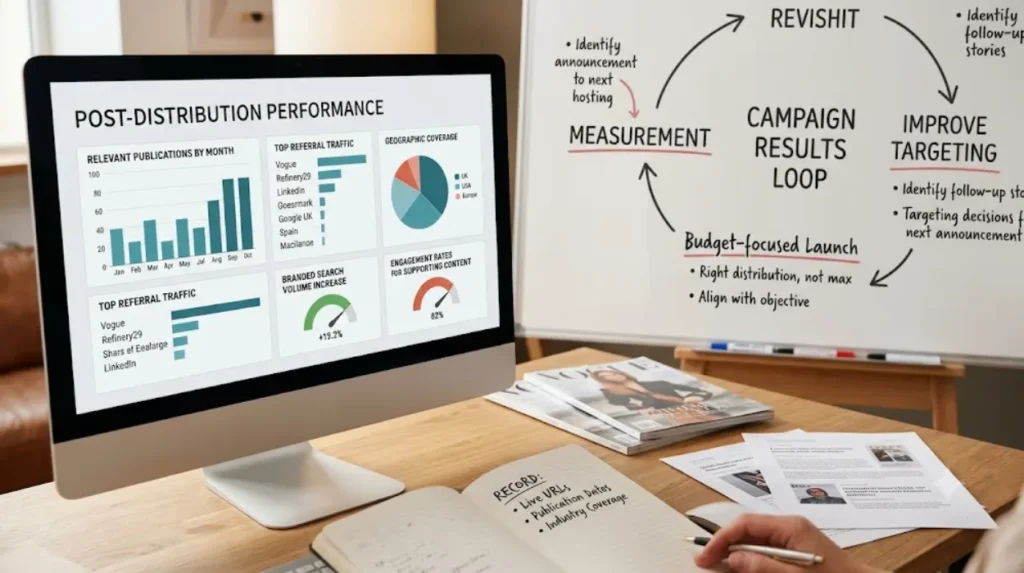
After distribution, boutique brands should verify published coverage, record media URLs, monitor referral and search activity, update internal content, identify follow-up stories, and use campaign results to improve targeting for the next announcement.
Post-distribution measurement determines whether the network delivered useful outcomes.
Brands should record:
- Number of relevant publications
- Publication names
- Publication dates
- Live URLs
- Geographic coverage
- Industry coverage
- Referral traffic
- Branded search activity
- Engagement with supporting content
The data also improves future purchasing decisions.
Explore More Expert Insights:
Time Intelligence Media Group Service Guide: Custom PR Distribution for D2C Innovators
Selecting a Retail Wire: A Media Kit Checklist for New Consumer Brand Partnerships
If regional publications generate stronger engagement than broad consumer outlets, the next campaign can prioritise regional distribution. If retail publications produce relevant traffic, future product announcements can receive greater retail targeting.
For niche boutique brands, press release distribution works best as a measurable component of a broader media and search strategy. The right network provides targeted access, transparent costs, useful reporting, and opportunities for continued digital visibility.
A budget-focused launch does not require maximum distribution. It requires the right distribution network for the right announcement, audience, location, and commercial objective.