E-commerce sales slumps often create a visibility problem before they create a revenue problem. When fewer consumers encounter a brand, fewer people enter the consideration stage. Continuous press coverage keeps products, expertise, launches, and business developments visible across relevant media channels.
Press coverage refers to editorial mentions of a business, product, founder, campaign, or development in newspapers, magazines, trade publications, online publications, and other recognised media outlets. Continuous coverage means maintaining a consistent flow of newsworthy stories rather than relying on one announcement.
For e-commerce businesses in the United Kingdom, this approach supports visibility across competitive retail categories. It also creates additional opportunities for branded searches, referral traffic, product discovery, and third-party validation.
Why does continuous press coverage matter during an e-commerce sales slump?
Continuous press coverage maintains brand visibility when direct sales activity slows, creating repeated opportunities for consumers to discover products, search for the brand, encounter third-party information, and re-enter the purchasing journey through relevant editorial coverage.
A sales slump reduces the number of customers completing transactions. It does not automatically reduce the need for visibility. Consumers continue researching products, comparing prices, reading reviews, following trends, and searching for alternatives.
Press coverage places a brand within those information environments.
For example, a UK homeware retailer experiencing weaker summer sales can generate relevant coverage around new interior trends, sustainable materials, seasonal buying behaviour, or a new product collection. Each story creates another opportunity for consumers to encounter the retailer.
Continuous coverage also reduces dependence on individual promotional campaigns. A single product launch creates one concentrated visibility event. A sustained editorial programme creates multiple opportunities throughout the year.
What does continuous coverage mean?
Continuous coverage does not mean publishing identical announcements every week. It means developing different legitimate news angles from genuine business activity.
Examples include:
- New product launches
- Product innovations
- Retail partnerships
- Founder milestones
- Customer research
- Industry surveys
- Sustainability initiatives
- Seasonal consumer trends
- Business expansion
- New collections
- Awards and recognised achievements
- E-commerce market insights
Each story needs a distinct reason for publication.
How does press coverage affect consumer visibility during weak sales periods?
Press coverage increases the number of external touchpoints between an e-commerce business and potential customers, helping consumers encounter products through news articles, features, interviews, trend stories, trade publications, and search results.
Consumer purchasing journeys often include several information-gathering stages. A customer searches for a product, compares alternatives, reads editorial content, checks reviews, visits product pages, and then decides whether to purchase.
Press coverage contributes to the information stage.
An article about the best UK products for a specific use case can introduce a consumer to an unfamiliar retailer. A founder interview can establish business expertise. A product feature can introduce a specific item to consumers who were not previously searching for the brand.
The effect is particularly relevant during sales slumps because businesses often increase promotional activity when demand falls. Continuous editorial visibility provides a separate communication channel.
Why is third-party coverage valuable?
Third-party coverage provides information outside the company’s own website and social profiles. This creates additional sources for consumers researching a business.
A retailer selling specialist skincare products, for example, can appear in beauty publications, consumer lifestyle articles, founder interviews, and trend reports. These appearances create different discovery routes.
Editorial coverage also supports branded search behaviour. Consumers who encounter a company in an article can later search its name directly. This creates another measurable interaction between media visibility and website traffic.
How does continuous press coverage support search visibility?

Continuous press coverage creates additional indexed references to a business, its products, and relevant topics, supporting brand discovery, search demand, contextual relevance, referral traffic, and the wider digital footprint surrounding an e-commerce website.
Search engines organise information across websites, pages, entities, topics, and references. Press coverage adds external pages containing a company name, product names, executives, locations, categories, and industry terminology.
This does not mean every article produces a direct ranking increase. Search visibility depends on multiple factors, including relevance, authority, technical performance, content quality, competition, and search intent.
Press coverage contributes to the broader information environment surrounding a business.
For example, an independent UK footwear retailer selling vegan trainers can receive coverage about sustainable footwear, new product releases, ethical manufacturing, and changing consumer preferences. Those stories associate the retailer with multiple relevant concepts.
How does coverage create long-tail search opportunities?
Long-tail keywords are specific search queries that usually contain several words and express a defined information need.
Examples include:
- “vegan trainers made in the UK”
- “best waterproof walking shoes for UK weather”
- “sustainable gifts for new homeowners”
- “independent British skincare brands”
- “organic cotton bedding UK”
Press coverage discussing these subjects creates additional web content around related entities and terminology.
This relationship becomes more important when product information continues receiving attention after the original launch. Businesses developing this approach can explore:
Product syndication as a separate method for extending product visibility beyond the initial announcement.
What types of stories generate continuous e-commerce press coverage?
The strongest continuous coverage programmes use genuine business developments, useful consumer information, original data, product news, expert commentary, partnerships, seasonal insights, and market trends that provide distinct reasons for journalists to publish.
E-commerce businesses have multiple potential sources of news. The key requirement is a clear editorial purpose.
A product launch is one type of announcement. It is not the only one.
Product and collection stories
New products provide direct news opportunities. A release becomes more useful when it contains specific information about the product, target customer, price, availability, materials, technology, or market relevance.
For example, a UK accessories retailer launching a recycled-material handbag collection can provide details about materials, manufacturing, availability, and consumer demand.
Original research
Original research provides information that journalists can reference. E-commerce businesses can survey customers or analyse first-party purchasing data to identify trends.
Examples include:
- Seasonal buying patterns
- Changes in product preferences
- Consumer spending priorities
- Popular product categories
- Regional purchasing trends
Research requires transparent methodology and accurate data.
Expert commentary
Founders and senior executives can provide informed commentary on relevant developments. A fashion retailer can comment on seasonal retail trends. A technology retailer can discuss changes in consumer device preferences.
Commentary works when it provides specific information rather than promotional statements.
Partnerships and business milestones
Retail partnerships, distribution agreements, new facilities, international expansion, awards, funding events, and major operational milestones can create legitimate news.
Each announcement needs factual evidence and a clear explanation of why the development matters.
How can e-commerce businesses maintain coverage without repeating the same story?
E-commerce businesses maintain continuous coverage by building multiple editorial angles around different developments, separating product news from market insights, using new evidence, and matching each announcement to a specific audience and publication category.
Repetition weakens editorial value. Publishing the same product message repeatedly does not create meaningful news.
A better approach separates stories by purpose.
A product launch focuses on what is new. A consumer survey focuses on what the data reveals. A founder interview focuses on expertise. A retail partnership focuses on commercial expansion.
This structure creates different reasons for journalists and publications to engage.
How should stories be planned?
A simple quarterly structure provides consistency.
Quarter 1: product launches, consumer research, founder expertise
Quarter 2: seasonal trends, partnerships, customer data
Quarter 3: new collections, market insights, sustainability developments
Quarter 4: festive purchasing trends, annual results, upcoming product developments
The exact schedule depends on the business and its genuine news flow.
The objective is not to manufacture news. It is to identify useful stories within existing business activity.
How does press coverage help rebuild consumer trust?
Consistent third-party coverage gives consumers more independent information about an e-commerce business, supporting familiarity, credibility, product understanding, and confidence during purchasing research without replacing reviews, customer service, or transparent product information.
Trust develops through repeated exposure to credible information. Consumers often assess unfamiliar businesses before purchasing, particularly when products have higher prices or specialist features.
Press coverage provides additional information about the company behind a product.
For example, coverage of a UK furniture retailer can explain its manufacturing process, materials, design expertise, retail partnerships, and sustainability initiatives. Different articles answer different consumer questions.
This information complements other trust signals such as customer reviews, secure payment systems, delivery policies, returns information, and clear contact details.
Why is frequency important?
One article does not establish sustained visibility. A business that appears once and then disappears from editorial coverage becomes dependent on consumers remembering the original story.
Regular coverage creates recurring opportunities for discovery.
Frequency also supports broader topic coverage. A retailer can become associated with several related subjects instead of one isolated announcement.
Which e-commerce businesses benefit most from continuous press coverage?
Continuous press coverage is particularly relevant for competitive e-commerce businesses with frequent product developments, specialist products, changing consumer demand, seasonal sales cycles, or limited existing brand recognition in the UK market.
The approach applies across many e-commerce categories.
Niche retailers
Specialist businesses often need to reach highly specific audiences. Media coverage in relevant trade and consumer publications provides targeted discovery opportunities.
Examples include specialist cycling retailers, independent beauty businesses, premium pet brands, and sustainable homeware stores.
Emerging brands
New brands face a recognition challenge because consumers have limited prior knowledge. Consistent coverage provides more opportunities to introduce the company, products, founders, and market position.
Seasonal businesses
Businesses with concentrated demand benefit from visibility before and during key buying periods.
Examples include Christmas gift retailers, wedding suppliers, summer travel products, and back-to-school products.
Established retailers facing declining demand
Established businesses also experience sales fluctuations. Continuous coverage provides additional communication opportunities when paid advertising and promotional campaigns alone do not produce sufficient visibility.
How should e-commerce businesses measure the impact of continuous press coverage?
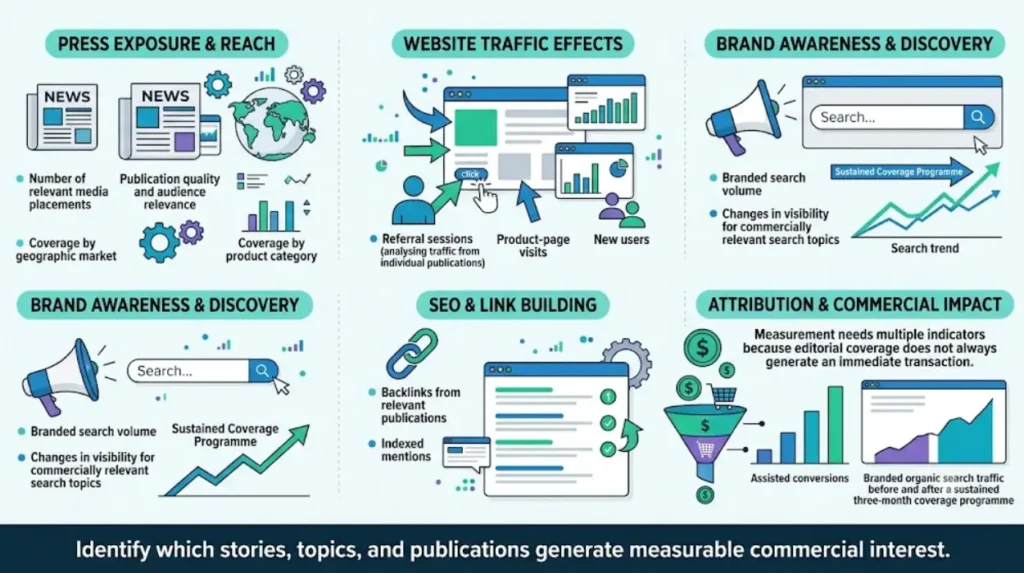
E-commerce businesses can measure press coverage through publication volume, audience relevance, referral traffic, branded search activity, indexed mentions, backlinks, engagement, assisted conversions, and changes in visibility for commercially relevant search topics.
Measurement needs multiple indicators because editorial coverage does not always generate an immediate transaction.
Useful metrics include:
- Number of relevant media placements
- Publication quality and audience relevance
- Referral sessions
- Branded search volume
- Product-page visits
- New users
- Backlinks from relevant publications
- Assisted conversions
- Coverage by geographic market
- Coverage by product category
For example, a retailer can compare branded organic search traffic before and after a sustained three-month coverage programme. It can also analyse referral traffic from individual publications.
The purpose is to identify which stories, topics, and publications generate measurable commercial interest.
Explore More Expert Insights:
How Under-the-Radar Consumer Brands Build Trust and Credibility Against Retail Giants
Why New E-commerce Startups Fail Without an Omnichannel Media Visibility Strategy
What is the long-term value of continuous press coverage for e-commerce?
Continuous press coverage creates a sustained stream of external visibility that supports discovery, search presence, consumer research, credibility, referral traffic, and brand familiarity, making media activity a recurring part of long-term e-commerce visibility rather than a one-time launch tactic.
Sales slumps require more than short-term promotional activity. E-commerce businesses need continued visibility while consumers research products and evaluate competing brands.
A consistent press strategy provides repeated opportunities to enter those research journeys.
The strongest approach combines genuine news, original data, useful expertise, product developments, and relevant seasonal stories. Each story serves a distinct editorial purpose.
Continuous coverage does not guarantee immediate sales. Its role is to expand the number of places where consumers can discover, research, and recognise an e-commerce business.
For brands assessing the next stage of this process, understanding:
Press release distribution networks provides a natural progression from awareness of continuous media visibility to evaluating distribution options.