
An omnichannel media visibility strategy coordinates brand exposure across national, regional, trade, social, search, and digital media channels to create consistent visibility throughout the customer journey from discovery to purchase.
An omnichannel media visibility strategy is a structured approach to distributing and reinforcing brand information across multiple media environments. It connects earned media, digital publishing, search visibility, social content, influencer coverage, and relevant industry publications.
For an e-commerce startup, visibility is different from simply generating website traffic. Customers encounter products through several channels before making purchasing decisions. A startup needs consistent information across those channels.
Which channels form an omnichannel media strategy?
Common channels include:
- National business and consumer publications
- Regional newspapers and digital publications
- Retail and e-commerce trade media
- Search engines
- Social media platforms
- Creator and influencer publications
- Product review websites
- Industry newsletters
- Digital magazines
- Online marketplaces
For example, a new UK skincare brand can receive coverage in a consumer publication, appear in a retail trade article, gain search visibility for its product category, and publish supporting content on social platforms.
Each channel serves a different discovery function.
Why does media visibility matter for new e-commerce startups?
Media visibility gives new e-commerce startups external exposure, searchable brand information, and third-party references that support discovery when consumers compare unfamiliar products, brands, prices, reviews, and purchasing options.
New e-commerce businesses start without the recognition established retailers already possess. Consumers often encounter an unfamiliar brand for the first time through search results, editorial coverage, social content, product reviews, or recommendations.
Media visibility creates additional discovery points.
A startup selling sustainable homeware, for example, needs visibility beyond its own product pages. Coverage in a home and lifestyle publication creates an external reference. A trade publication creates an industry reference. Search content provides another discovery route.
These references establish a broader digital footprint.
How does visibility support brand discovery?
Brand discovery occurs when consumers first encounter information about a company or product.
Media visibility supports discovery through:
- Editorial exposure — Publications introduce products to established audiences.
- Search visibility — Media coverage creates additional indexed pages containing brand information.
- Category association — Articles connect a startup with relevant product categories.
- Third-party validation — Independent publications provide external references.
- Repeated exposure — Multiple channels reinforce the same brand identity.
The objective is not to place identical content everywhere. Each channel provides a different context for discovering the business.
Why is a single media channel insufficient for e-commerce growth?
A single media channel restricts the number of discovery points available to customers and leaves startups dependent on one audience, algorithm, publication type, or traffic source for brand visibility and product awareness.
A startup relying exclusively on social media faces platform-specific distribution rules. A business relying only on paid advertising depends on continued advertising expenditure. A company focused only on search needs sustained organic visibility.
Each channel has different characteristics.
What happens when startups rely only on social media?
Social media provides rapid content distribution, but platform visibility depends on audience behaviour and platform algorithms.
A fashion startup that publishes exclusively on Instagram, for example, limits discovery to users accessing that platform. A consumer searching Google for a specific product category encounters a different discovery environment.
What happens when startups rely only on paid advertising?
Paid advertising produces controlled placements but requires continuous spending.
When campaigns stop, the paid traffic source stops. Editorial coverage, indexed articles, reviews, and other earned visibility assets continue to exist after publication.
What happens when startups rely only on organic search?
Search visibility provides valuable discovery, but new websites often have limited authority and few indexed references.
External media coverage creates additional pages containing relevant brand and product information. These pages expand the number of places where consumers encounter the business.
How does an omnichannel strategy work across the customer journey?
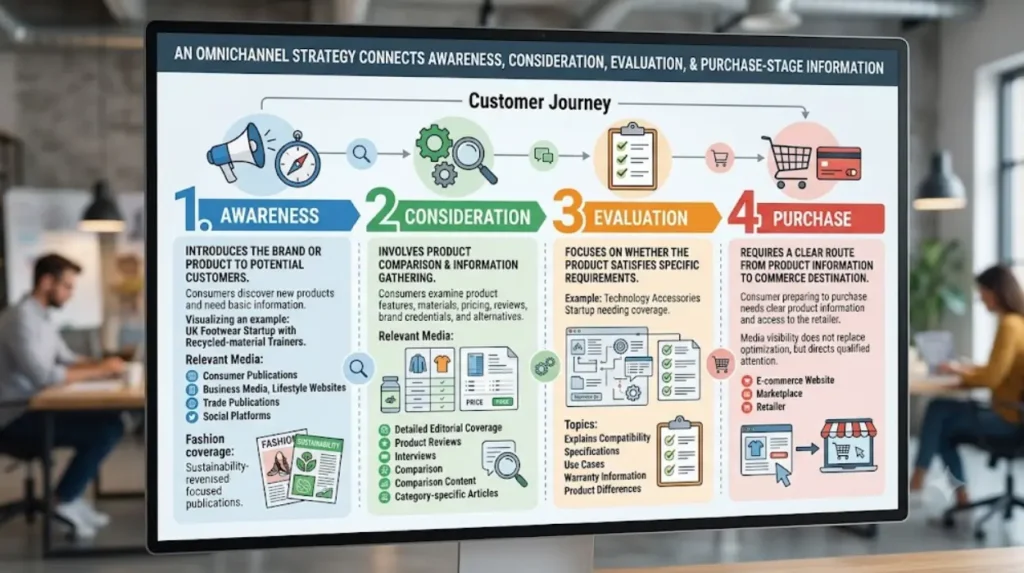
An omnichannel media strategy connects awareness, consideration, evaluation, and purchase-stage information so consumers encounter consistent brand details while moving between search, editorial content, social platforms, reviews, and e-commerce properties.
The customer journey contains several information requirements.
A consumer discovering a new product needs basic information. A consumer comparing products needs specifications, pricing, reviews, and evidence. A consumer preparing to purchase needs clear product information and access to the retailer.
Media visibility supports different stages.
What happens during the awareness stage?
Awareness introduces the brand or product to potential customers.
Relevant media includes consumer publications, business media, lifestyle websites, trade publications, social platforms, and digital newsletters.
For example, a UK footwear startup launching a recycled-material trainer can gain awareness through fashion coverage and sustainability-focused publications.
What happens during the consideration stage?
Consideration involves product comparison and information gathering.
Consumers examine product features, materials, pricing, reviews, brand credentials, and alternatives.
Detailed editorial coverage, product reviews, interviews, comparison content, and category-specific articles provide information for this stage.
What happens during the evaluation stage?
Evaluation focuses on whether the product satisfies specific requirements.
A technology accessories startup, for example, needs coverage that explains compatibility, specifications, use cases, warranty information, and product differences.
What happens during the purchase stage?
Purchase requires a clear route from product information to the e-commerce website, marketplace, or retailer.
Media visibility does not replace product-page optimisation. It directs qualified attention toward the commercial destination.
Which media channels matter most for e-commerce startups?
The most relevant media channels depend on the product category, target audience, geographic market, and customer journey, with national, regional, trade, search, social, review, and creator channels serving distinct visibility functions.
No single channel provides every type of exposure.
What role does national media play?
National media provides broad geographic exposure and access to large consumer or business audiences.
A consumer electronics startup, for example, benefits from technology and national consumer publications that reach audiences beyond its existing customer base.
What role does regional media play?
Regional media connects products with specific UK locations and communities.
A food startup launching in Manchester, Leeds, and Birmingham can use regional coverage to build awareness in those markets.
What role does trade media play?
Trade media focuses on specific industries and professional audiences.
Examples include retail, e-commerce, fashion, beauty, food, technology, and logistics publications.
Trade coverage is particularly relevant when a startup needs visibility among retailers, distributors, buyers, suppliers, or industry professionals.
What role does search visibility play?
Search visibility allows consumers to discover information through queries.
Relevant search entities include product names, product categories, problems, features, materials, and use cases.
For example, a startup selling reusable water bottles needs visibility around searches involving reusable bottles, insulated bottles, sustainable drinkware, and related product attributes.
How should startups coordinate content across different media channels?
Startups coordinate omnichannel visibility by maintaining consistent brand facts while adapting the format, message, evidence, and level of detail to each publication, platform, search environment, and stage of the customer journey.
Consistency does not mean publishing identical content.
A press announcement provides news information. A trade article provides industry context. A product review examines performance. A social post communicates concise information. A product page provides commercial details.
Each asset serves a specific purpose.
Which information needs to remain consistent?
Core information includes:
- Brand name
- Product name
- Product category
- Key specifications
- Launch date
- Pricing
- Availability
- Founder or company information
- Geographic availability
- Product claims
Inconsistent information creates confusion.
If a product is described as launching in September in one publication and October in another, customers receive conflicting information. Accurate information across channels supports trust and improves information retrieval.
How does timing affect e-commerce media visibility?
Timing determines when media exposure reaches consumers, making campaign planning important around product launches, seasonal demand, retail events, promotional periods, and predictable changes in consumer purchasing behaviour.
E-commerce demand is highly seasonal.
UK businesses frequently plan campaigns around events such as Christmas, Black Friday, Cyber Monday, summer sales, back-to-school purchasing, Valentine’s Day, Mother’s Day, and Father’s Day.
Media exposure needs to appear before peak purchasing activity.
For example, a gift-focused product requires discovery before consumers begin actively searching for presents. Coverage published after the primary buying period has less relevance to that campaign.
For a deeper understanding of campaign timing, explore:
Timing Your Campaign: How to Synchronize Press Releases with Major Seasonal Sales Events.
Why does early visibility matter?
Consumers need time to discover, evaluate, compare, and purchase products.
A campaign launched several weeks before a major seasonal event provides more opportunities for editorial discovery, search indexing, social sharing, and repeated exposure.
Timing also allows media coverage to accumulate rather than concentrating every visibility activity into a short period.
What mistakes cause e-commerce startups to lose media visibility?
Common failures include relying on one channel, using inconsistent brand information, ignoring trade and regional media, publishing without timing, producing weak news angles, and measuring traffic without assessing broader visibility and audience reach.
Several operational mistakes repeatedly reduce the effectiveness of startup media activity.
Which mistakes are most common?
Single-channel dependency: The startup relies entirely on one platform.
Weak news value: Announcements contain product information but lack a clear reason for media interest.
Inconsistent messaging: Product names, claims, prices, or launch dates differ between channels.
Poor timing: Coverage appears after the relevant purchasing period.
Limited media targeting: The campaign ignores specialist publications that serve the product category.
Incomplete measurement: The startup measures clicks but ignores publication reach, search visibility, backlinks, referral traffic, and brand mentions.
These problems reduce the overall value of media activity.
How can e-commerce startups measure omnichannel media visibility?
Startups measure omnichannel visibility through media mentions, publication reach, referral traffic, search impressions, branded searches, backlinks, engagement, content placement, and conversions attributed to specific visibility channels.
Measurement needs to cover both exposure and commercial outcomes.
Which metrics provide useful visibility data?
Key metrics include:
- Number of media mentions
- Number of publications carrying coverage
- Estimated publication audience
- Referral sessions
- Branded search impressions
- Non-branded search impressions
- Backlinks from relevant publications
- Social engagement
- Product-page visits
- Assisted conversions
- Direct conversions
A startup selling premium home furnishings, for example, can compare referral traffic from design publications with search traffic generated after editorial coverage.
The comparison identifies which channels contribute to discovery and consideration.
Explore More Expert Insights:
The Direct Impact of Brand Awareness on Reducing Customer Acquisition Costs (CAC)
How High-Authority Backlinks from Retail Media Resurrect Declining Organic Shop Traffic
Why is omnichannel media visibility important for long-term e-commerce growth?
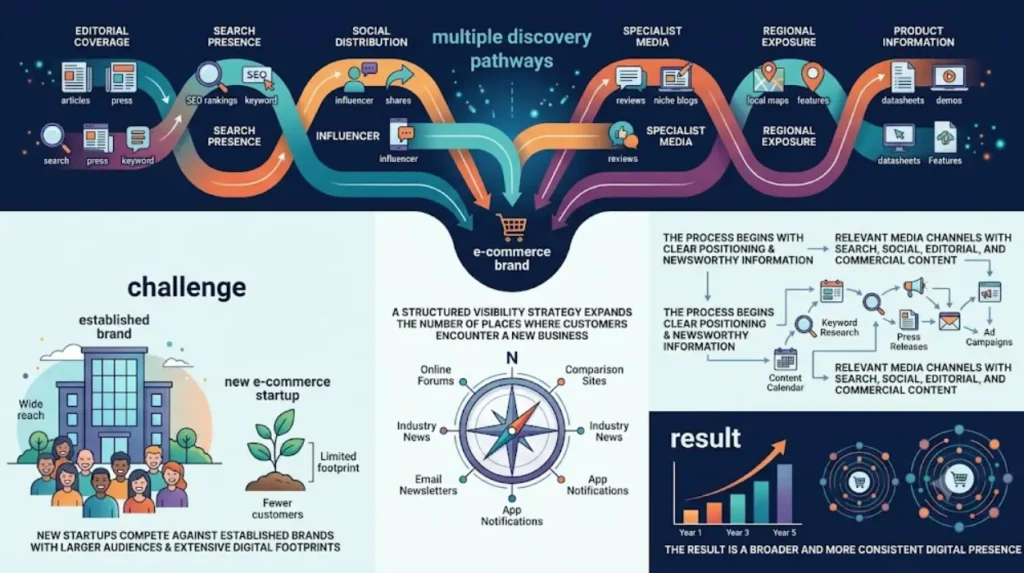
Omnichannel media visibility creates multiple discovery pathways for e-commerce brands by combining editorial coverage, search presence, social distribution, specialist media, regional exposure, and product information across the customer journey.
New e-commerce startups compete against established brands with larger audiences and extensive digital footprints.
A structured visibility strategy expands the number of places where customers encounter a new business.
The process begins with clear positioning and newsworthy information. It then connects relevant media channels with search, social, editorial, and commercial content.
The result is a broader and more consistent digital presence.
For consumer brands evaluating retail media partnerships and distribution requirements, explore:
Selecting a Retail Wire: provides a further decision-stage resource.
An omnichannel media visibility strategy therefore functions as a coordinated system rather than a collection of isolated promotional activities. For new e-commerce startups, that distinction determines how effectively customers discover, research, and recognise the brand across the UK digital media environment.