
Seasonal sales events create concentrated periods of consumer attention. Black Friday, Cyber Monday, Christmas shopping, Boxing Day sales, January sales, Easter promotions, and summer clearance campaigns all create specific media opportunities for consumer brands.
A press release published during these periods needs more than a strong announcement. Timing determines when journalists receive the story, when search demand increases, and when consumers encounter the brand.
Press release timing for seasonal campaigns therefore requires coordination between the news cycle, promotional calendar, media deadlines, inventory availability, and customer demand.
Why does press release timing matter during seasonal sales events?
Press release timing determines whether a seasonal announcement reaches journalists before consumer demand peaks. Coordinated distribution gives media outlets time to assess the story, publish relevant coverage, and align reporting with the commercial event and promotional period.
A seasonal press release has a limited relevance window. A Christmas product announcement published on 24 December has less editorial value than the same announcement distributed in early December.
The timing process starts with the commercial calendar. Marketing teams need to identify the sales event, campaign launch date, promotional period, product availability, and key customer deadlines.
Media planning then works backwards from these dates.
For example, a brand launching a Black Friday promotion on 27 November needs media coverage before the peak shopping period. A release distributed on the morning of Black Friday competes with a high volume of other retail announcements.
What makes seasonal news different?
Seasonal news has a defined context. Journalists receive large volumes of retail content around major events.
Relevant examples include:
- Black Friday product launches
- Cyber Monday technology discounts
- Christmas gift guides
- Boxing Day promotions
- January clearance campaigns
- Easter retail collections
- Summer sale launches
- Back-to-school product campaigns
The strongest timing strategy connects the announcement to an identifiable consumer or market development rather than simply announcing a discount.
When should you send a press release before a major sale?
Most seasonal press releases require advance distribution rather than same-day publication. Consumer campaigns benefit from giving journalists sufficient editorial time to review announcements, request information, prepare articles, and schedule coverage before peak shopping activity.
The correct lead time depends on the type of announcement.
A straightforward promotional announcement requires less preparation than a product launch involving samples, interviews, photography, or expert commentary.
How far ahead should different campaigns start?
A practical planning framework is:
| Campaign type | Recommended media planning window |
|---|---|
| Major seasonal campaign | 3–6 weeks |
| New product launch | 4–8 weeks |
| Gift guide opportunity | 6–10 weeks |
| Retail promotion | 2–4 weeks |
| Flash sale | 3–7 days |
| Last-minute stock or availability update | 1–3 days |
These windows represent planning periods rather than mandatory publication dates.
Gift guide coverage requires particular attention because editorial teams often prepare seasonal content weeks before consumers begin purchasing.
For Christmas campaigns, this means media outreach often starts well before December.
How do you build a seasonal press release timeline?
A seasonal press release timeline starts with the sales date and works backwards through editorial preparation, content production, distribution, journalist review, publication, and campaign measurement. Each stage receives a specific deadline and responsible owner.
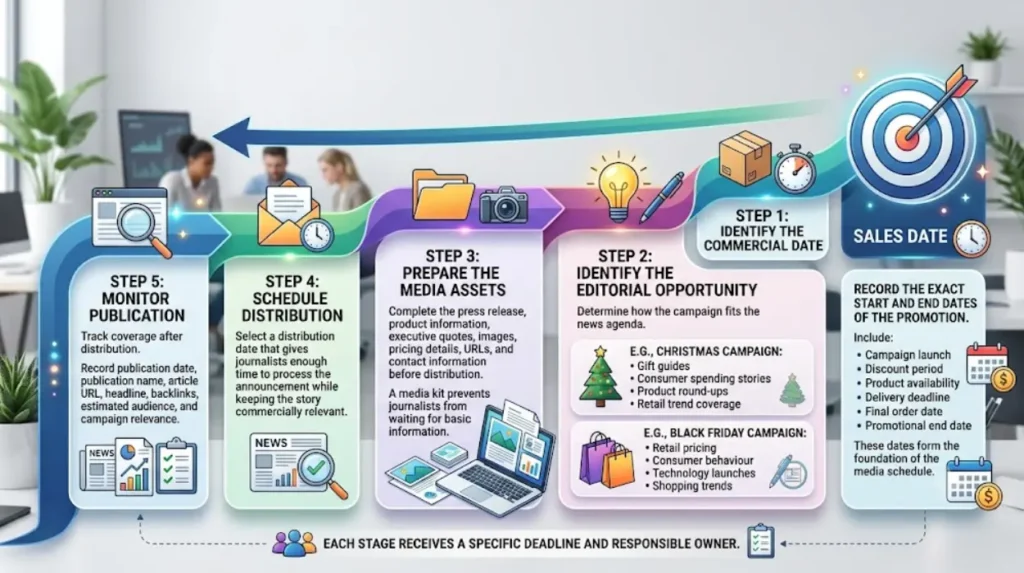
A backward planning model reduces timing conflicts.
Step 1: Identify the commercial date
Record the exact start and end dates of the promotion.
Include:
- Campaign launch
- Discount period
- Product availability
- Delivery deadline
- Final order date
- Promotional end date
These dates form the foundation of the media schedule.
Step 2: Identify the editorial opportunity
Determine how the campaign fits the news agenda.
A Christmas campaign can support gift guides, consumer spending stories, product round-ups, and retail trend coverage.
A Black Friday campaign can support retail pricing, consumer behaviour, technology launches, and shopping trends.
Step 3: Prepare the media assets
Complete the press release, product information, executive quotes, images, pricing details, URLs, and contact information before distribution.
A media kit prevents journalists from waiting for basic information.
Step 4: Schedule distribution
Select a distribution date that gives journalists enough time to process the announcement while keeping the story commercially relevant.
Step 5: Monitor publication
Track coverage after distribution. Record publication date, publication name, article URL, headline, backlinks, estimated audience, and campaign relevance.
What should a seasonal press release contain?
A seasonal press release needs a clear news angle, exact campaign dates, relevant product information, verified pricing, supporting evidence, usable media assets, and contact details. Every factual element must match the live campaign before distribution.
The announcement needs to answer the core editorial questions quickly.
What information matters most?
Include:
- What is being announced?
- When does the campaign begin?
- When does it end?
- Which products are included?
- What are the prices?
- Where can customers purchase?
- Why is the announcement relevant now?
- Who can provide additional comment?
Pricing accuracy is particularly important during seasonal sales.
If a product is advertised at £80 during a Black Friday promotion, the release needs to identify the promotional price and campaign dates accurately.
How does the headline affect timing?
The headline needs to communicate the news immediately.
Weak headlines focus on generic promotion language.
Stronger headlines identify the product, event, timing, and commercial relevance.
For example:
UK Retailer Launches Christmas Gift Collection Ahead of Peak Festive Shopping
This provides a clearer editorial angle than:
Major Christmas Sale Now Live
The first headline contains information that supports search discovery and editorial assessment.
How do seasonal sales affect media competition?
Major retail events create high media competition because numerous brands publish announcements within the same period. Earlier planning, stronger news angles, relevant evidence, and targeted distribution help a release compete for limited editorial attention.
Black Friday provides a clear example.
Retailers, technology companies, fashion brands, marketplaces, consumer electronics businesses, and financial organisations all publish related announcements.
The volume increases further during Christmas and January sales.
How can brands improve editorial relevance?
A seasonal announcement needs information beyond a discount.
Useful supporting elements include:
- Consumer spending data
- Product demand statistics
- Retail trends
- Expert commentary
- New product information
- Customer behaviour insights
- Industry research
- Regional shopping trends
For example, a fashion retailer can connect a Christmas product launch to changing festive shopping behaviour.
A technology retailer can connect a Black Friday announcement to increased demand for specific product categories.
This creates a stronger media story than a price reduction alone.
How should you coordinate press releases with SEO?
Seasonal press release SEO requires alignment between publication timing, search demand, campaign terminology, landing pages, headlines, and supporting content. The release needs consistent keywords and dates across media coverage, website pages, and campaign assets.
Search behaviour changes around seasonal events.
Consumers begin searching for terms such as “Black Friday deals”, “Christmas gifts”, “January sales”, and specific product categories before peak purchasing dates.
The press release needs terminology that accurately reflects the campaign.
What SEO elements require coordination?
Coordinate:
- Primary seasonal keyword
- Product keywords
- Brand name
- Campaign dates
- Promotional terminology
- Landing-page URL
- Image descriptions
- Supporting articles
The campaign landing page must also be live when media coverage directs customers to it.
Publishing a press release before the destination page exists creates a poor user journey.
Brands developing broader media visibility can also review their:
Omnichannel media visibility strategy to understand how press coverage connects with wider digital discovery.
How does distribution timing differ across media categories?
National, regional, trade, lifestyle, technology, and consumer media operate with different editorial priorities and deadlines. Seasonal campaigns perform better when distribution timing reflects the publication type rather than treating every media outlet as having identical requirements.
National business media often prioritise market developments, company results, investment, employment, and consumer trends.
Lifestyle publications focus more heavily on products, seasonal recommendations, fashion, food, beauty, travel, and shopping.
Trade publications prioritise sector-specific developments.
Regional publications need a clear local connection.
Why does media segmentation matter?
Consider a UK Christmas campaign for a new homeware product.
A lifestyle publication can focus on gift recommendations.
A retail trade publication can focus on category performance.
A regional publication can focus on a local founder, retailer, store opening, or manufacturing operation.
The same announcement therefore requires different editorial angles.
What mistakes reduce the impact of seasonal press releases?
Common seasonal press release mistakes include late distribution, weak news angles, inaccurate promotional information, missing media assets, poor audience targeting, and inconsistent campaign dates. These problems reduce editorial usefulness and create friction between media coverage and commercial activity.
Which timing errors occur most often?
Publishing too late: The campaign reaches journalists after their seasonal content is already scheduled.
Ignoring editorial lead times: Gift guides and planned shopping features often require advance preparation.
Using only promotional language: A discount without news value provides limited editorial context.
Changing prices after distribution: Conflicting prices damage trust and create correction requests.
Sending identical content to every outlet: National, regional, trade, and lifestyle publications require different angles.
Launching before the landing page: Readers reach a page that does not yet contain the advertised offer.
How can brands measure the results of seasonal media timing?
Seasonal media performance requires measurement across coverage volume, publication quality, referral traffic, search visibility, backlinks, campaign engagement, and commercial outcomes. Comparing these metrics against the publication schedule identifies which timing decisions produced measurable results.
Track performance before, during, and after the sales event.
Which metrics matter?
Useful measurements include:
- Number of published articles
- Number of referring domains
- Backlinks generated
- Referral sessions
- Branded search activity
- Organic traffic
- Campaign-page visits
- Media publication reach
- Engagement with campaign content
- Conversion activity
The measurement period needs to match the campaign.
A Black Friday campaign requires analysis before the event, during the event, and after the promotional period.
This identifies whether media coverage created early awareness, peak-period traffic, or longer-term search visibility.
How should seasonal campaigns connect with broader media strategy?
Seasonal press releases work best as part of a planned media programme rather than isolated announcements. A structured calendar connects seasonal sales, product launches, editorial opportunities, search demand, regional stories, and ongoing brand visibility throughout the year.
A quarterly media calendar provides a useful planning structure.
For example:
Q1: January sales, new-year product launches, consumer spending stories.
Q2: Easter campaigns, spring launches, summer previews.
Q3: Back-to-school campaigns, autumn launches, early Christmas product coverage.
Q4: Black Friday, Cyber Monday, Christmas, Boxing Day, and year-end campaigns.
This approach prevents every announcement from competing for attention during the same two or three weeks.
A broader media programme also helps identify where specialist distribution, retail media, regional publications, trade outlets, and consumer media fit into the campaign.
Brands evaluating distribution options for consumer announcements can later explore:
Retail wire as part of their media kit planning.
What is the best process for synchronizing seasonal press releases?

The most effective process begins with the commercial calendar, works backwards through editorial deadlines, prepares complete media assets, selects targeted distribution dates, coordinates SEO assets, and measures coverage against campaign performance after publication.
The complete process is:
- Define the seasonal sales event.
- Confirm campaign dates and pricing.
- Identify relevant editorial opportunities.
- Research media lead times.
- Build the press release and media kit.
- Prepare the campaign landing page.
- Segment target publications.
- Schedule distribution before peak demand.
- Monitor media publication.
- Track traffic, search visibility, backlinks, and conversions.
- Compare results against timing.
- Apply the findings to the next seasonal campaign.
Explore More Expert Insights:
How to Build an E-commerce Digital Press Kit That Captures the Attention of Lifestyle Editors
Step-by-Step Blueprint: Turning a Standard Product Rollout Into a Major Digital Media Event
Seasonal media planning is therefore a coordination exercise between commerce, editorial calendars, SEO, distribution, and measurement.
The strongest campaigns establish the timing before the press release is written. This gives the announcement enough editorial lead time, keeps the information commercially relevant, and creates a consistent path from media discovery to customer action.