
A retail wire distributes structured consumer brand announcements across relevant retail, business, lifestyle, trade, and digital media channels. It gives partnership teams a defined route for publishing launches, collaborations, product updates, and commercial announcements.
A retail wire is a media distribution network designed to circulate news releases to publishers, journalists, editors, websites, search platforms, and other media endpoints.
For a new consumer brand partnership, the wire forms part of the media distribution infrastructure. It does not replace a media kit, journalist outreach, brand content, or direct relationship building.
A strong distribution process connects the announcement with the correct media categories. These categories include retail, e-commerce, consumer products, fashion, beauty, food and drink, technology, business, and regional media.
The selection process starts with the partnership announcement itself.
A product collaboration requires different media targeting from a retail expansion announcement. A new supermarket listing requires different distribution priorities from a direct-to-consumer product launch.
This distinction makes wire selection a commercial decision rather than a simple publishing decision.
Which media kit assets does a retail wire need?
A retail media kit needs accurate brand information, product details, executive quotes, high-resolution imagery, contact information, company descriptions, supporting data, and relevant links. These assets give publishers the information required to understand, verify, and develop the announcement.
Company information
Include a concise company description covering:
- Brand name
- Business category
- Headquarters
- Established date
- Core products
- Primary customer segment
- Official website
- Media contact
The company description needs to remain consistent across the release, media kit, website, and corporate profiles.
Product information
Product details need factual specifications. Include product names, product categories, launch dates, retail availability, pricing, product URLs, and distribution channels.
For example, a UK skincare brand announcing a Boots partnership needs to identify the products entering the retailer, launch timing, availability, and relevant product information.
Executive information
Provide the name, job title, and company affiliation for every quoted spokesperson.
A partnership announcement often includes comments from the founder, chief executive, commercial director, or retail partner.
Quotes need to add information rather than repeat the headline.
Visual assets
Retail media kits require publication-ready imagery.
Recommended assets include:
- Product photography
- Packaging photography
- Lifestyle photography
- Founder or executive headshots
- Retail display images
- Partnership campaign images
- Brand logos
File names also need descriptive terminology. “brand-product-launch.jpg” provides more useful context than “IMG_4821.jpg”.
Supporting evidence
Include verified figures where they strengthen the announcement.
Examples include a retailer footprint, product availability count, launch date, customer numbers, investment amount, or sales milestone.
Every figure requires internal verification before distribution.
How do you evaluate retail wire coverage?
Evaluate a retail wire by examining media categories, UK publication reach, geographic targeting, sector relevance, publishing speed, search visibility, reporting, asset support, and distribution transparency. These criteria determine whether the service fits the commercial purpose of the partnership announcement.
UK media relevance
A UK consumer brand requires access to publications relevant to its target market.
Assess whether the distribution network includes suitable:
- National business media
- Retail publications
- E-commerce publications
- Consumer publications
- Lifestyle media
- Regional publications
- Industry trade media
A large distribution list does not automatically provide relevant coverage.
A smaller network with strong retail and consumer relevance can provide a better fit for a specialist announcement.
Geographic distribution
UK brands often need a combination of national and regional visibility.
For example, a Manchester-based food brand entering 40 independent retailers across Greater Manchester needs regional distribution alongside broader retail coverage.
Review whether the wire separates UK national, regional, and international distribution.
Publishing speed
Timing affects retail announcements.
A release connected to a product launch, seasonal campaign, store opening, or retailer listing requires a defined publication schedule.
For campaigns linked to major shopping periods, coordinate distribution with the wider [seasonal sales timing] strategy.
Search visibility
Review how the wire handles online publication and search discovery.
Relevant factors include:
- Search-indexed publication pages
- Descriptive headlines
- Structured release formatting
- Permanent publication URLs
- Brand and product references
- Links to relevant company pages
- Image availability
Search visibility is one component of media distribution. It does not guarantee organic rankings.
What should you check before selecting a retail wire?
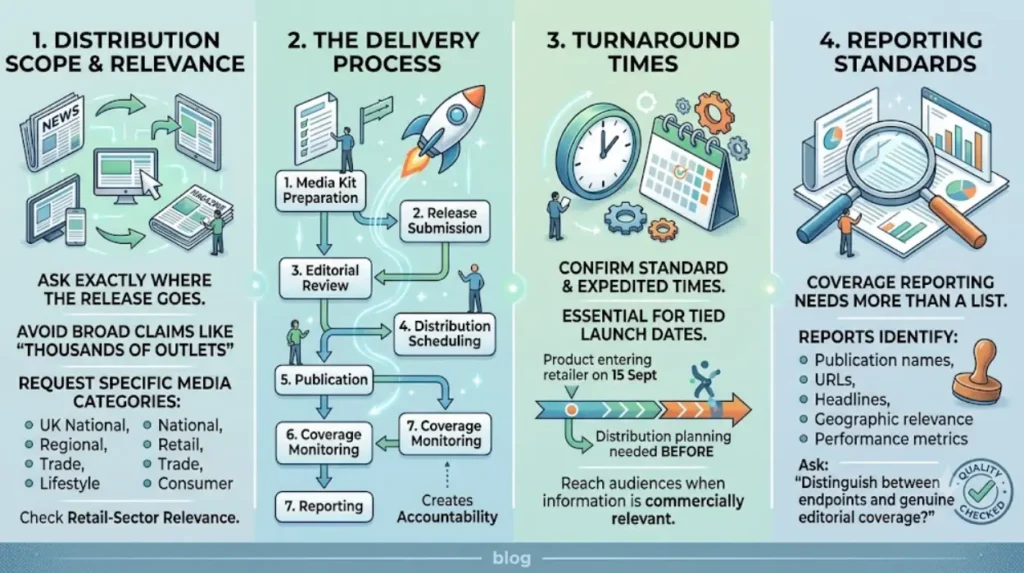
Before selecting a retail wire, check its UK media coverage, retail-sector relevance, distribution process, turnaround time, media asset support, reporting standards, search visibility, pricing structure, and customer support. Compare these criteria against the partnership announcement.
Distribution scope
Ask exactly where the release is distributed.
A provider needs to identify its distribution categories rather than rely on broad claims such as “thousands of media outlets”.
Request details covering UK national, regional, retail, trade, lifestyle, and consumer channels.
Delivery process
Establish how a release moves from submission to publication.
A clear process includes:
- Media kit preparation
- Release submission
- Editorial review
- Distribution scheduling
- Publication
- Coverage monitoring
- Reporting
This process creates accountability between the brand and distribution provider.
Turnaround time
Confirm standard and expedited turnaround times.
A consumer partnership tied to a fixed retailer launch date requires predictable scheduling.
For example, a product entering a retailer on 15 September requires distribution planning before the retail availability date. The announcement needs to reach media audiences when the information remains commercially relevant.
Reporting
Coverage reporting needs more than a publication list.
A useful report identifies publication names, URLs, publication dates, headline information, geographic relevance, and available performance metrics.
Ask whether reports distinguish between distribution endpoints and genuine editorial coverage.
How does a media kit affect retail wire performance?
A complete media kit improves distribution accuracy because editors and publishers receive consistent information, usable imagery, verified product details, executive quotes, and contact information without requiring additional clarification before assessing the announcement.
The media kit provides the supporting material behind the release.
A journalist reviewing a new retail partnership needs immediate access to the facts.
A weak media kit creates information gaps. Missing product images, incomplete company descriptions, unclear launch dates, and absent contact details reduce usability.
Create a fact sheet
The fact sheet provides a concise reference for the partnership.
Include:
- Partnership name
- Retailer name
- Product names
- Availability date
- Locations
- Pricing
- Product URLs
- Company information
- Media contact
Prepare retailer information
Retail partnerships require accurate retailer naming.
Check the official retailer name, store availability, online availability, launch date, and relevant product categories.
Do not use informal retailer descriptions when the official corporate or trading name is available.
Prepare approved quotes
Approve executive and partner quotes before distribution.
This reduces last-minute amendments and maintains consistency across the release and media kit.
How do you compare retail wire providers before signing?
Compare retail wire providers using the same criteria and request identical information from each provider. Score distribution relevance, UK reach, retail categories, turnaround, reporting, asset support, pricing, and account management before making a final selection.
A comparison framework creates a consistent procurement process.
| Selection criterion | What to verify |
|---|---|
| UK reach | National, regional, and local distribution |
| Retail relevance | Retail and consumer publication categories |
| Trade coverage | Relevant specialist publications |
| Turnaround | Standard publication schedule |
| Media kit support | Images, links, company information |
| Reporting | Publication and coverage data |
| Search visibility | Online publication and indexing features |
| Pricing | Distribution fees and additional charges |
| Account support | Submission and campaign assistance |
| Campaign flexibility | Scheduling and distribution options |
Price needs to be assessed against the actual distribution requirement.
A £300 distribution package with limited retail relevance does not provide the same service as a £500 package with targeted UK retail, consumer, and trade distribution. The decision depends on campaign objectives and measurable requirements.
What questions should a consumer brand ask a retail wire provider?
Ask the provider where the release distributes, which UK retail categories it covers, how quickly it publishes, what reporting it provides, how media assets are handled, what additional fees apply, and how distribution results are verified.
Use these questions during provider evaluation:
Media reach
- Which UK retail publications receive releases?
- Which consumer categories are covered?
- Does distribution include regional UK media?
- Are trade publications included?
- How is the distribution network maintained?
Campaign execution
- What is the standard turnaround?
- Can distribution be scheduled for a specific date?
- What editorial checks occur?
- How are corrections handled?
- Who manages the campaign after submission?
Reporting
- What does the final report contain?
- Are publication URLs included?
- Are publication dates included?
- Are estimated reach figures explained?
- Does the report separate distribution from editorial pickup?
Commercial terms
- What is included in the quoted price?
- Are images included?
- Are additional distribution categories charged separately?
- Are revisions charged separately?
- Are expedited services charged separately?
These questions expose differences between providers that appear similar at first review.
When is a retail wire the right distribution choice?
A retail wire is appropriate when a consumer brand needs structured media distribution for a retail launch, product partnership, store expansion, commercial milestone, seasonal campaign, or other announcement requiring targeted UK retail and consumer media visibility.
A retail wire works particularly well for announcements with a clear news event.
Examples include a beauty brand entering a national retailer, a food company launching a supermarket partnership, a fashion label opening new retail locations, or a consumer technology brand securing a major retail listing.
The release needs a defined news angle.
“Brand launches new product” provides limited commercial context.
“UK skincare brand enters 120 retail stores following product expansion” provides a clearer retail development.
The second example identifies the company category, market, commercial development, and scale.
How can a retail wire support a new consumer brand partnership?
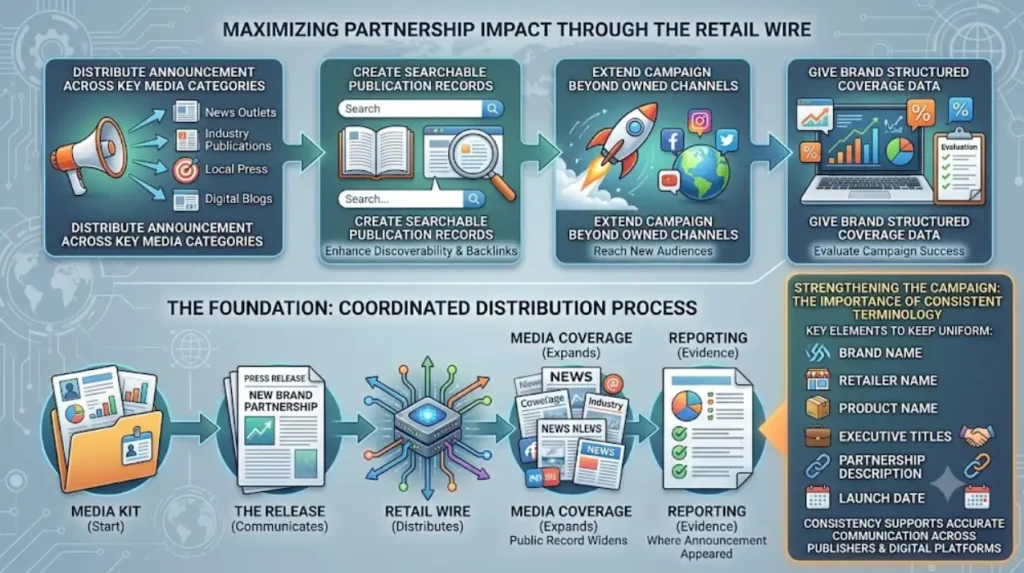
A retail wire supports a new consumer partnership by distributing the announcement across relevant media categories, creating searchable publication records, extending the campaign beyond owned channels, and giving the brand structured coverage data for campaign evaluation.
The value comes from coordinated distribution.
A partnership announcement starts with the media kit. The release communicates the news. The retail wire distributes it. Media coverage expands the public record. Reporting provides evidence of where the announcement appeared.
This structure supports broader media visibility across the partnership lifecycle.
The campaign also benefits from consistent terminology.
Use the same brand name, retailer name, product name, executive titles, partnership description, and launch date throughout the release and media kit.
Consistency supports accurate communication across publishers and digital platforms.
Explore More Expert Insights:
Enterprise Retail PR: Evaluating Time Intelligence Media Group vs. Generic Wire Solutions
ROI Case Study: How Time Intelligence Media Group Saved an Underperforming Product Launch
How should you make the final retail wire decision?
Select the retail wire that provides the strongest documented fit between your consumer brand, partnership announcement, target UK media categories, campaign timing, media kit requirements, reporting needs, and budget. Base the decision on verified distribution criteria.
Start with the announcement objective.
Define the target audience.
Identify the relevant media categories.
Audit the media kit.
Compare distribution providers.
Confirm pricing and turnaround.
Review reporting requirements.
Then select the provider that matches the campaign specification.
For new consumer brands, the most important selection factor is relevance. A distribution network needs to reach the media environments connected to the announcement.
A retail partnership also requires precise timing. Brands planning distribution around major shopping periods can use:
Custom PR Distribution to align publication dates with commercial activity.
For brands already evaluating distribution providers, a detailed:
Press Distribution Strategy assessment provides the next decision point: coverage, reach, reporting, timing, and commercial fit.
The final media kit needs to be complete before submission. The release needs verified facts. The distribution schedule needs a fixed date. The reporting requirements need agreement before publication.
This process turns retail wire selection into a measurable media procurement decision rather than a simple distribution purchase.