
Public confidence changes quickly during a crisis. A delayed or inconsistent response increases uncertainty, attracts media scrutiny, and weakens stakeholder trust. A structured crisis communication framework provides a repeatable process for issuing accurate statements quickly while maintaining legal, regulatory, and reputational standards.
For organisations operating in regulated sectors such as financial technology, banking, cryptocurrency, healthcare, and public services, rapid communication protects credibility alongside operational recovery. This article explains how crisis communication frameworks work, what they include, and how organisations use them to restore confidence after disruptive events.
What is a crisis communication framework?
A crisis communication framework is a structured process that defines how an organisation prepares, approves, delivers, and updates public statements during disruptive events. It establishes responsibilities, communication channels, approval workflows, and messaging standards that enable consistent communication within minutes instead of days.
A crisis communication framework is a documented operational system. It guides executives, legal teams, communications professionals, customer support teams, and technical specialists through predefined communication procedures.
The framework focuses on speed without sacrificing accuracy.
Core objectives of a crisis communication framework
A complete framework aims to:
- Deliver verified information quickly.
- Reduce misinformation.
- Maintain regulatory compliance.
- Protect organisational credibility.
- Support customers and stakeholders.
- Coordinate internal and external messaging.
For example, a UK FinTech platform experiencing payment disruptions communicates simultaneously with customers, regulators, employees, investors, and journalists using approved messaging developed before the incident.
Why does rapid communication rebuild public confidence?
Rapid communication demonstrates organisational control, transparency, and accountability. Early factual updates reduce speculation, answer immediate stakeholder concerns, and establish an authoritative information source. Consistent communication throughout the incident reinforces trust while preventing conflicting narratives from dominating public discussion across multiple media channels.
Silence creates information gaps. Those gaps become filled by rumours, social media speculation, or inaccurate reporting.
Rapid statements achieve several objectives immediately.
They acknowledge the incident
Acknowledgement confirms awareness.
Example:
- Payment platform outage
- Cryptocurrency exchange security investigation
- Banking service interruption
Customers know the organisation recognises the problem.
They confirm active response
A statement explains that investigation and response activities have started.
This demonstrates operational control.
They establish an official source
Stakeholders know where future updates will appear.
This reduces dependence on unofficial sources.
Readers seeking broader context on crisis-related reputation management can also explor:
What components form an effective crisis communication framework?
An effective framework combines governance, predefined messaging, stakeholder mapping, approval procedures, monitoring systems, spokesperson guidance, communication channels, and continuous review processes. Each component supports rapid, accurate, and legally compliant communication throughout every phase of incident management and organisational recovery.
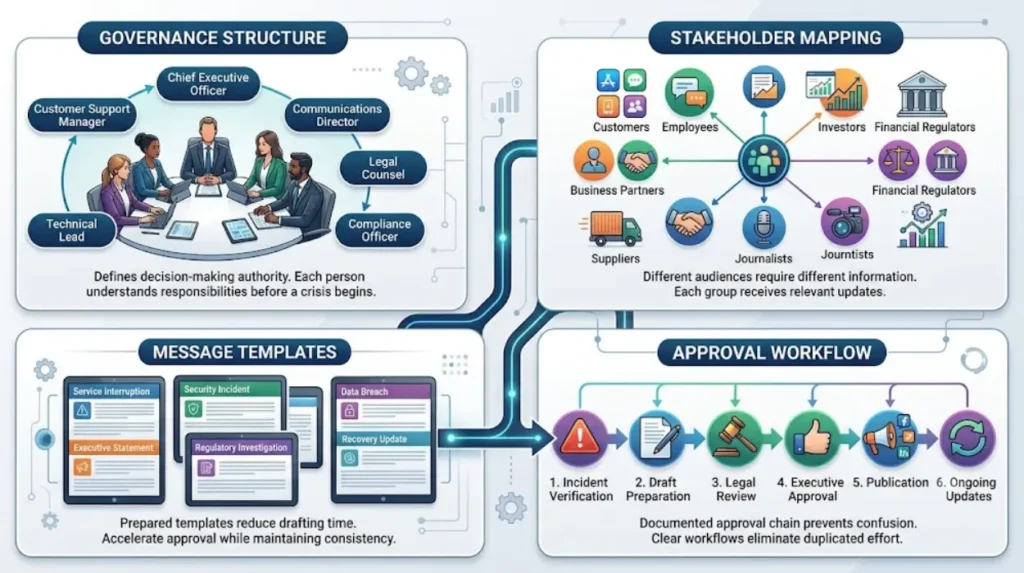
Every framework contains operational building blocks.
Governance structure
Governance defines decision-making authority.
Typical roles include:
- Chief Executive Officer
- Communications Director
- Legal Counsel
- Compliance Officer
- Technical Lead
- Customer Support Manager
Each person understands responsibilities before a crisis begins.
Stakeholder mapping
Different audiences require different information.
Examples include:
- Customers
- Employees
- Investors
- Financial regulators
- Business partners
- Journalists
- Suppliers
Each group receives relevant updates.
Message templates
Prepared templates reduce drafting time.
Templates commonly cover:
- Service interruption
- Security incident
- Data breach
- Executive statement
- Regulatory investigation
- Recovery update
Templates accelerate approval while maintaining consistency.
Approval workflow
A documented approval chain prevents confusion.
Typical workflow:
- Incident verification
- Draft preparation
- Legal review
- Executive approval
- Publication
- Ongoing updates
Clear workflows eliminate duplicated effort.
How quickly should organisations issue their first public statement?
The first verified public statement belongs within the earliest practical stage after incident confirmation. The initial communication acknowledges the situation, confirms active investigation, outlines immediate actions, and commits to scheduled updates using verified facts without speculation or unsupported assumptions.
Speed depends on verified information.
Accuracy remains essential.
Information that belongs in the first statement
An initial announcement typically includes:
- Confirmation that an incident exists
- Time of detection
- Immediate operational response
- Customer impact, if confirmed
- Next scheduled update
- Official communication channels
Short statements communicate more effectively than lengthy explanations.
Information that does not belong
Avoid including:
- Unverified technical causes
- Estimated financial losses
- Blame allocation
- Unsupported recovery timelines
Facts strengthen credibility.
Speculation weakens confidence.
Which communication channels support effective crisis response?
Multiple communication channels ensure stakeholders receive timely updates regardless of where they obtain information. Coordinated publishing across websites, social platforms, customer notifications, media statements, investor communications, and regulatory reporting maintains message consistency throughout the crisis lifecycle and recovery process.
Organisations communicate through several coordinated platforms.
Corporate website
The website acts as the central information hub.
Every public update links back to it.
Press statements
Journalists rely on official releases for verified facts.
Structured press releases improve reporting accuracy.
Email updates
Customers receive direct operational information.
Examples include:
- Service restoration
- Security guidance
- Account updates
Social media
Social platforms distribute concise updates rapidly.
Every post links to detailed official information.
Internal communication
Employees require the same verified information.
Internal consistency reduces misinformation.
How do organisations maintain message consistency throughout a crisis?
Message consistency depends on centralised approvals, standard terminology, documented talking points, scheduled updates, and continuous coordination between communications, legal, technical, and executive teams. Every published statement reflects identical verified facts regardless of audience or communication platform used during the incident.
Consistency protects organisational credibility.
Contradictory statements create confusion.
Create a single source of truth
One approved document contains:
- Current facts
- Confirmed timelines
- Approved terminology
- Frequently asked questions
Every department references this information.
Schedule regular updates
Predictable communication reassures stakeholders.
Example schedule:
- Initial statement
- Two-hour operational update
- End-of-day summary
- Recovery announcement
Regular updates reduce uncertainty.
Train designated spokespersons
Only authorised representatives speak publicly.
Media interviews remain aligned with published statements.
How do crisis communication frameworks support regulated industries?
Regulated industries require communication processes that satisfy legal obligations alongside public transparency. Structured frameworks integrate compliance reviews, regulatory notifications, documented approvals, and evidence-based messaging while maintaining communication speed during operational disruption or reputational incidents affecting public confidence.
Highly regulated sectors operate under additional reporting obligations.
Examples include:
- Financial technology
- Cryptocurrency
- Banking
- Insurance
- Healthcare
These sectors balance transparency with legal compliance.
Regulatory coordination
Certain incidents require immediate regulator notification.
Public statements remain aligned with official regulatory communications.
Documentation
Every communication becomes part of the incident record.
Organisations document:
- Draft versions
- Approval timestamps
- Distribution records
- Published updates
This supports governance and post-incident review.
What mistakes reduce public confidence during crisis communication?
Delayed responses, inconsistent messaging, excessive technical language, inaccurate information, defensive statements, missing updates, and unclear accountability reduce stakeholder confidence. Structured communication frameworks minimise these risks by enforcing verified messaging, defined responsibilities, and scheduled communication throughout incident management and organisational recovery.
Several communication failures repeatedly appear during major incidents.
Delayed acknowledgement
Waiting too long encourages speculation.
Conflicting updates
Different departments publish different information.
Consistency disappears.
Technical complexity
Customers require practical information.
Highly technical explanations delay understanding.
Missing follow-up
One announcement is insufficient.
Stakeholders expect ongoing updates until normal operations resume.
Explore More Expert Insights:
Crafting an Authoritative Press Release Layout for Cross-Border Mergers and Restructuring
Maximizing Post-Launch Momentum: Turning Tokenomics PR into Long-Tail Search Traffic
How can organisations strengthen crisis communication before an incident occurs?

Preparation strengthens crisis communication through documented procedures, simulation exercises, media training, stakeholder planning, template development, monitoring systems, and periodic framework reviews. Organisations that rehearse communication processes respond faster, coordinate more effectively, and maintain stronger public confidence during disruptive events.
Preparation begins long before any crisis develops.
Conduct simulation exercises
Scenario testing identifies weaknesses.
Examples include:
- Payment network outage
- Cybersecurity incident
- Liquidity event
- Data exposure
- Executive resignation
Exercises improve response speed.
Prepare communication assets
Useful resources include:
- Approved statement templates
- Contact databases
- Media lists
- Internal escalation guides
- Frequently asked questions
Prepared resources reduce operational delays.
Review framework regularly
Business operations change continuously.
Communication frameworks require scheduled updates to remain accurate.
Organisations evaluating practical implementation approaches can also explore:
A crisis communication framework transforms emergency communication into a structured operational process. It replaces uncertainty with defined responsibilities, verified messaging, documented approvals, and coordinated distribution.
Rapid statements acknowledge incidents, reduce speculation, and establish trusted information sources. Consistent updates reinforce credibility throughout investigation and recovery. Strong governance, stakeholder mapping, message templates, approval workflows, and communication training create faster and more reliable responses.
For organisations operating in highly regulated sectors, effective crisis communication supports regulatory compliance while protecting reputation, customer confidence, investor trust, and long-term organisational resilience. A documented framework enables every response to remain accurate, timely, and consistent when public confidence matters most.