
Financial journalists receive hundreds of press releases every week. Most cover funding announcements, product launches, partnerships, executive appointments, market reports, and regulatory developments. Editors and reporters work under strict deadlines. They assess each release quickly and prioritise stories that deliver verified facts, clear public interest, and measurable business significance. Understanding this filtering process helps explain why only a small percentage of startup announcements receive editorial attention.
Why do financial journalists reject most startup pitch releases?
Financial journalists reject most startup pitch releases because they lack news value, credible evidence, verified data, relevant timing, or editorial relevance. Reporters assess every submission against strict editorial standards and remove announcements that fail basic reporting requirements within the first review process.
Most financial newsrooms receive several hundred emails every working day. A significant proportion comes from early-stage businesses introducing new products, funding rounds, partnerships, or expansion plans.
Journalists apply a rapid filtering process before reading every paragraph. The first assessment focuses on whether the story qualifies as news.
What qualifies as news?
A newsworthy announcement contains information that affects businesses, investors, customers, regulators, or markets.
Examples include:
- A completed Series A funding round worth £12 million.
- A merger between two regulated financial institutions.
- Approval from the Financial Conduct Authority.
- Publication of audited annual financial results.
- Expansion into three new regulated markets.
General marketing claims rarely pass this stage because they provide limited public value.
Why does credibility matter immediately?
Financial reporting depends on verified facts.
Journalists check whether statements include:
- Named executives
- Company registration details
- Official financial figures
- Regulatory references
- Supporting documentation
Anonymous claims reduce confidence in the information.
How do journalists decide whether a headline deserves attention?
Journalists review headlines first because they summarise the entire announcement in seconds. Headlines containing measurable facts, clear business developments, and identifiable entities receive more attention than promotional statements or vague marketing language without supporting evidence or context.
A financial journalist spends only a few seconds deciding whether to continue reading.
The headline performs one task: explain the news immediately.
Which headlines attract editorial interest?
Strong financial headlines include:
- Verified funding amounts
- Company names
- Geographic markets
- Regulatory approvals
- Acquisition announcements
Example:
“London fintech secures £18 million Series B investment.”
The headline identifies the sector, location, and measurable event.
Which headlines are ignored?
Marketing-driven headlines often fail because they describe opinions rather than events.
Examples include:
- Revolutionary financial platform launches.
- Changing the future of payments.
- The next generation of banking technology.
These statements contain no verifiable information.
What information do journalists examine after the headline?
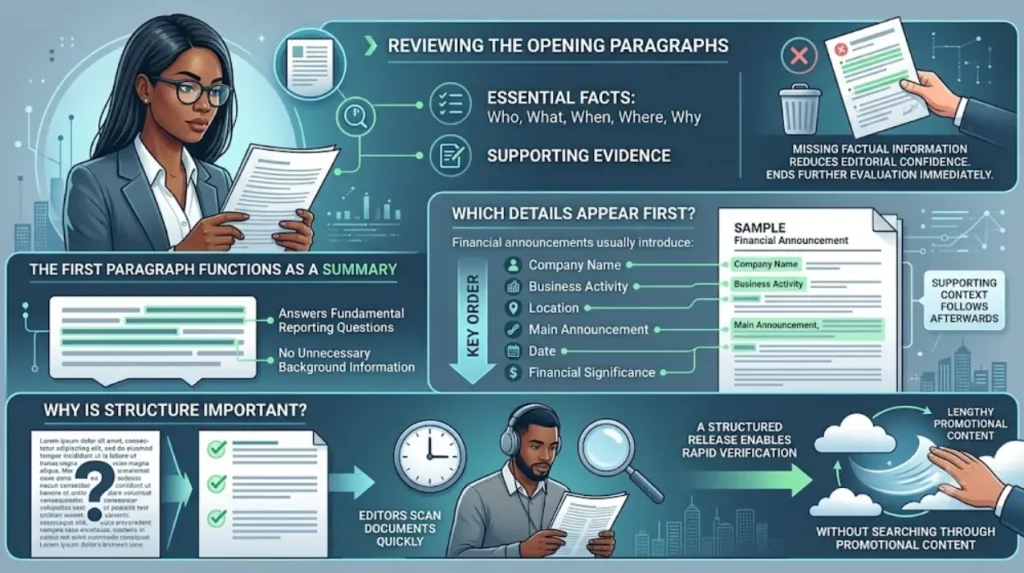
After reading the headline, journalists review the opening paragraphs for essential facts including who, what, when, where, why, and supporting evidence. Missing factual information reduces editorial confidence and frequently ends further evaluation of the announcement immediately.
The first paragraph functions as a summary.
It answers the fundamental reporting questions without unnecessary background information.
Which details appear first?
Financial announcements usually introduce:
- Company name
- Business activity
- Location
- Main announcement
- Date
- Financial significance
Supporting context follows afterwards.
Why is structure important?
Editors scan documents quickly.
A structured release enables rapid verification without searching through lengthy promotional content.
Readers interested in developing stronger announcement structures can explore:
Crafting an Authoritative Press Release Layout.
Why does evidence influence editorial decisions?
Evidence determines whether journalists trust the information presented. Verified financial figures, regulatory documentation, official statements, independent sources, and supporting records strengthen credibility and reduce the time required for editorial fact-checking before publication decisions are made.
Financial journalism relies on verification rather than opinion.
Every factual statement requires evidence.
Which forms of evidence strengthen a release?
Common supporting material includes:
- Audited financial statements
- Regulatory filings
- Investment agreements
- Court documents
- Government records
- Official market statistics
For example, a completed acquisition announcement becomes stronger when supported by Companies House filings and transaction values.
What weakens credibility?
Unverified statements reduce confidence.
Examples include:
- Market-leading solution
- Fastest-growing company
- Industry-changing innovation
Without measurable evidence, these claims receive limited editorial value.
How does timing affect whether a pitch receives coverage?
Timing influences editorial decisions because financial news competes with major economic events, government announcements, earnings reports, and market developments. Well-timed releases align with newsroom schedules instead of competing directly with nationally significant financial stories and events.
Financial journalists monitor continuous news cycles.
Breaking economic developments immediately change editorial priorities.
Which events dominate financial coverage?
Examples include:
- Bank of England interest rate announcements
- National Budget statements
- Inflation statistics
- Employment figures
- Major corporate earnings
These events receive priority because they influence wider markets.
When does poor timing reduce visibility?
Announcements released during significant national financial events often receive limited attention because newsroom resources focus elsewhere.
What role does relevance play in editorial selection?
Editorial relevance measures whether information matters to the publication’s audience. Journalists compare every announcement against reader interests, publication focus, geographic coverage, and sector priorities before allocating reporting resources to individual startup stories and developments.
Every financial publication serves a defined audience.
Coverage reflects that audience consistently.
How do publications define relevance?
Business publications often specialise in areas such as:
- Banking
- Insurance
- Asset management
- Technology
- Venture capital
- Cryptocurrency
A fintech funding announcement suits financial publications more than general lifestyle publications.
Why does audience alignment matter?
Editors prioritise information that directly benefits their readers.
Sector relevance increases editorial value.
Which common mistakes prevent startup releases from receiving attention?
Startup releases frequently fail because they contain promotional language, unsupported claims, incomplete financial information, unclear headlines, excessive length, and insufficient verification. These weaknesses increase editorial workload and reduce the likelihood of further investigation or publication consideration.
Several recurring issues appear across unsuccessful submissions.
Promotional writing
Journalists report facts.
Advertising language does not support factual reporting.
Missing numbers
Financial reporting requires measurable information.
Examples include:
- Revenue
- Investment values
- Employee numbers
- Market size
- Transaction value
Excessive length
Long introductions delay important information.
Editors prefer concise factual summaries.
Weak quotations
Executive quotations often repeat information already stated.
Effective quotations add explanation rather than repetition.
How do journalists verify claims before publishing?

Verification protects editorial accuracy and publication credibility. Journalists compare statements against official records, regulatory databases, company filings, public documents, and independent sources before confirming that reported information meets professional reporting standards and legal requirements for publication.
Fact-checking forms an essential stage of financial journalism.
Verification reduces reporting errors.
Which sources support verification?
Examples include:
- Companies House
- Financial Conduct Authority registers
- London Stock Exchange announcements
- Government publications
- Annual reports
Independent verification strengthens reporting accuracy.
Why are official records important?
Official records provide objective evidence.
They establish whether financial claims match publicly available information.
Explore More Expert Insights:
Why Continuous Media PR is Essential for Struggling Startups Sustaining Investor Relations
How Emerging Crypto Brands Build Institutional Trust in Highly Volatile Markets
How can startups understand the editorial filtering process?
Understanding editorial filtering helps startups recognise how financial reporting operates. Journalists prioritise verified facts, measurable developments, public relevance, and efficient information presentation while applying consistent reporting standards across every incoming financial announcement and business submission received daily.
The editorial process follows repeatable steps.
Each stage removes announcements that fail basic reporting standards.
Typical newsroom evaluation sequence
- Read the headline.
- Assess immediate news value.
- Review the opening paragraph.
- Verify factual information.
- Check supporting evidence.
- Confirm relevance to readers.
- Decide whether further reporting is justified.
Every stage focuses on factual accuracy rather than promotional messaging.
Readers seeking a deeper understanding of professional distribution channels can later explore:
Exclusive Business and Crypto Syndication Networks after learning the editorial principles discussed in this educational guide.
Financial journalists filter hundreds of startup pitch releases by applying consistent editorial standards. They evaluate news value, headline quality, factual structure, supporting evidence, timing, audience relevance, and verification before considering publication. Every assessment focuses on factual reporting rather than promotional messaging. Understanding these editorial processes explains why verified business developments receive greater media attention than unsupported marketing claims and provides a clearer picture of how financial reporting operates within UK newsrooms.