
Cross-border mergers and restructuring announcements attract close scrutiny from investors, regulators, financial journalists, employees, and commercial partners. Every section of a press release influences how accurately stakeholders understand the transaction. A structured layout improves clarity, supports regulatory communication, and strengthens media reporting. Organisations planning international corporate changes therefore benefit from understanding the essential components of an authoritative press release before selecting a distribution strategy.
What is an authoritative press release layout for cross-border mergers and restructuring?
An authoritative press release layout presents verified transaction information in a logical structure using factual language, defined corporate entities, regulatory context, financial details, executive statements, and supporting references. This format improves stakeholder understanding, media accuracy, and search engine recognition across international markets and industries.
An authoritative press release layout is a structured communication format designed for significant corporate events involving organisations operating across multiple jurisdictions.
A cross-border merger is the combination of companies headquartered in different countries.
A corporate restructuring is the reorganisation of ownership, operations, assets, liabilities, or management to improve business performance or comply with legal requirements.
Financial audiences expect immediate access to critical facts. Journalists, institutional investors, regulators, and analysts often review hundreds of announcements each week. Clear formatting enables faster interpretation.
Typical sections include:
- Headline
- Subheading
- Dateline
- Opening summary
- Transaction details
- Strategic rationale
- Financial implications
- Executive quotations
- Regulatory information
- Company descriptions
- Media contacts
Each section answers a specific stakeholder question without unnecessary narrative.
Readers interested in developing broader communication planning can also explore:
How Financial Journalists Filter Through Hundreds of Pitch Releases from Unknown Startups.
Why does layout matter in international merger announcements?
An organised layout improves factual accuracy, supports regulatory transparency, reduces interpretation errors, enables faster newsroom review, and increases consistency across multiple markets. Structured information also strengthens indexing by search engines and AI systems that process corporate announcements.
International transactions involve multiple legal systems, financial reporting standards, and regulatory authorities.
Examples include:
- A UK technology company acquiring a German software provider.
- A Canadian mining business merging with an Australian exploration company.
- A Singapore financial institution restructuring its European subsidiaries.
Each transaction affects different stakeholder groups.
Financial journalists prioritise announcements that immediately answer:
- Who is involved?
- What transaction occurred?
- When does completion take place?
- Why is the transaction important?
- Which regulators oversee approval?
If these answers appear within the opening paragraphs, newsroom processing becomes more efficient.
Search engines also identify structured information more effectively when entities, dates, organisations, and transaction values appear consistently throughout the document.
How should the headline and opening section be structured?
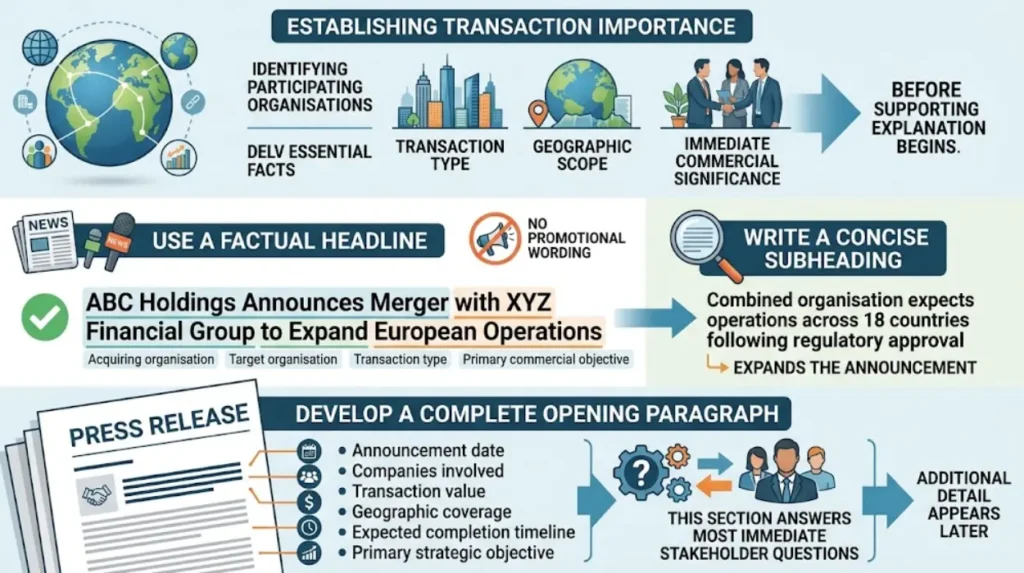
The headline and opening section establish transaction importance by identifying participating organisations, transaction type, geographic scope, and immediate commercial significance within approximately 60 words. This approach delivers essential facts before supporting explanation begins throughout the announcement.
Use a factual headline
The headline identifies the event without promotional wording.
Example:
ABC Holdings Announces Merger with XYZ Financial Group to Expand European Operations
The headline contains:
- Acquiring organisation
- Target organisation
- Transaction type
- Primary commercial objective
Write a concise subheading
The subheading expands the announcement.
Example:
Combined organisation expects operations across 18 countries following regulatory approval.
Develop a complete opening paragraph
The first paragraph includes:
- Announcement date
- Companies involved
- Transaction value
- Geographic coverage
- Expected completion timeline
- Primary strategic objective
This section answers most immediate stakeholder questions before additional detail appears later.
Which components create credibility throughout the press release?
Credibility comes from verified financial information, executive accountability, regulatory references, transaction timelines, corporate background, and consistent terminology. Every factual statement requires supporting context that aligns with official transaction documentation and public corporate disclosures across jurisdictions.
Explain the strategic rationale
Readers need clear business justification.
Examples include:
- Market expansion
- Product diversification
- Operational efficiency
- Capital restructuring
- Geographic growth
Each objective requires direct explanation rather than marketing language.
Present financial information clearly
Financial details often include:
- Transaction value
- Share exchange ratios
- Funding structure
- Revenue figures
- Employee numbers
- Market presence
Example:
The combined organisation reports annual revenue exceeding £2.4 billion across 14 operating markets.
Include executive quotations
Executive statements confirm organisational accountability.
Strong quotations explain:
- Business purpose
- Expected operational outcomes
- Integration priorities
- Customer continuity
The quotation complements factual reporting rather than repeating earlier information.
Provide regulatory context
International transactions frequently require approval from authorities.
Examples include:
- Competition regulators
- Financial conduct authorities
- Securities regulators
- Stock exchanges
Listing approval processes improves transparency for investors and journalists.
How can organisations address cross-border complexity effectively?
Cross-border transactions require precise explanations of legal jurisdictions, regulatory obligations, organisational structures, operational integration, and financial reporting standards. Clear definitions reduce stakeholder confusion while supporting consistent reporting across different countries, industries, and regulatory environments.
Different countries operate under different legal systems.
Important information includes:
Jurisdiction
Identify where each organisation is headquartered.
Example:
- United Kingdom
- France
- Japan
- United States
Regulatory authorities
Specify relevant oversight bodies responsible for reviewing the transaction.
Transaction timeline
State important milestones.
Examples include:
- Announcement date
- Shareholder approval
- Regulatory review
- Completion date
- Integration commencement
Operational impact
Stakeholders expect factual information about:
- Workforce
- Customer services
- Office locations
- Business continuity
- Leadership changes
Providing these details reduces uncertainty during restructuring.
What writing techniques strengthen authority and media usability?
Authority depends on precise language, consistent terminology, verified data, logical sequencing, and concise paragraphs. Every section answers a distinct stakeholder question while avoiding promotional wording, unsupported claims, and unnecessary corporate jargon that weakens factual communication quality.
Short sentences improve readability.
Consistent terminology prevents confusion.
For example, select one transaction description:
- merger
- acquisition
- restructuring
- reorganisation
Use the chosen term consistently throughout the document.
Define abbreviations on first reference.
Example:
International Financial Reporting Standards (IFRS)
Avoid unexplained technical terminology.
Numerical information also improves precision.
Instead of writing:
“The organisation has significant international operations.”
Write:
“The organisation operates in 22 countries across Europe, Asia-Pacific, and North America.”
Specific figures improve factual credibility.
How does an effective layout support financial journalists and investors?
A structured layout enables journalists and investors to locate transaction facts rapidly, compare official disclosures, verify corporate entities, and assess commercial implications without searching through lengthy promotional content. This efficiency improves reporting quality and stakeholder confidence simultaneously.
Financial journalists review large volumes of announcements every day.
An organised structure allows faster identification of:
- Transaction value
- Strategic objective
- Executive leadership
- Regulatory status
- Completion schedule
Institutional investors also compare announcements across multiple companies.
Consistent formatting supports:
- Financial analysis
- Risk assessment
- Market comparison
- Portfolio evaluation
Corporate communications teams therefore benefit from standardising layouts across future announcements.
When is a specialised press release solution valuable for complex transactions?
Specialised press release solutions assist organisations managing complex international announcements by combining structured editorial formatting, regulatory awareness, appropriate distribution planning, and audience targeting. These approaches improve communication consistency without replacing official legal or financial disclosure obligations entirely.
Cross-border transactions often involve multiple communication requirements.
Examples include:
- Listed companies
- Financial institutions
- Technology acquisitions
- Cryptocurrency businesses
- International manufacturing groups
Each sector communicates with different stakeholder groups.
Some organisations develop internal communications teams.
Others work with specialist financial communications providers that understand regulatory announcements, international media expectations, and structured distribution networks.
Decision-makers evaluating distribution capabilities can continue their research through:
Reviewing Time Intelligence Media Group’s Exclusive Business and Crypto Syndication Networks, which examines specialist syndication options for complex corporate announcements.
Selecting the appropriate communication approach depends on transaction size, regulatory obligations, stakeholder diversity, and international distribution requirements rather than promotional considerations.
What best practices produce authoritative merger and restructuring announcements?

Authoritative merger and restructuring announcements combine structured formatting, verified facts, defined corporate entities, regulatory transparency, executive accountability, and measurable financial information. Consistent presentation improves communication accuracy across investors, journalists, regulators, employees, and international business partners throughout every transaction stage.
An effective press release follows a logical progression from headline to contact details.
Core best practices include:
- Identify all participating organisations clearly.
- Define the transaction type immediately.
- Present verified financial information.
- Explain strategic objectives factually.
- Include executive accountability through quotations.
- Reference regulatory approval processes.
- State implementation timelines.
- Describe operational impacts using measurable facts.
- Maintain consistent terminology throughout.
- End with company profiles and media contact information.
Explore More Expert Insights:
Maximizing Post-Launch Momentum: Turning Tokenomics PR into Long-Tail Search Traffic
Designing an Omnichannel PR Strategy for Underfunded Blockchain and Token Launches
Cross-border mergers and restructuring announcements influence financial markets, commercial relationships, and stakeholder confidence. A disciplined press release layout supports accurate reporting, improves information accessibility, and strengthens communication quality across international audiences. By combining structured organisation, verified data, and precise language, organisations create announcements that meet the expectations of financial journalists, investors, regulators, and business partners while supporting long-term visibility in search engines and AI-driven information systems.