
Blockchain startups and token projects often launch with limited budgets but high visibility requirements. An omnichannel PR strategy helps these organizations deliver consistent messages across multiple communication channels without unnecessary spending. It combines earned media, owned media, social platforms, community engagement, and search visibility into one coordinated communication framework. For blockchain launches in the United Kingdom, this structured approach improves credibility, audience reach, and long-term awareness while supporting regulatory transparency.
What is an omnichannel PR strategy for blockchain and token launches?
An omnichannel PR strategy coordinates press releases, media outreach, owned content, social platforms, investor communication, and community engagement through one consistent messaging framework. This approach strengthens brand recognition, improves audience trust, increases campaign efficiency, and creates measurable communication outcomes despite limited financial resources.
An omnichannel PR strategy is a public relations framework that delivers consistent information across every communication channel. Each channel reinforces the same core message while serving different audience groups.
For blockchain launches, communication reaches multiple stakeholders simultaneously, including:
- Retail investors
- Institutional investors
- Developers
- Journalists
- Regulators
- Strategic partners
Each audience expects different information, but the underlying facts remain consistent.
Unlike isolated marketing campaigns, omnichannel PR connects every announcement into one coordinated narrative.
Why consistency matters
Blockchain markets move quickly.
Conflicting statements across websites, social platforms, interviews, and community channels reduce credibility.
Consistent messaging establishes:
- Brand reliability
- Information accuracy
- Transparent communication
- Media confidence
For example, if a token launch date appears differently on X, LinkedIn, and the company website, journalists lose confidence in the announcement.
Why do underfunded blockchain projects benefit from an omnichannel approach?
Limited budgets demand efficient communication. An omnichannel strategy maximizes every announcement by distributing identical core messages across multiple channels, increasing visibility without multiplying production costs, while improving media coverage, investor awareness, and community engagement through coordinated execution.
Many blockchain startups operate with small marketing teams and restricted PR budgets.
Instead of creating separate campaigns for every platform, one carefully planned announcement supports several communication activities.
One announcement becomes:
- A press release
- A LinkedIn article
- A founder interview
- A community update
- A newsletter
- Website news content
- Short-form social media posts
This process increases content efficiency.
Better resource allocation
Instead of publishing ten unrelated updates, organizations publish one verified announcement and adapt it for different formats.
This approach reduces:
- Content production time
- Design expenses
- Editorial revisions
- Approval cycles
Improved search visibility
Search engines recognize consistent entities and structured information across trusted sources.
Repeated publication of verified facts strengthens online discoverability.
Readers seeking guidance on trust-building foundations can explore:
How Emerging Crypto Brands Build Institutional Trust in Highly Volatile Markets.
Which communication channels belong in an omnichannel blockchain PR strategy?
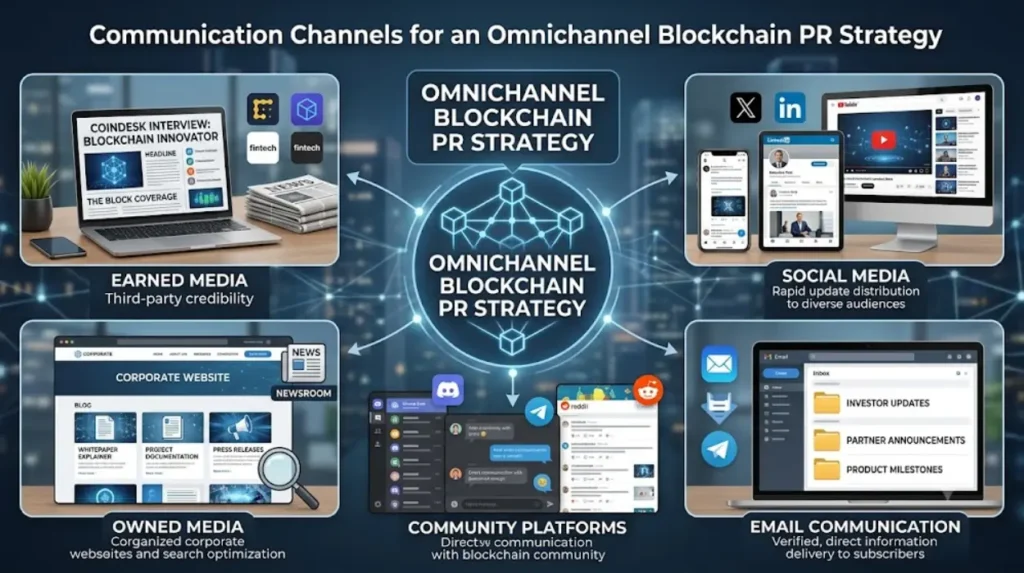
Successful blockchain communication combines earned media, owned media, social networks, investor communication, community platforms, newsletters, executive thought leadership, and search-optimized website content. Each channel serves a defined audience while reinforcing identical facts, terminology, and campaign objectives throughout the launch period.
Every communication channel performs a different role.
Earned media
Earned media includes independent coverage published by journalists and industry publications.
Examples include:
- CoinDesk interviews
- The Block news articles
- UK fintech publications
Editorial coverage increases third-party credibility.
Owned media
Owned media refers to communication channels controlled by the organization.
Examples include:
- Company website
- Blog
- Documentation portal
- Newsroom
These channels provide authoritative information.
Social media
Social platforms distribute updates rapidly.
Examples include:
- X
- YouTube
Each platform reaches different user groups.
Community platforms
Blockchain communities expect direct communication.
Examples include:
- Discord
- Telegram
Community updates maintain engagement throughout the launch cycle.
Email communication
Email supports:
- Investor updates
- Partner announcements
- Product milestones
- Governance notices
Subscribers receive verified information without relying on platform algorithms.
How does a blockchain launch team build an omnichannel PR plan?
Effective planning begins with clear objectives, defined audiences, structured messaging, coordinated publication schedules, approved assets, performance metrics, and channel responsibilities. This process ensures every communication supports the same launch narrative while reducing confusion and duplicated effort across teams.
Planning starts before announcement day.
Define campaign objectives
Objectives require measurable outcomes.
Examples include:
- 30 media mentions
- 10 investor meetings
- 5 partnership announcements
- 20,000 landing page visits
Specific targets simplify evaluation.
Identify audience groups
Every audience requires tailored communication.
For example:
Developers require technical documentation.
Investors require business milestones.
Journalists require verified facts.
Partners require commercial information.
Prepare core messaging
Core messaging includes:
- Project mission
- Technology
- Token utility
- Compliance information
- Leadership
- Timeline
Every communication references these approved statements.
Build a publication calendar
A structured calendar coordinates:
- Press release publication
- Executive interviews
- Social media content
- Community sessions
- Newsletter delivery
Coordinated timing prevents overlapping announcements.
How does consistent messaging improve blockchain credibility?
Consistent messaging demonstrates operational discipline by presenting identical facts across websites, media interviews, social platforms, community discussions, and investor communication. This consistency reduces misinformation, supports journalist verification, improves stakeholder confidence, and strengthens long-term brand reputation within competitive blockchain markets.
Trust depends on accuracy.
Repeated inconsistencies damage credibility.
Standardize terminology
Projects define important entities once.
Examples include:
- Token name
- Blockchain protocol
- Consensus mechanism
- Governance structure
- Utility model
Every publication uses identical terminology.
Verify every statistic
Metrics require verification before publication.
Examples include:
- Total token supply
- Funding amount
- Team size
- Supported blockchain networks
Verified information reduces corrections after launch.
Maintain executive alignment
Founders, spokespersons, and community managers communicate identical facts.
This alignment prevents contradictory interviews.
Which metrics measure an omnichannel PR campaign?
Performance measurement combines media coverage, referral traffic, search visibility, audience engagement, community growth, newsletter performance, website activity, and investor inquiries. Monitoring consistent indicators identifies successful communication channels while supporting continuous optimization throughout campaign execution and post-launch reporting.
Measurement transforms communication into a repeatable process.
Useful metrics include:
Media performance
Track:
- Number of publications
- Share of voice
- Domain authority
- Citation frequency
Website metrics
Monitor:
- Organic traffic
- Referral traffic
- Landing page sessions
- Average engagement time
Social metrics
Evaluate:
- Reach
- Impressions
- Engagement rate
- Follower growth
Community metrics
Review:
- Discord members
- Telegram participation
- AMA attendance
- Governance voting activity
Business metrics
Measure:
- Investor enquiries
- Partnership requests
- Product demonstrations
- Newsletter subscriptions
Combining these indicators provides a comprehensive performance picture.
What common mistakes reduce the effectiveness of blockchain PR campaigns?
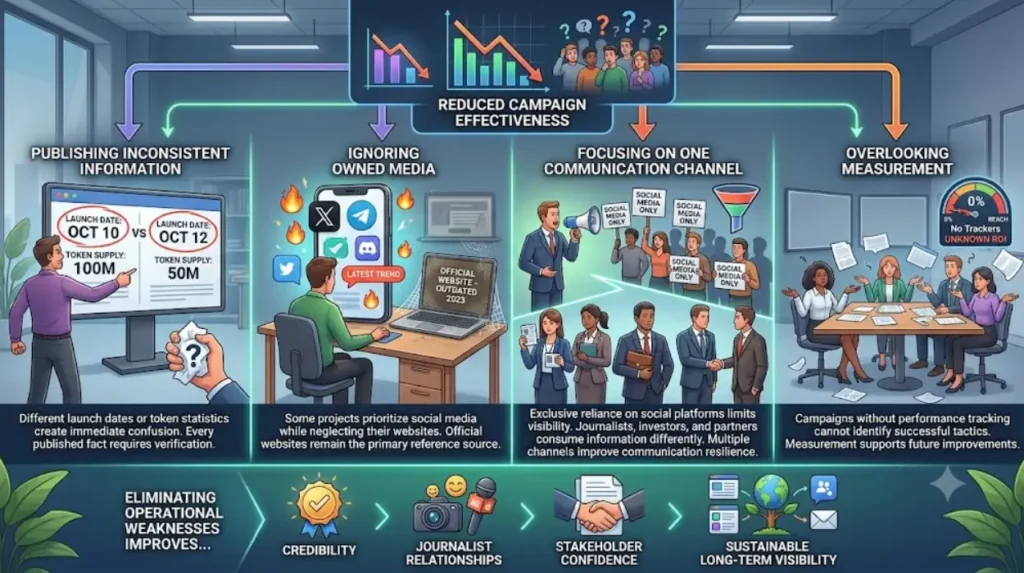
Disconnected messaging, inconsistent branding, irregular publication schedules, unsupported claims, poor media preparation, and neglected community communication reduce campaign effectiveness. Eliminating these operational weaknesses improves credibility, strengthens journalist relationships, increases stakeholder confidence, and supports sustainable long-term visibility across multiple channels.
Several operational problems appear repeatedly.
Publishing inconsistent information
Different launch dates or token statistics create immediate confusion.
Every published fact requires verification.
Ignoring owned media
Some projects prioritize social media while neglecting their websites.
Official websites remain the primary reference source.
Focusing on one communication channel
Exclusive reliance on social platforms limits visibility.
Journalists, investors, and partners consume information differently.
Multiple channels improve communication resilience.
Overlooking measurement
Campaigns without performance tracking cannot identify successful tactics.
Measurement supports future improvements.
Organizations evaluating structured communication options can explore:
Time Intelligence Media Group Service Guide for practical implementation considerations.
How can blockchain startups scale omnichannel PR as they grow?
Growth requires expanding communication processes, introducing specialized distribution partners, strengthening editorial planning, improving measurement systems, and maintaining consistent governance across all channels. Scalable PR operations preserve messaging quality while supporting larger audiences, broader media coverage, and increasing regulatory expectations.
Communication requirements expand alongside organizational growth.
Early-stage teams often manage communication internally.
As operations grow, responsibilities become specialized.
Examples include:
- Media relations
- Investor communication
- Executive positioning
- Community management
- Content production
- Performance reporting
A documented communication framework supports this transition.
Regular editorial planning also improves consistency.
Monthly content calendars, approved messaging documents, and defined publication workflows reduce delays and improve operational efficiency.
An omnichannel strategy remains effective because every communication channel supports the same verified narrative rather than operating independently.
Explore More Expert Insights:
Timing Your Disclosure: Synchronizing Crypto Press Releases with Crucial Regulatory Filings
How to Build a Secure Digital Press Kit to Rebuild Trust During Quarterly Earnings Reports
Designing an omnichannel PR strategy allows underfunded blockchain and token launches to achieve broader visibility without unnecessary spending. A structured framework connects earned media, owned media, social platforms, community engagement, newsletters, and investor communication through one consistent messaging strategy. Clear objectives, standardized information, coordinated publishing schedules, and measurable performance indicators improve communication efficiency and strengthen organizational credibility. As blockchain projects expand, scalable omnichannel PR processes support sustainable media visibility, stronger stakeholder relationships, and consistent market communication across the United Kingdom.