
Crypto organisations operate in a fast-moving regulatory environment where timing influences market transparency, investor confidence, and media credibility. A press release published before or after an important regulatory filing changes how stakeholders interpret the information. Synchronizing public announcements with required filings creates consistent communication, reduces confusion, and supports regulatory compliance.
Businesses preparing token launches, exchange updates, investment products, mergers, fundraising announcements, or licensing milestones benefit from structured disclosure planning. A coordinated process aligns legal, compliance, investor relations, and communications teams before information reaches journalists and the public.
Why does timing matter when publishing crypto press releases?
Synchronizing crypto press releases with regulatory filings creates consistent public disclosure, supports legal compliance, improves media accuracy, strengthens investor confidence, reduces misinformation, and provides journalists with verified information. Coordinated communication helps organisations present complete facts through official regulatory documents and public announcements simultaneously across relevant communication channels.
Timing determines whether information reaches different audiences at the same moment. Investors, journalists, regulators, customers, and business partners all rely on official information when evaluating a crypto business.
If a press release appears before a mandatory filing becomes publicly available, readers lack access to supporting documentation. This situation creates unnecessary questions and increases verification work for journalists.
Publishing after the filing becomes available produces a stronger communication sequence. The regulatory document establishes the official record, while the press release explains the announcement in accessible language.
Common regulatory events include:
- Virtual asset licensing approvals
- Stablecoin reserve disclosures
- Fundraising announcements
- Prospectus publications
- Financial reporting
- Material operational updates
- Risk disclosure amendments
Businesses seeking broader communication planning can also review:
The Role of Strategic Press Distribution for wider distribution strategy considerations.
What qualifies as a regulatory filing in the crypto industry?
A regulatory filing is an official document submitted to a government authority or recognised financial regulator. These filings disclose material information about operations, financial performance, governance, licensing, investment products, or legal obligations using legally prescribed reporting formats and submission procedures for regulated organisations.
Different crypto businesses file different documents depending on their activities.
Licensing submissions
Crypto exchanges, custody providers, and payment firms submit licensing documentation before regulated activities begin.
Example:
A digital asset exchange applying for operational authorisation submits licensing documentation before announcing commercial expansion.
Financial disclosures
Public companies releasing quarterly or annual results file financial reports before discussing performance publicly.
Example:
A listed blockchain infrastructure company publishes audited annual accounts before issuing a media announcement summarising revenue growth.
Investment product filings
Asset managers launching regulated crypto investment products submit required documentation before marketing begins.
Example:
A digital asset fund files documentation for a regulated investment vehicle before announcing product availability.
Material event disclosures
Material events include acquisitions, executive appointments, cybersecurity incidents, governance changes, and capital raises.
Each filing establishes an official regulatory record before supporting communication expands public understanding.
How can organisations synchronize press releases with regulatory filings?

Successful synchronization follows a structured workflow involving compliance review, legal approval, publication scheduling, regulator confirmation, media preparation, and coordinated release execution. Every department works from one disclosure calendar, ensuring identical information appears across filings, websites, investor materials, and media communications without conflicting statements or publication delays.
Effective synchronization begins weeks before publication.
Build a disclosure calendar
Create one calendar containing:
- Filing deadlines
- Publication embargoes
- Media distribution times
- Executive availability
- Investor communications
- Website updates
Every department references the same schedule.
Complete legal review first
Legal teams verify:
- Required disclosures
- Restricted information
- Forward-looking statements
- Risk language
- Regulatory terminology
Legal approval precedes communications approval.
Prepare media materials
Communications teams prepare:
- Press releases
- Executive quotes
- Frequently asked questions
- Background information
- Fact sheets
These materials remain unpublished until filing confirmation.
Confirm filing acceptance
Many regulators acknowledge successful submission before public availability.
Publication begins only after confirmation according to organisational policy and regulatory requirements.
Release simultaneously
A coordinated launch includes:
- Regulatory filing
- Company newsroom
- Press distribution
- Investor relations website
- Social communication
- Email notifications
Every channel communicates identical information.
Which departments participate in synchronized disclosure planning?
Compliance, legal, finance, executive leadership, investor relations, communications, cybersecurity, and operational teams each contribute verified information before publication. Cross-functional coordination produces accurate disclosures, consistent messaging, documented approvals, and complete records supporting regulatory obligations and responsible corporate communication across financial markets and media channels.
Synchronizing disclosures extends beyond marketing.
Compliance
Compliance verifies regulatory obligations.
Responsibilities include:
- Reporting deadlines
- Regulatory requirements
- Filing completeness
- Record retention
Legal
Legal validates language accuracy.
Responsibilities include:
- Liability review
- Disclosure wording
- Contract references
- Litigation considerations
Finance
Finance confirms financial figures.
Responsibilities include:
- Revenue data
- Capital raised
- Asset values
- Reserve information
Communications
Communications translates technical information into clear public language.
Responsibilities include:
- Media briefing
- Press release preparation
- Journalist responses
- Messaging consistency
Executive leadership
Executives approve final disclosure.
Responsibilities include:
- Strategic alignment
- Corporate governance
- Public accountability
What risks result from poor disclosure timing?
Poor disclosure timing creates inconsistent public information, increases regulatory scrutiny, weakens journalist confidence, generates investor confusion, complicates market interpretation, and damages organisational credibility. Preventable timing errors often originate from disconnected approval workflows, incomplete coordination, and inconsistent publication schedules between internal departments and regulatory processes.
Several common risks appear repeatedly across financial communications.
Information mismatch
A filing contains details absent from the press release.
Journalists report conflicting information.
Early disclosure
Information becomes public before required regulatory publication.
This sequence creates compliance concerns.
Delayed explanation
The filing becomes available hours before media communication.
Investors interpret technical documents without explanatory context.
Version inconsistency
Website content differs from filing language.
Media organisations identify discrepancies.
Incorrect statistics
Financial figures differ between documents.
Verification becomes difficult.
Each timing issue increases communication complexity during critical announcements.
How does synchronized timing improve media coverage?
Journalists report financial and crypto developments more efficiently when regulatory filings and press releases become available together. Complete documentation supports accurate reporting, reduces verification delays, strengthens source credibility, and improves factual consistency across business publications, financial newsrooms, specialist crypto media, and trade journals.
Financial journalists rely on documented evidence.
A synchronized announcement provides:
- Official filing
- Executive statement
- Supporting statistics
- Company background
- Regulatory references
This package reduces follow-up requests.
For example, when a crypto asset manager announces a regulated investment fund, journalists review both the regulatory filing and the accompanying press release before publication. The reporting process becomes faster because supporting documents already exist.
Consistent disclosure also benefits analysts, institutional investors, and research firms.
What practical framework supports synchronized crypto disclosures?
A structured disclosure framework combines governance policies, approval workflows, communication timelines, document management, publication checkpoints, and post-release verification. Standardised processes improve operational consistency while reducing manual errors during high-profile financial announcements involving regulated crypto activities and investment-related communications across multiple jurisdictions.
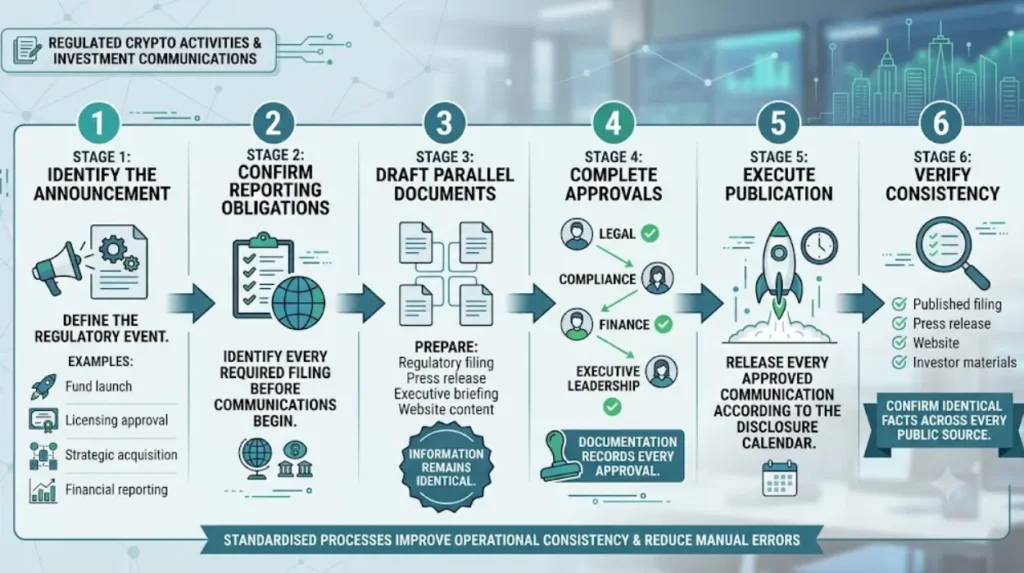
A practical workflow contains six stages.
Stage 1: Identify the announcement
Define the regulatory event.
Examples include:
- Fund launch
- Licensing approval
- Strategic acquisition
- Financial reporting
Stage 2: Confirm reporting obligations
Identify every required filing before communications begin.
Stage 3: Draft parallel documents
Prepare:
- Regulatory filing
- Press release
- Executive briefing
- Website content
Information remains identical.
Stage 4: Complete approvals
Obtain approval from:
- Legal
- Compliance
- Finance
- Executive leadership
Documentation records every approval.
Stage 5: Execute publication
Release every approved communication according to the disclosure calendar.
Stage 6: Verify consistency
Review:
- Published filing
- Press release
- Website
- Investor materials
Confirm identical facts across every public source.
Organisations evaluating communication providers for regulated financial announcements can later compare operational capabilities through:
How can crypto businesses strengthen future disclosure planning?
Organisations strengthen disclosure planning by establishing documented governance policies, maintaining central approval systems, training internal teams, reviewing regulatory developments regularly, and measuring communication performance after every announcement. Continuous process improvement supports consistent regulatory compliance and reliable public communication throughout organisational growth and market expansion.
Long-term disclosure planning depends on repeatable processes rather than individual decisions.
Best practices include:
- Maintain one disclosure calendar for every department.
- Store approved communication templates centrally.
- Document every approval stage.
- Conduct post-announcement reviews after each major disclosure.
- Update communication procedures following regulatory changes.
- Train legal, compliance, finance, and communications teams together.
- Review timing performance using measurable publication records.
Explore More Expert Insights:
How to Build a Secure Digital Press Kit to Rebuild Trust During Quarterly Earnings Reports
As crypto regulation continues evolving in the United Kingdom and international financial markets, organizations that integrate regulatory filings with structured communication workflows create clearer disclosures, improve operational consistency, and support accurate reporting. Synchronizing press releases with official filings establishes one verified source of truth for regulators, journalists, investors, and the wider financial community.