
Healthcare technology evolves through continuous innovation. Industry analysts track these developments to identify companies introducing measurable improvements in patient care, clinical workflows, diagnostics, digital health, medical devices, and healthcare software. Their evaluations influence market research, investment analysis, procurement decisions, and industry discussions. Understanding this evaluation process helps HealthTech professionals produce accurate information that aligns with established industry expectations.
What does a disruptive HealthTech innovator mean?
A disruptive HealthTech innovator introduces a healthcare technology that delivers measurable improvements over existing solutions through better clinical outcomes, operational efficiency, cost reduction, accessibility, or regulatory advancement. Analysts evaluate disruption using evidence, market impact, scalability, and implementation results rather than marketing claims alone.
HealthTech refers to technology designed for healthcare delivery, diagnosis, treatment, monitoring, administration, and research. Examples include artificial intelligence diagnostic software, wearable cardiac monitors, robotic surgical systems, remote patient monitoring platforms, and electronic prescribing systems.
Disruption describes a measurable change in how healthcare organisations deliver services. Industry analysts define disruption through objective improvements rather than product popularity.
Key characteristics of disruptive innovation
Analysts commonly examine whether a technology demonstrates:
- Improved clinical performance
- Faster healthcare delivery
- Lower operating costs
- Better patient accessibility
- Regulatory compliance
- Scalable implementation
- Verified clinical evidence
For example, an artificial intelligence imaging platform that reduces radiology reporting time by 45% while maintaining diagnostic accuracy demonstrates measurable operational improvement.
How do industry analysts discover emerging HealthTech companies?
Industry analysts discover HealthTech innovators by monitoring public information, regulatory announcements, scientific publications, clinical studies, conference presentations, investment activity, patent filings, and healthcare market developments throughout the year across multiple trusted information sources and independent datasets.
Analysts rarely depend on one source of information. Instead, they compare data from multiple channels before forming conclusions.
Regulatory announcements
Healthcare regulations produce reliable information because submissions follow established legal standards.
Examples include:
- Medical device approvals
- Clinical investigation approvals
- Digital health certifications
- Product safety updates
- Healthcare policy changes
These announcements establish factual milestones that analysts incorporate into research.
Scientific publications
Peer-reviewed journals provide evidence supporting technology performance.
Examples include studies published in:
- Medical imaging
- Oncology
- Cardiology
- Digital therapeutics
- Health informatics
Analysts review study methodology, sample size, statistical significance, and clinical relevance.
Healthcare conferences
Industry conferences introduce emerging technologies before widespread commercial adoption.
Examples include:
- Medical technology exhibitions
- Clinical congresses
- Digital health conferences
- Healthcare innovation forums
Conference presentations often include product demonstrations, clinical results, and implementation case studies.
Patent activity
Patent filings reveal technical innovation before commercial expansion.
Analysts evaluate:
- Filing frequency
- Technology categories
- Geographic coverage
- Technical originality
Patent activity helps identify long-term innovation trends.
What information attracts an analyst’s attention first?
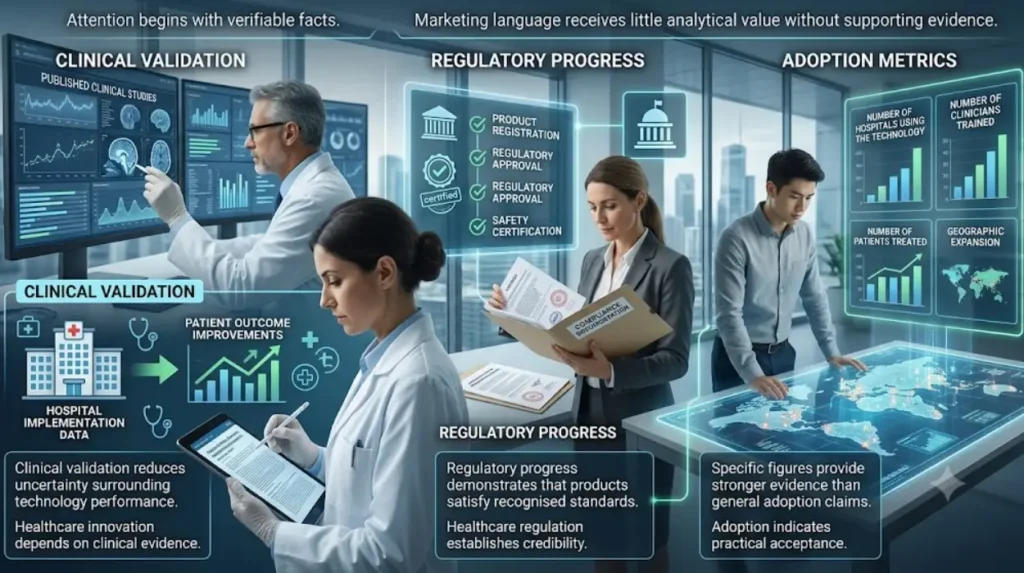
Industry analysts first examine objective evidence that verifies innovation, including regulatory milestones, clinical validation, measurable performance improvements, market adoption, leadership expertise, research collaborations, and documented implementation outcomes supported by publicly available information from credible organisations and institutions.
Attention begins with verifiable facts.
Marketing language receives little analytical value without supporting evidence.
Clinical validation
Healthcare innovation depends on clinical evidence.
Analysts review:
- Published clinical studies
- Independent evaluations
- Hospital implementation data
- Patient outcome improvements
Clinical validation reduces uncertainty surrounding technology performance.
Regulatory progress
Healthcare regulation establishes credibility.
Analysts track milestones including:
- Product registration
- Regulatory approval
- Compliance certification
- Safety documentation
Regulatory progress demonstrates that products satisfy recognised standards.
Adoption metrics
Adoption indicates practical acceptance.
Useful measurements include:
- Number of hospitals using the technology
- Number of clinicians trained
- Number of patients treated
- Geographic expansion
Specific figures provide stronger evidence than general adoption claims.
How do analysts evaluate whether a HealthTech innovation is credible?
Analysts evaluate HealthTech credibility by examining independent evidence, clinical validation, regulatory compliance, leadership experience, implementation success, financial stability, technical documentation, healthcare partnerships, and measurable improvements that withstand objective verification across multiple trusted sources of information consistently.
Credibility develops through consistent evidence.
Every important claim requires supporting documentation.
Independent validation
Independent organisations strengthen credibility.
Examples include:
- Universities
- Teaching hospitals
- Research institutes
- Public healthcare organisations
Independent validation reduces reliance on self-reported information.
Clinical effectiveness
Healthcare technologies require measurable outcomes.
Analysts compare:
- Treatment effectiveness
- Diagnostic accuracy
- Workflow efficiency
- Patient safety indicators
Performance measurements remain central throughout evaluation.
Leadership expertise
Executive experience contributes to analytical assessment.
Relevant backgrounds include:
- Medicine
- Biomedical engineering
- Clinical research
- Healthcare management
- Medical device development
Experienced leadership improves organisational capability.
Which data sources do healthcare industry analysts trust?
Healthcare industry analysts prioritise trusted information published by regulatory authorities, peer-reviewed journals, recognised healthcare organisations, government agencies, academic institutions, financial disclosures, and verified public records because these sources maintain established standards for accuracy and transparency across healthcare sectors.
Reliable information supports consistent research.
Analysts compare several trusted sources before publishing findings.
Regulatory databases
Government databases provide verified records.
Examples include:
- Medical device registrations
- Product approvals
- Safety notices
- Clinical investigation records
These databases establish factual timelines.
Academic research
Universities publish evidence using recognised scientific methods.
Analysts examine:
- Study quality
- Research design
- Statistical analysis
- Replication potential
Academic research strengthens evidence-based evaluation.
Healthcare organisations
Professional organisations publish industry guidance.
Examples include:
- Clinical practice recommendations
- Healthcare standards
- Technology assessments
- Evidence reviews
These publications provide additional context for technology evaluation.
Why do measurable outcomes matter more than product claims?
Measurable outcomes provide objective evidence that a HealthTech innovation improves healthcare delivery. Analysts compare verified performance indicators, implementation results, patient outcomes, and operational improvements because numerical evidence supports reliable market evaluation and long-term industry forecasting with greater accuracy.
Healthcare technology exists to solve measurable problems.
Analysts therefore prioritise performance data.
Operational improvements
Examples include:
- Appointment scheduling reduced from 15 minutes to 5 minutes
- Diagnostic reporting reduced from 48 hours to 12 hours
- Administrative workload reduced by 35%
Specific measurements improve analytical reliability.
Clinical improvements
Examples include:
- Earlier disease detection
- Reduced hospital readmissions
- Improved medication adherence
- Higher diagnostic sensitivity
Clinical evidence directly supports healthcare value.
Economic outcomes
Healthcare organisations also measure financial performance.
Examples include:
- Lower treatment costs
- Reduced equipment downtime
- Fewer administrative errors
- Increased resource utilisation
Economic evidence complements clinical evidence.
How does market adoption influence analyst evaluations?
Market adoption demonstrates whether healthcare organisations successfully implement an innovation under real operating conditions. Analysts assess customer growth, implementation scale, repeat deployments, geographic expansion, healthcare partnerships, and long-term usage patterns alongside technical performance and clinical validation evidence.
Adoption reflects practical success.
Implementation across multiple healthcare settings increases confidence.
Hospital adoption
Analysts review:
- Number of hospitals
- Number of healthcare systems
- Number of specialist clinics
- International expansion
Larger implementation datasets improve evaluation quality.
Clinical diversity
Technology used across different specialties demonstrates broader applicability.
Examples include:
- Cardiology
- Oncology
- Radiology
- Primary care
- Emergency medicine
Broader clinical adoption strengthens market evidence.
Long-term implementation
Analysts monitor sustained usage rather than initial deployment.
Long-term adoption demonstrates operational reliability.
How can organisations publish information that analysts understand?
Organisations communicate effectively with analysts by publishing accurate, structured, evidence-based information supported by verified data, regulatory milestones, clinical research, implementation metrics, executive expertise, and clearly documented healthcare outcomes without exaggerated language or unsupported performance claims throughout public communications.
Structured communication improves analytical understanding.
Clear information reduces interpretation errors.
Useful public information commonly includes:
- Product description
- Regulatory status
- Clinical evidence
- Performance metrics
- Healthcare applications
- Research partnerships
- Implementation statistics
Analysts prefer factual language over promotional descriptions.
Educational resources discussing:
Leveraging Regulatory Press Releases explain how structured regulatory announcements improve information quality for industry evaluation.
Readers researching advanced decision-making processes can later explore:
Best Newswire Services for broader understanding of healthcare communication distribution methods.
Why is understanding analyst evaluation important?
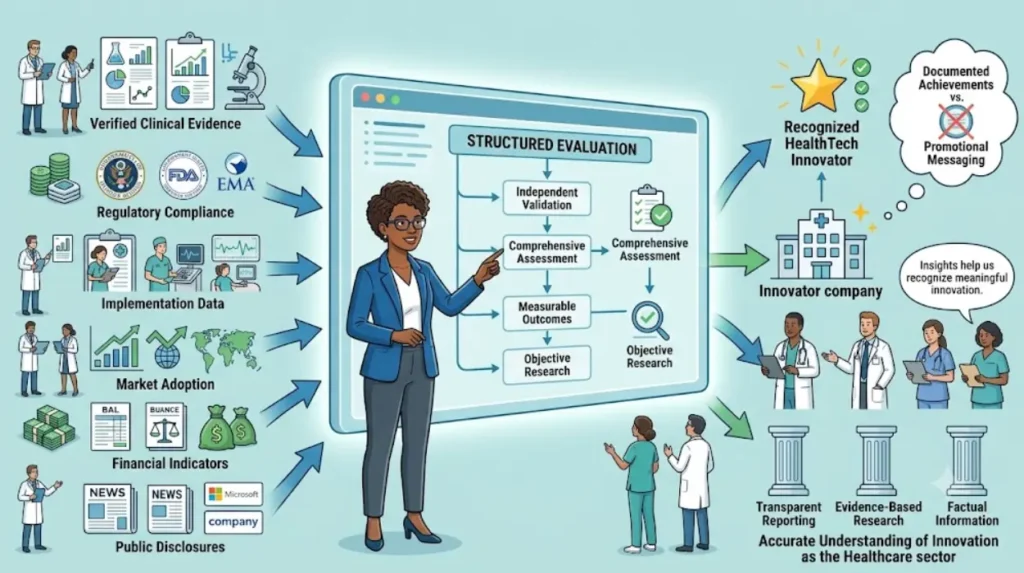
Understanding analyst evaluation helps healthcare professionals recognise how evidence-based research identifies meaningful innovation. Objective information, verified clinical evidence, regulatory compliance, measurable outcomes, and transparent reporting collectively determine how disruptive HealthTech innovators become recognised across the healthcare industry.
Industry analysts perform structured evaluations rather than subjective reviews.
Their research combines regulatory information, scientific evidence, healthcare implementation data, market adoption, financial indicators, and public disclosures into comprehensive assessments.
Explore More Expert Insights:
What Happens to a Healthcare Brand’s Reputation During a Misinformation Crisis?
How Medical Journalists Filter Through Hundreds of Science Pitches Every Day
HealthTech innovators gain recognition through documented achievements instead of promotional messaging. Verified clinical evidence, regulatory milestones, measurable operational improvements, independent validation, and transparent reporting consistently form the foundation of analyst evaluation. As healthcare technology continues to evolve, organisations that communicate factual, evidence-based information contribute to a more accurate understanding of innovation across the healthcare sector.