
Healthcare industry analysts examine regulatory developments every day to understand market direction, product maturity, competitive positioning, and commercial readiness. A well-structured regulatory press release presents verified information, explains regulatory milestones, and provides evidence that supports informed industry evaluation. Organisations that understand this process improve the visibility and credibility of their announcements.
Why do healthcare industry analysts pay attention to regulatory press releases?
Healthcare industry analysts rely on regulatory press releases because they present verified milestones, explain product progress, identify commercial readiness, and provide factual information supported by recognised regulatory authorities. These announcements help analysts evaluate innovation, market potential, competitive positioning, and future healthcare developments efficiently.
Healthcare industry analysts assess companies using reliable and publicly available information. Regulatory announcements rank among the most trusted communication formats because they describe events verified through official regulatory processes.
Examples include:
- Regulatory approvals
- Clinical trial authorisations
- Market clearances
- Safety updates
- Manufacturing certifications
- Product label expansions
Each announcement provides measurable business progress.
Unlike promotional marketing content, regulatory press releases focus on factual developments supported by regulatory agencies, published documentation, and compliance requirements.
Analysts compare these announcements across multiple organisations to identify market leaders, emerging technologies, and investment trends.
What qualifies as a regulatory press release?
A regulatory press release announces an official healthcare regulatory event using accurate, compliant, and verifiable information. It explains the regulatory milestone, identifies the responsible authority, describes the affected product, and outlines the commercial or clinical significance without promotional claims.
A regulatory press release communicates information related to government agencies or recognised healthcare regulators.
Common regulatory authorities include:
- Medicines and Healthcare products Regulatory Agency (MHRA)
- National Institute for Health and Care Excellence (NICE)
- European Medicines Agency (EMA)
- U.S. Food and Drug Administration (FDA)
Typical announcement topics include:
- Device approvals
- Drug approvals
- Clinical study permissions
- CE marking updates
- Quality management certifications
- Manufacturing inspections
- Regulatory partnerships
Each announcement follows strict compliance standards.
What information does a regulatory press release include?
A complete regulatory announcement normally contains:
- Product or technology name
- Regulatory authority
- Approval or authorisation type
- Relevant dates
- Clinical indication
- Company background
- Executive statement
- Supporting regulatory context
- Forward-looking information where permitted
These components allow analysts to understand the importance of the milestone quickly.
How do analysts evaluate regulatory announcements?
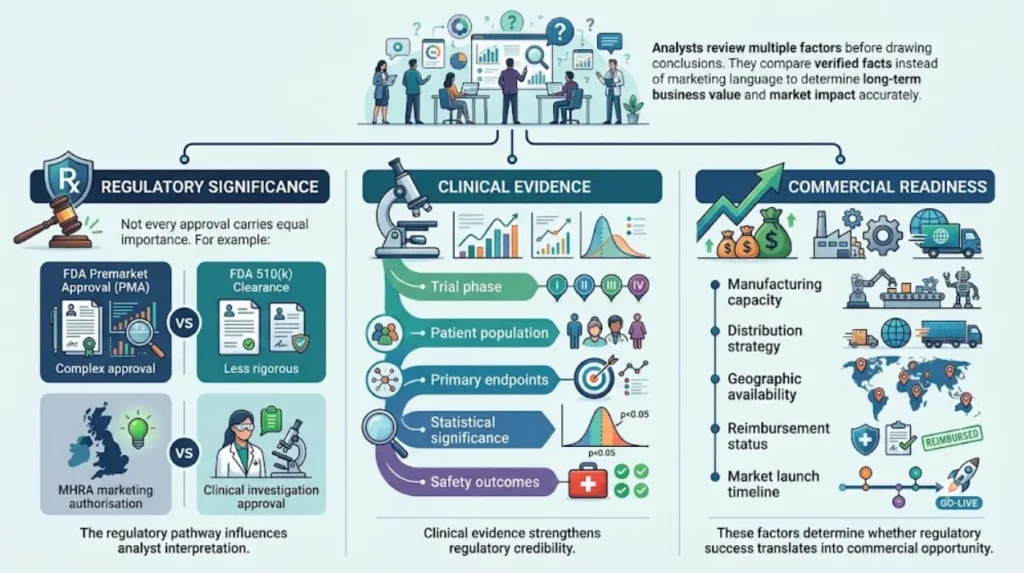
Healthcare industry analysts evaluate regulatory announcements by examining evidence, regulatory significance, clinical relevance, commercial opportunity, competitive positioning, and consistency across previous disclosures. They compare verified facts instead of marketing language to determine long-term business value and market impact accurately.
Analysts review multiple factors before drawing conclusions.
Regulatory significance
Not every approval carries equal importance.
For example:
- An FDA Premarket Approval (PMA) represents a different regulatory pathway than a 510(k) clearance.
- An MHRA marketing authorisation differs from a clinical investigation approval.
The regulatory pathway influences analyst interpretation.
Clinical evidence
Analysts review supporting evidence.
Important considerations include:
- Trial phase
- Patient population
- Primary endpoints
- Statistical significance
- Safety outcomes
Clinical evidence strengthens regulatory credibility.
Commercial readiness
Analysts also evaluate business readiness.
Indicators include:
- Manufacturing capacity
- Distribution strategy
- Geographic availability
- Reimbursement status
- Market launch timeline
These factors determine whether regulatory success translates into commercial opportunity.
How can a regulatory press release attract analyst attention?
A regulatory press release attracts analyst attention through factual headlines, structured information, recognised regulatory terminology, supporting clinical evidence, transparent data, and clear explanations of business significance. Well-organised content improves discoverability across news platforms, databases, and industry research workflows.
Analysts process hundreds of announcements every month.
A structured format improves efficiency.
Use precise regulatory language
Avoid vague wording.
Instead of writing:
- Significant achievement
Use:
- MHRA marketing authorisation granted
- FDA 510(k) clearance received
- CE Mark certification completed
Specific terminology improves clarity.
Present measurable facts
Analysts value numbers.
Examples include:
- Trial enrolled 620 patients.
- Study completed across 28 hospitals.
- Approval covers three treatment indications.
- Manufacturing facility produces 2 million diagnostic kits annually.
Measured information supports objective evaluation.
Explain market relevance
Every regulatory milestone requires context.
Explain:
- Which patient population benefits
- Which disease area is addressed
- Which healthcare challenge is solved
- Which market segment is affected
Context transforms regulatory information into business insight.
Readers looking for broader background can also explore:
Disruptive HealthTech Innovators to understand how structured communications support analyst engagement.
What makes regulatory press releases easier for analysts to cite?
Healthcare industry analysts cite regulatory press releases that contain verified facts, transparent sources, structured formatting, and clearly defined entities. Consistent terminology, supporting references, and organised sections improve citation accuracy across reports, market research, and investment analysis documents.
Analysts often summarise announcements for:
- Industry reports
- Investment research
- Market intelligence
- Technology assessments
- Healthcare trend analysis
Citation-friendly content reduces interpretation errors.
Define every entity
Define important entities immediately.
Examples include:
- Digital therapeutic
- Software as a Medical Device (SaMD)
- In vitro diagnostic (IVD)
- Companion diagnostic
- Orphan drug designation
Definitions improve understanding across different audiences.
Include supporting references
Supporting references strengthen credibility.
Useful references include:
- Regulatory application numbers
- Clinical trial identifiers
- Published journal studies
- Government announcements
- Product documentation
These references help analysts validate information independently.
How do regulatory press releases support long-term analyst relationships?
Consistent regulatory communication establishes transparency, demonstrates operational maturity, and provides analysts with dependable information over time. Repeated delivery of factual updates builds confidence in organisational reporting practices and improves long-term visibility within healthcare industry research communities consistently.
Analysts monitor organisations across multiple years.
Single announcements rarely define long-term reputation.
Instead, analysts observe communication consistency.
Examples include:
- Quarterly regulatory updates
- Product approval announcements
- Clinical milestone reports
- Manufacturing expansion notices
- Post-market surveillance updates
Regular communication creates a complete business narrative.
Consistent reporting also improves historical analysis because analysts compare previous milestones against current progress.
Which distribution approaches increase analyst visibility?
Healthcare organisations increase analyst visibility by selecting distribution methods that reach financial media, healthcare publications, regulatory news platforms, business databases, and specialist industry audiences. Broader distribution expands opportunities for analysts to discover verified regulatory developments efficiently and consistently.
Distribution determines who discovers a regulatory announcement.
Healthcare organisations often combine several distribution channels.
Common approaches include:
- Healthcare newswire services
- Financial news platforms
- Medical trade publications
- Biotechnology publications
- Corporate investor relations pages
- Regulatory disclosure portals
Each channel serves a different audience.
Analysts frequently monitor multiple sources simultaneously.
Distribution strategies also influence search engine visibility because authoritative publications strengthen content discoverability.
Organisations evaluating distribution options can continue with:
Best Newswire Services to compare available healthcare-focused distribution solutions.
What common mistakes reduce analyst engagement?
Healthcare organisations reduce analyst engagement when regulatory announcements contain promotional language, incomplete evidence, unclear regulatory terminology, inconsistent data, or missing context. Accurate reporting, transparent documentation, and logical organisation improve analyst confidence and information usability significantly.
Several recurring issues reduce announcement quality.
Overusing marketing language
Statements such as:
- Revolutionary solution
- Industry-leading innovation
- Game-changing platform
provide little analytical value.
Analysts prioritise evidence over promotional descriptions.
Omitting regulatory details
Missing information creates uncertainty.
Examples include:
- No regulatory pathway identified
- No approval date listed
- No indication specified
- No clinical context provided
Incomplete announcements require additional research.
Ignoring structured formatting
Large blocks of text reduce readability.
Clear headings, concise paragraphs, and logical sequencing improve information retrieval.
Failing to explain business relevance
A regulatory event requires commercial context.
Explain:
- Target healthcare market
- Intended users
- Patient population
- Product availability
- Strategic importance
These details improve analytical interpretation.
How can healthcare organisations build stronger regulatory communications?

Healthcare organisations strengthen regulatory communications by combining compliance, structured writing, factual reporting, accurate terminology, and broad distribution. This approach improves analyst understanding, supports industry research, and increases the long-term visibility of important healthcare regulatory achievements across competitive markets.
An effective regulatory communication strategy includes several connected practices.
These include:
- Maintaining consistent reporting standards
- Publishing announcements promptly after regulatory milestones
- Using recognised regulatory terminology
- Including measurable clinical and commercial information
- Referencing supporting documentation
- Selecting distribution channels aligned with healthcare and business audiences
Explore More Expert Insights:
Crisis Communication Frameworks: Issuing Rapid Medical Statements Without Sacrificing Compliance
Crafting an Authoritative Press Release Layout for Complex FDA Approval Announcements
This structured approach helps analysts evaluate organisations using verified evidence rather than interpretation.
Healthcare markets continue to expand across pharmaceuticals, biotechnology, medical devices, diagnostics, digital health, and artificial intelligence. Regulatory milestones remain one of the strongest indicators of organisational progress within these sectors. Press releases that communicate those milestones with clarity, factual precision, and structured context become valuable resources for analysts, investors, journalists, and healthcare decision-makers alike.
When regulatory communications consistently deliver complete, transparent, and well-organised information, they contribute to stronger industry visibility, improved analyst coverage, and a more accurate understanding of healthcare innovation.