
Launching a Software as a Service (SaaS) product requires more than publishing on a single platform. Product Hunt offers visibility within a technology-focused community, but long-term product adoption depends on broader awareness, consistent messaging, search visibility, media coverage, customer trust, and ongoing marketing activities. Understanding the complete launch process helps SaaS founders build sustainable growth rather than relying on a single promotional event.
Why is Product Hunt popular among SaaS startups?
Product Hunt provides SaaS startups with access to technology enthusiasts, founders, developers, investors, and early adopters. It creates immediate exposure during launch day, encourages community engagement, generates user feedback, and helps products gain initial visibility within a highly active audience.
Product Hunt is an online platform where new technology products are discovered, discussed, and ranked daily. Products receive upvotes, comments, and reviews from community members.
A Product Hunt launch typically includes:
- Product listing
- Product description
- Images and videos
- Founder introduction
- Community discussion
- User questions
- Product reviews
Many successful SaaS companies have appeared on Product Hunt. Examples include Notion, Loom, Linear, Figma, and Raycast. Their Product Hunt launches formed only one part of much larger marketing campaigns.
How does Product Hunt ranking work?
Products receive visibility based on community engagement. Upvotes, comments, user participation, and launch timing all influence daily rankings.
Higher rankings increase exposure inside the Product Hunt ecosystem. They do not guarantee widespread market awareness outside the platform.
Why isn’t Product Hunt alone enough for a successful SaaS product launch?
Product Hunt reaches a specific technology audience instead of the entire software market. Business buyers, procurement teams, industry journalists, analysts, search engine users, and enterprise decision-makers often discover SaaS products through different channels throughout their buying journey.
A SaaS launch aims to achieve multiple objectives simultaneously.
These objectives include:
- Brand awareness
- Customer acquisition
- Search visibility
- Industry credibility
- Product validation
- User education
- Lead generation
Product Hunt primarily supports early community discovery.
It does not automatically create:
- News coverage
- Organic search rankings
- Industry analyst attention
- Long-term content visibility
- Enterprise trust
- Continuous customer demand
A single launch day generates limited momentum unless supported by additional marketing activities.
Different audiences use different discovery channels
Technology enthusiasts actively browse Product Hunt.
Business executives often discover software through:
- Google Search
- Industry publications
- Professional newsletters
- Technology conferences
- Analyst reports
- Podcasts
- Customer referrals
Every audience follows a different research process before purchasing SaaS products.
What limitations does Product Hunt have during a SaaS launch?
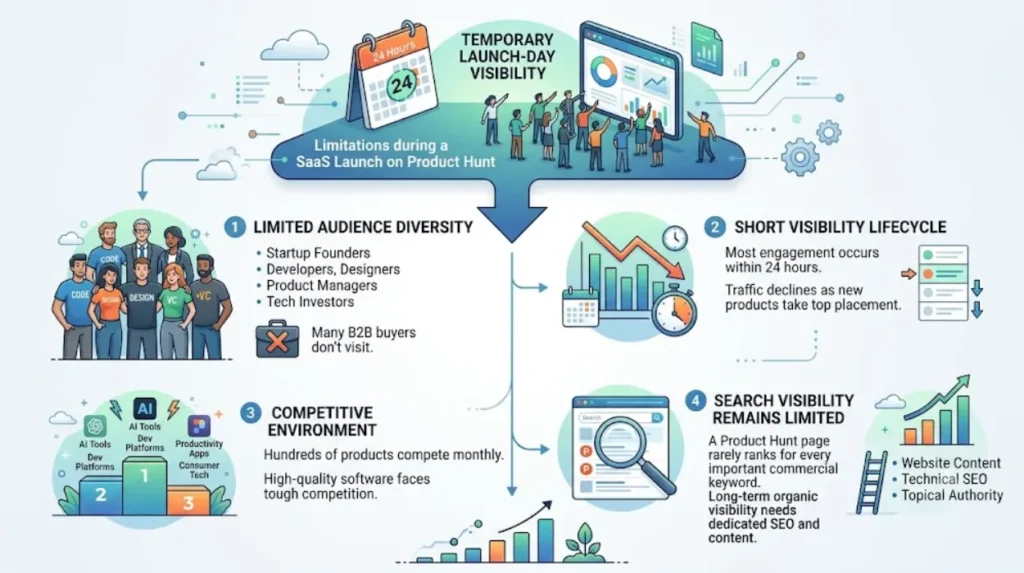
Product Hunt creates concentrated visibility within a short launch period. Most products experience high engagement during launch day followed by rapid declines in traffic, discussions, and community attention over the following days and weeks without additional promotion.
Launch-day visibility is temporary.
Thousands of new products appear every year. New launches continuously replace previous listings on the homepage.
Several limitations affect long-term growth.
Limited audience diversity
Most visitors share similar interests.
Typical users include:
- Startup founders
- Developers
- Designers
- Product managers
- Technology investors
Many B2B buyers never visit Product Hunt during software evaluation.
Short visibility lifecycle
Most engagement occurs within 24 hours.
Traffic commonly declines after launch day because newer products receive homepage placement.
Competitive environment
Hundreds of products compete for attention every month.
Even high-quality software competes directly with artificial intelligence tools, developer platforms, productivity applications, and consumer technology launches.
Search visibility remains limited
A Product Hunt page rarely ranks for every important commercial keyword.
Long-term organic visibility depends on dedicated website content, technical SEO, and topical authority.
What marketing channels strengthen a SaaS product launch?
Successful SaaS launches combine multiple communication channels that reach different audiences across awareness, consideration, evaluation, and purchasing stages. Each channel contributes distinct visibility, credibility, customer education, and measurable acquisition opportunities over extended periods after launch day.
A coordinated launch strategy distributes information across several platforms.
Important channels include:
- Company website
- Search engine optimisation (SEO)
- Email marketing
- Press releases
- Social media
- Content marketing
- Customer communities
- Webinars
- Industry newsletters
- Partner announcements
Each channel supports different customer behaviours.
Website
The company website provides product information, pricing, documentation, onboarding resources, and conversion opportunities.
Search engines
Organic search attracts users researching specific business problems.
Search visibility continues long after launch.
Email marketing
Email campaigns notify existing subscribers about product releases, feature updates, and customer success stories.
Social platforms
LinkedIn supports B2B communication.
X helps distribute technology news.
YouTube explains product features through demonstrations.
Why does media coverage matter for SaaS products?
Media coverage expands product awareness beyond existing technology communities. Industry publications, technology news websites, podcasts, newsletters, and independent journalists introduce SaaS products to broader professional audiences researching emerging software solutions across multiple business sectors.
Editorial coverage differs from community discussions.
Journalists evaluate:
- Industry relevance
- Business impact
- Innovation
- Customer value
- Market trends
Technology publications often reach decision-makers who never browse Product Hunt.
Industry visibility also improves online credibility because multiple independent sources discuss the same product.
For organisations exploring analyst engagement strategies,
Leveraging Press Releases offers additional educational context.
Industry analysts
Technology analysts evaluate software markets.
Their reports influence purchasing decisions inside many organisations.
Technology influencers
Technology creators publish:
- Product reviews
- Demonstration videos
- Educational articles
- Industry commentary
These resources remain searchable for extended periods.
How does search engine optimisation support long-term SaaS growth?
Search engine optimisation increases organic visibility by aligning website content with user search intent. Educational resources, product documentation, comparison pages, and technical articles help SaaS companies attract consistent traffic throughout the customer buying journey over many months.
SEO focuses on discoverability.
Potential customers search for:
- Software categories
- Business challenges
- Feature comparisons
- Integration guides
- Pricing information
- Implementation resources
Well-structured content answers these questions.
Educational content
Educational articles explain industry concepts.
Examples include:
- Workflow automation
- Customer relationship management
- Cybersecurity monitoring
- Cloud infrastructure management
Documentation
Documentation helps users understand implementation, integrations, APIs, and product functionality.
Documentation also supports search visibility because it answers highly specific user queries.
What role do customer trust and social proof play in a SaaS launch?
Customer trust influences software adoption because organisations evaluate reliability before purchasing subscription products. Independent reviews, customer testimonials, implementation examples, security information, and transparent product documentation strengthen confidence during software evaluation processes across different industries.
Trust develops gradually.
Several trust signals contribute to purchasing decisions.
Examples include:
- Customer case studies
- User reviews
- Product demonstrations
- Security certifications
- Transparent pricing
- Documentation quality
- Customer support resources
Enterprise buyers often complete structured evaluation processes before selecting software vendors.
Product Hunt represents only one information source within that evaluation.
Customer reviews
Independent review platforms help buyers compare products using verified customer experiences.
Product documentation
Detailed documentation demonstrates product maturity and operational readiness.
How can SaaS founders build momentum after Product Hunt launch day?

Post-launch momentum depends on continuous communication, product improvements, customer engagement, educational publishing, search optimisation, and ongoing outreach. Consistent activity extends product visibility beyond launch week and supports sustainable audience growth across multiple acquisition channels over time.
A launch marks the beginning of market communication.
Successful post-launch activities include:
- Publishing educational articles
- Sharing customer success stories
- Releasing feature updates
- Improving onboarding
- Monitoring customer feedback
- Expanding documentation
- Participating in industry discussions
Regular updates maintain product relevance.
Analyse launch performance
Performance metrics include:
- Website traffic
- Product sign-ups
- Conversion rate
- Customer retention
- Organic search growth
- Referral sources
These measurements identify successful acquisition channels.
Continue product development
Customer feedback informs future improvements.
Regular feature releases encourage continued customer engagement.
Explore More Expert Insights:
What Happens to a Tech Startup’s Brand Reputation During a Product Outage?
How Tech Journalists Filter Through Hundreds of Pitch Press Releases Daily
What does a balanced SaaS launch strategy look like?
A balanced SaaS launch combines community engagement, media visibility, search optimisation, educational content, customer trust building, and continuous marketing. Multiple channels reduce dependence on a single platform and create broader opportunities for sustainable business growth over the long term.
An effective SaaS launch integrates several activities throughout different phases.
Before launch:
- Build landing pages
- Prepare product documentation
- Publish educational content
- Grow an email subscriber list
- Create launch assets
During launch:
- Publish on Product Hunt
- Share updates across social platforms
- Engage with community discussions
- Monitor customer feedback
- Track launch metrics
After launch:
- Continue publishing educational content
- Improve search visibility
- Expand documentation
- Build customer case studies
- Strengthen industry relationships
As organisations compare broader launch distribution options,
Best Newswire Services explains how business-focused news distribution supports wider visibility during later decision stages.
Product Hunt introduces SaaS products to an engaged technology community, but successful product launches depend on broader marketing activities that reach multiple audiences through different discovery channels. Sustainable growth comes from combining search visibility, educational content, media exposure, customer trust, and continuous communication rather than relying on a single launch platform.
A comprehensive SaaS launch supports awareness, credibility, customer education, and long-term discoverability. Product Hunt remains an important launch opportunity, but it functions as one component within a larger marketing strategy designed to attract diverse audiences and maintain visibility well beyond launch day.