
A tech media pitch deck is a structured presentation that helps founders explain their company, product, market, traction, and news value to journalists. A well-built deck supports media conversations with clear evidence, concise messaging, and relevant business data. It complements a press pitch rather than replacing it and helps reporters evaluate whether a story fits their publication.
For software-as-a-service (SaaS) founders, a pitch deck also provides context behind funding announcements, product launches, market expansion, and customer growth. It helps journalists quickly understand why the story matters and whether it aligns with their editorial focus.
Founders exploring media outreach strategies can also review:
How Do SaaS Startups Get Noticed by TechCrunch and VentureBeat? to understand how technology publications assess startup stories before deciding on coverage.
Why does a tech media pitch deck matter for founders?
A tech media pitch deck gives journalists structured business information in a format that supports fast editorial evaluation. It explains the company, validates its claims, highlights measurable traction, and provides evidence that strengthens the credibility of a media pitch during outreach.
Technology journalists review hundreds of story ideas every week. Most decisions happen within a short review period. A pitch deck reduces research time by presenting essential information in one document.
Unlike investor decks, media pitch decks focus on newsworthiness instead of fundraising. Journalists want verified facts, industry relevance, and supporting evidence.
What is the purpose of a media pitch deck?
A media pitch deck exists to answer key editorial questions:
- What does the company do?
- Why is this announcement important?
- What problem does the product solve?
- What evidence supports the claims?
- Why is the story relevant now?
For example, a SaaS company announcing 500 enterprise customers presents customer growth, product adoption, and market demand instead of financial projections.
How does it support media outreach?
The deck provides supporting material after the initial email pitch. It allows journalists to verify information before requesting interviews or additional documents.
What makes a tech media pitch deck different from an investor pitch deck?
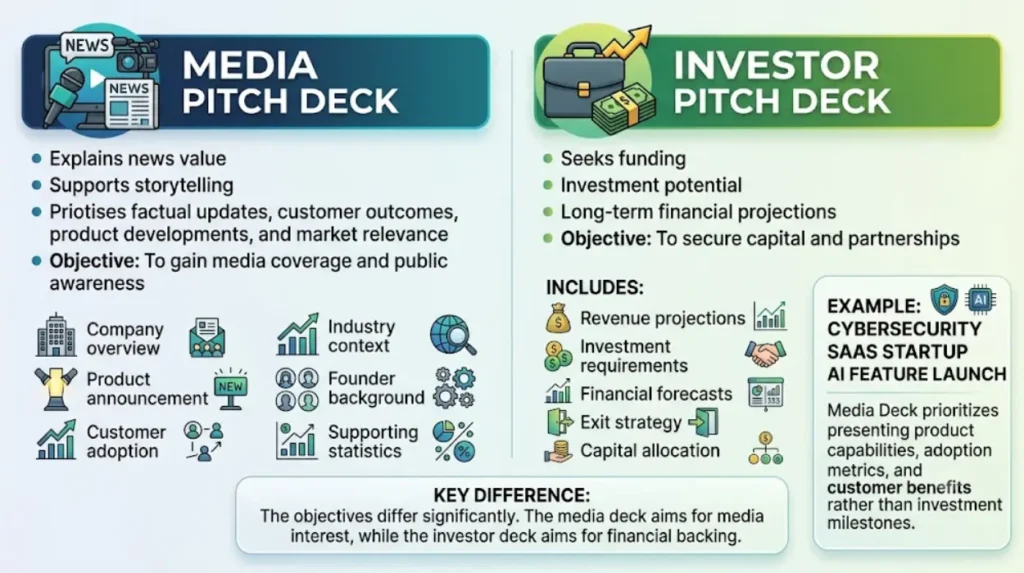
A media pitch deck explains news value instead of investment potential. It prioritises factual business updates, customer outcomes, product developments, and market relevance instead of valuation, fundraising strategy, or long-term financial projections for investors and venture capital firms.
Investor decks seek funding.
Media decks support storytelling.
The objectives differ significantly.
Investor pitch decks include:
- Revenue projections
- Investment requirements
- Financial forecasts
- Exit strategy
- Capital allocation
Media pitch decks include:
- Company overview
- Product announcement
- Customer adoption
- Industry context
- Founder background
- Supporting statistics
A cybersecurity SaaS startup launching an artificial intelligence feature presents product capabilities, adoption metrics, and customer benefits in its media deck rather than investment milestones.
Which sections belong in a tech media pitch deck?
An effective tech media pitch deck includes a company overview, problem statement, solution, market context, traction, customer proof, leadership information, supporting statistics, media assets, and contact details presented through concise slides with verified business information throughout.
Every slide serves one purpose.
Avoid combining unrelated information.
Company overview
Introduce the business in one sentence.
Include:
- Company name
- Founding year
- Headquarters
- Core product
- Primary customer segment
Example:
“A London-based SaaS platform helping logistics companies automate inventory forecasting.”
Problem statement
Define one measurable industry challenge.
Example:
“Retail businesses lose inventory accuracy because manual forecasting creates stock shortages.”
Solution
Explain how the product addresses that problem.
Focus on functionality instead of marketing language.
Market context
Provide credible industry statistics.
Example:
- UK SaaS market growth
- Cloud software adoption
- Digital transformation spending
Industry context helps journalists understand the broader significance of the announcement.
Business traction
Present measurable progress.
Examples include:
- 10,000 active users
- 1,200 paying customers
- 96% customer retention
- £4 million annual recurring revenue
- 180% year-over-year growth
Customer validation
Include recognisable examples where appropriate.
Examples:
- Healthcare software providers
- Financial technology companies
- Manufacturing businesses
Customer stories strengthen credibility.
Founder profile
Introduce leadership briefly.
Include:
- Previous experience
- Relevant expertise
- Industry achievements
Media resources
Provide:
- Product screenshots
- Executive photographs
- Company logo
- Website
- Contact information
How do founders present traction that journalists trust?
Journalists trust measurable business traction supported by verifiable figures, customer growth, product adoption, revenue milestones, partnerships, independent research, or funding events because factual evidence strengthens editorial confidence and reduces verification time before publication decisions are made.
Avoid unsupported claims.
Replace broad statements with measurable outcomes.
Strong traction examples
Instead of:
“Fast-growing startup.”
Use:
- Revenue increased from £900,000 to £2.1 million.
- Customer base expanded from 250 to 700 organisations.
- Platform processed 18 million transactions.
Specific numbers improve credibility.
Use independent validation
Examples include:
- Industry awards
- Published research
- Government partnerships
- University collaborations
Third-party validation adds supporting evidence.
How can founders align a pitch deck with technology publications?
Different technology publications focus on different editorial priorities. Founders improve relevance by matching announcements, supporting data, customer examples, and market context to the publication’s audience, industry focus, geographic coverage, and reporting style before media outreach begins.
Technology publications specialise in different topics.
Understanding editorial focus improves relevance.
Startup publications
These publications prioritise:
- Funding rounds
- Founder journeys
- Venture capital
- Product launches
Enterprise technology publications
Coverage focuses on:
- Digital transformation
- Artificial intelligence
- Cybersecurity
- Cloud infrastructure
SaaS publications
Coverage often includes:
- Product innovation
- Customer success
- Revenue growth
- Software adoption
Tailoring supporting material improves editorial alignment.
What common mistakes reduce media interest?
Media interest declines when pitch decks contain unsupported claims, excessive marketing language, unclear messaging, outdated statistics, inconsistent branding, or missing evidence because journalists require concise, factual information that supports efficient editorial assessment and accurate reporting throughout the review process.
Several recurring issues reduce effectiveness.
Too much promotional language
Replace phrases such as:
- Industry leader
- Revolutionary platform
- Best solution
Use measurable facts instead.
Too many slides
Most media decks remain between 10 and 15 slides.
Each slide covers one topic.
Missing evidence
Support every important claim with data.
For example:
Instead of saying customer satisfaction improved, report:
“Net Promoter Score increased from 41 to 68.”
Weak visual organisation
Use:
- Consistent headings
- Readable typography
- Clear charts
- High-quality screenshots
Simple layouts improve readability.
How does a tech media pitch deck support broader PR planning?
A technology media pitch deck supports press outreach, product launches, funding announcements, executive interviews, conference participation, and analyst briefings by keeping company messaging consistent across multiple communication activities and different media opportunities throughout the campaign lifecycle.
The same factual information supports multiple communications.
Examples include:
- Funding announcements
- Product launches
- Industry reports
- Executive interviews
- Conference media briefings
Consistency reduces conflicting messages across different channels.
As companies prepare wider communications,
Top 5 PR Distribution Services for SaaS Series A Funding Announcements Compared provides additional insight into distribution options that complement media outreach after a pitch deck is complete.
Supporting PR materials
A complete media kit often includes:
- Press release
- Founder biography
- Company fact sheet
- Product screenshots
- Media pitch deck
- Executive photographs
Together, these materials simplify journalist research.
How can founders improve a pitch deck before media outreach?

Founders improve media pitch decks by verifying statistics, updating business metrics, simplifying slide content, removing promotional wording, testing presentation flow, and ensuring every statement supports the central news announcement with factual and current business evidence.
Review every slide before distribution.
Confirm all numbers remain current.
Ensure consistency across every document.
Review checklist
Before sending the deck, verify:
- Headlines match the announcement.
- Statistics include accurate figures.
- Customer examples are approved for publication.
- Product images reflect the current version.
- Contact details are correct.
- Supporting documents are available.
A structured review process reduces factual errors and strengthens journalist confidence.
Explore More Expert Insights:
What to Look for in a PR Service That Times UK Releases for Maximum Pickup
DIY Timing vs Managed Distribution: Getting Your UK Release Seen
A technology media pitch deck converts because it communicates verified business information in a clear, structured format that supports editorial evaluation. It explains the company, defines the news, demonstrates measurable traction, and provides evidence that journalists use during story assessment.
For UK SaaS founders, the strongest media pitch decks prioritise clarity over promotion. They replace broad claims with measurable results, organise information logically, and align supporting evidence with the editorial priorities of technology publications. Combined with targeted outreach and accurate supporting materials, a well-prepared media pitch deck becomes a practical asset for securing consistent technology media coverage.