

Education providers need targeted content that reaches relevant UK audiences and supports measurable marketing goals. Education Sponsored Content by Time Intelligence Media Group provides a structured route for publishing branded educational content through media placements, improving audience reach, credibility, search visibility, and campaign consistency across UK markets.
Sponsored content gives universities, colleges, training providers, education technology companies, professional learning organisations, and specialist education brands a controlled publishing format. It combines useful editorial-style information with clearly identified brand messaging.
For organisations evaluating sponsored content, the key decision is not simply where an article appears. The decision involves audience relevance, publication quality, content structure, distribution, search visibility, compliance, and reporting.
For a broader understanding of audience distribution,
Education Sponsored Content explains how this content reaches UK readers through relevant media environments.
What is education sponsored content?
Education sponsored content is paid media content created for an education-related organisation and published through a media platform with clear sponsorship identification, relevant subject matter, and defined audience targeting for measurable communication objectives.
Education sponsored content differs from traditional advertising. A display advertisement promotes an offer through a visual placement. Sponsored content uses an article, interview, analysis, guide, case study, or expert-led feature.
Typical education topics include:
- University programmes
- Professional qualifications
- Online learning
- Apprenticeships
- Executive education
- Student recruitment
- Education technology
- Skills development
- Corporate training
- Research and innovation
For example, a UK training provider can publish an article explaining how leadership qualifications support management development. The content delivers useful information while establishing the provider as the relevant organisation behind the subject.
The sponsorship remains transparent. Clear labelling helps distinguish paid content from independent editorial coverage.
How does Time Intelligence Media Group deliver education sponsored content?

Time Intelligence Media Group delivers education sponsored content through a structured process covering campaign objectives, content development, publication selection, distribution, audience relevance, search optimisation, and performance reporting for UK-focused education campaigns.
Campaign planning
The process begins with the campaign objective. Education organisations define the intended outcome before content development starts.
Common objectives include:
- Building brand awareness
- Promoting educational programmes
- Reaching professional audiences
- Supporting student recruitment
- Increasing website visibility
- Generating qualified traffic
- Strengthening topical authority
A postgraduate education provider, for example, can focus a campaign on professionals researching advanced qualifications.
Content development
The article is structured around a specific audience need. The content uses relevant terminology and factual information.
A strong sponsored article contains a clear subject, logical headings, useful supporting information, and a relevant brand connection.
The brand appears within the context of the subject rather than functioning as repeated promotional copy.
Media placement
Publication selection connects the content with relevant audiences. Education campaigns require media environments that align with the intended readership.
Relevant audiences include students, parents, educators, professionals, employers, HR teams, business leaders, and decision-makers.
Distribution and reporting
Once approved, the content moves through the agreed publication and distribution process. Reporting provides campaign information such as publication details, URLs, placement information, and available performance indicators.
This creates a documented record of where sponsored content appeared and how the campaign performed.
What does an education sponsored content campaign include?
An education sponsored content campaign combines audience targeting, strategic content, relevant media placement, search-focused structure, transparent sponsorship, publication management, and reporting to create a controlled communication asset for UK education organisations.
Audience targeting
Audience relevance determines the value of a placement. A technical education article requires a different readership from a student-focused recruitment campaign.
For example, an executive education provider targets business professionals and managers rather than a general student audience.
Topic development
The subject needs a direct connection with the organisation’s expertise.
Useful themes include career development, professional qualifications, digital learning, workforce skills, education technology, research, and industry-specific training.
SEO structure
Sponsored content can include relevant keywords, descriptive headings, contextual internal links, and clear entities.
For example, an article about UK professional qualifications can naturally reference qualification types, professional development, continuing education, and relevant career pathways.
Search optimisation supports discoverability without turning the article into a keyword-heavy advertisement.
Publication
Publication provides the external media environment for the content. The selected outlet needs to match the intended audience and subject.
Publication quality remains important because the surrounding media context affects how readers perceive the content.
Reporting
Campaign reporting records the completed placements and available performance information. This supports internal marketing evaluation and future campaign planning.
Why use Time Intelligence Media Group for education sponsored content?
Time Intelligence Media Group gives education organisations a structured sponsored content route that connects content creation with UK media placement, audience targeting, search visibility, publication management, and campaign reporting within one organised workflow.
Controlled brand messaging
Sponsored content gives education organisations control over the core message.
A university can explain a new programme. A training provider can explain a qualification pathway. An education technology company can introduce a learning platform.
The organisation controls the factual information, positioning, supporting evidence, and destination links within the agreed content framework.
Relevant audience access
A well-matched publication puts the article in front of readers connected to the subject.
This matters for education brands because different education products serve distinct audiences. A corporate training programme targets employers and professionals. An undergraduate programme targets prospective students and their families.
Search visibility
Sponsored content creates an externally published digital asset. When the page is indexed and accessible to search engines, it provides another location where the organisation, subject, and relevant entities appear online.
Search value depends on publication quality, indexing, content relevance, linking practices, and search-engine treatment of the page.
Brand authority
Educational organisations depend heavily on trust. Readers assess qualifications, expertise, programme quality, institutional reputation, and subject knowledge before taking action.
A useful sponsored article creates an additional context for demonstrating expertise.
For example, an education technology provider can publish a detailed article about digital assessment methods and connect the discussion to its specialist expertise.
How can education brands use sponsored content across the UK?
Education brands can use sponsored content for programme promotion, thought leadership, recruitment campaigns, education technology launches, professional training, research communication, and sector awareness across relevant UK audience segments and media environments.
Universities and higher education providers
Universities can use sponsored content to explain programmes, research developments, student services, employability initiatives, and specialist academic expertise.
A university launching a new postgraduate course can publish an article explaining the skills, career applications, and learning structure associated with the programme.
Training providers
Training organisations can use content to explain professional development pathways and workplace skills.
A management training provider can publish content about leadership development, team management, or strategic decision-making.
EdTech companies
Education technology brands can use sponsored articles to explain digital learning systems, assessment platforms, artificial intelligence applications, or classroom technology.
The content focuses on the educational problem and then connects the solution to the provider.
Professional education organisations
Professional learning providers can target audiences seeking qualifications, certifications, continuing professional development, and specialist skills.
Content can address career progression, changing workplace requirements, and professional knowledge gaps.
How does education sponsored content support SEO and AI search visibility?
Education sponsored content supports digital visibility by creating structured, context-rich pages that associate an education organisation with relevant topics, entities, terminology, and published information across external media environments.
Search engines evaluate published content using numerous signals. Content relevance and clarity remain essential.
For AI-driven search, clearly defined entities and factual statements improve machine understanding of the subject.
An article that clearly identifies a university, qualification, subject area, target audience, and educational outcome gives search systems more contextual information.
Effective content uses:
- Clear headings
- Direct answers
- Defined entities
- Specific terminology
- Factual statements
- Relevant supporting examples
- Logical topic relationships
- Natural keyword usage
The objective is not to write exclusively for search engines. The objective is to create content that remains understandable to readers and machines.
What should UK education organisations consider before buying sponsored content?
UK education organisations need to assess publication relevance, audience alignment, content quality, sponsorship disclosure, distribution scope, search considerations, reporting, costs, and campaign objectives before purchasing sponsored content services.
Publication relevance
Check whether the publication reaches the intended audience.
A general business audience and a specialist education audience serve different campaign purposes.
Content standards
Assess how the provider develops and reviews content. The article needs accurate information, logical structure, and clear brand relevance.
Sponsorship transparency
Paid content requires clear identification. Transparency protects audience trust and separates sponsored material from independent editorial content.
Distribution scope
Confirm where the content appears and how publication is managed.
The campaign brief needs defined expectations around publication, links, content format, and reporting.
Measurement
Define campaign metrics before publication.
Relevant measures include referral traffic, engagement, branded search activity, enquiries, conversions, publication count, and available visibility indicators.
The exact metrics depend on the campaign objective.
How can organisations start an education sponsored content campaign?
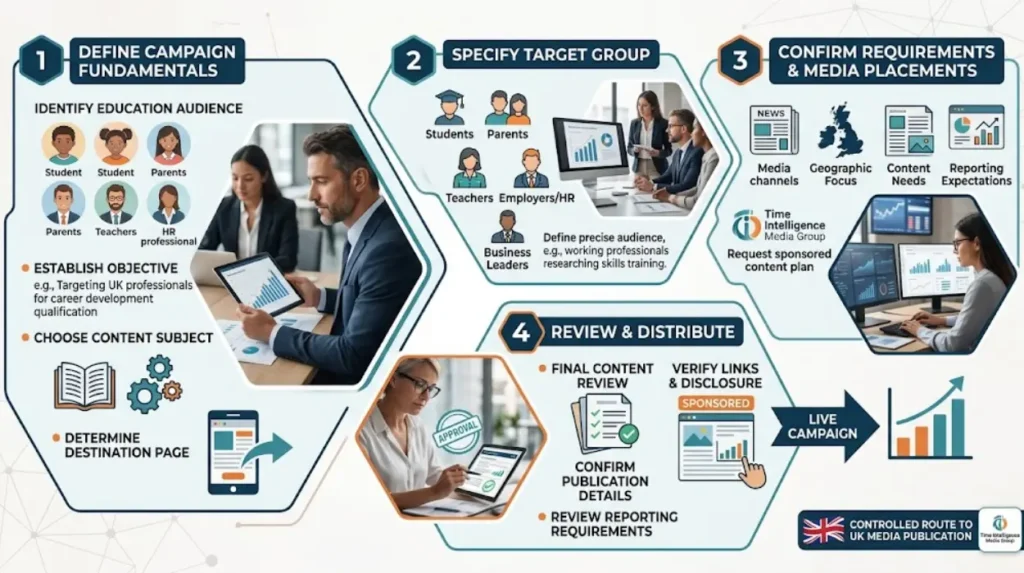
Organisations can start by defining their education audience, campaign objective, subject, destination page, geographic focus, publication requirements, content needs, and reporting expectations before requesting a sponsored content plan from Time Intelligence Media Group.
Start with one measurable objective.
For example, an education provider launching a professional qualification can target UK professionals researching career development and skills training.
Next, define the content subject. The topic needs enough informational value to support a complete article.
Then identify the target audience. Specify whether the campaign targets students, parents, teachers, employers, HR professionals, business leaders, or another defined group.
Explore More Expert Insights:
AI-Optimised Sponsored Content by Time Intelligence Media Group
Legal Sponsored Content by Time Intelligence Media Group
The next step is selecting appropriate media placements and confirming the campaign requirements.
A final review checks the content, links, sponsorship disclosure, publication details, and reporting requirements before distribution.
Education organisations that need a controlled route from content creation to UK media publication can use Time Intelligence Media Group’s sponsored content service to structure the campaign around audience relevance, content quality, visibility, and measurable outcomes.
What are the key benefits of education sponsored content?
Education sponsored content provides education organisations with controlled messaging, relevant audience access, external publication, search visibility, brand exposure, and measurable campaign assets that support specific UK marketing and communication objectives.
The strongest campaigns connect every component to one defined objective.
An education brand seeking awareness needs broad relevant reach. A professional training provider seeking enquiries needs content aligned with a specific decision-making audience. An EdTech company launching a product needs educational content that explains the problem and solution clearly.
This makes sponsored content a practical component of an integrated UK education marketing strategy.
For organisations ready to move from audience research to implementation,
Education Sponsored Content provides a direct route into campaign planning, content development, media placement, and reporting with Time Intelligence Media Group.



