

Sponsored content, public relations, and native advertising are three distinct forms of communication used to distribute brand messages. Sponsored content is paid editorial-style material, PR focuses on earned media attention, and native advertising places paid promotional messages within a publication’s existing advertising environment. Each format has different control, disclosure, distribution, and measurement characteristics.
What is sponsored content?
Sponsored content is paid media content created for a defined audience and published through a media platform under a commercial arrangement. It uses an editorial-style format while remaining identifiable as paid content through disclosure labels such as “Sponsored”, “Paid Content”, or “Advertisement”.
Sponsored content gives an organisation control over the core message, subject, structure, and publication timing. The content often takes the form of an article, interview, expert commentary, case study, research feature, or educational guide.
The defining characteristic is paid placement. A publisher provides access to its audience in return for payment or an agreed commercial arrangement.
What does sponsored content include?
Common sponsored content formats include:
- Expert-led articles
- Industry reports
- Educational features
- Brand interviews
- Customer case studies
- Research-based articles
- Product or service explainers
For example, a technology company can publish an educational article about cybersecurity risks through a business publication. The article carries a paid-content disclosure while presenting information relevant to the publication’s audience.
How is sponsored content different from ordinary editorial content?
Editorial content is selected and controlled by a publication’s editorial team. Sponsored content exists through a paid commercial arrangement.
This distinction affects control. Sponsored content provides greater control over messaging and publication timing. Editorial coverage gives the publication greater control over the final story.
The UK advertising framework also requires commercial content to be recognisable as advertising. Clear disclosure helps audiences distinguish paid communication from independent editorial coverage.
What is PR?
Public relations is the strategic management of communication between an organisation and its audiences. Media relations is one PR activity focused on earning coverage from journalists and publications through newsworthy information, press releases, interviews, briefings, and announcements.
PR covers a wider communication function than media placement alone. It includes reputation management, stakeholder communication, crisis communication, corporate communications, media relations, and public affairs.
How does PR generate media coverage?
PR teams develop information that has potential editorial value. They then present that information to relevant journalists, editors, broadcasters, or publications.
A typical process includes:
- Identifying a newsworthy development.
- Preparing a press release or media pitch.
- Selecting relevant journalists or publications.
- Distributing the information.
- Responding to journalist enquiries.
- Monitoring resulting coverage.
- Measuring media visibility and audience response.
Examples include a company announcing a major investment, a university releasing new research, or a business reporting a significant expansion.
What control does PR provide?
PR does not provide the same publication control as paid content. Journalists decide whether a story receives coverage and determine the editorial treatment.
A press release can provide facts, quotes, statistics, and background information. The resulting article can use some, all, or none of those elements.
This distinction makes PR fundamentally different from sponsored content. Sponsored content purchases a defined media placement. PR seeks independent editorial coverage.
For readers exploring the next stage of this comparison,
Sponsored content vs PR examines how the two formats differ when reaching UK audiences.
What are native ads?
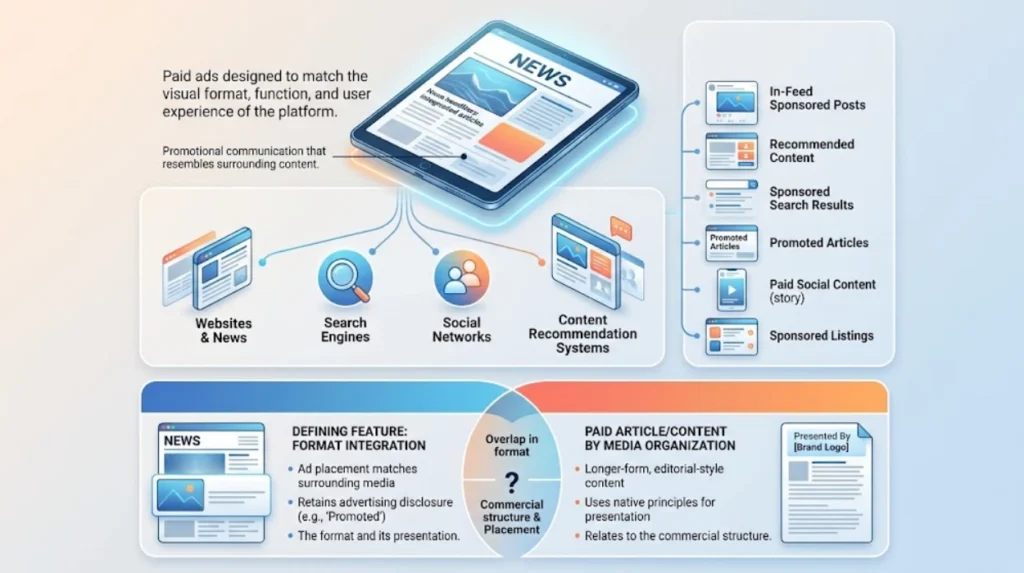
Native advertising is paid advertising designed to match the visual format, function, and user experience of the media environment where it appears. Its purpose is promotional communication delivered through an advertising placement that resembles surrounding platform content.
Native advertising appears across websites, search platforms, social networks, news publishers, and content recommendation systems.
Examples include:
- In-feed sponsored posts
- Recommended-content placements
- Sponsored search results
- Promoted articles
- Paid social content
- Sponsored listings
The defining feature is format integration. A native advertisement fits into the surrounding media environment while retaining advertising disclosure.
How are native ads different from sponsored content?
Sponsored content and native advertising overlap in format, but they are not identical concepts.
Sponsored content generally refers to a paid piece of content published through a media organisation. Native advertising describes the advertising format and its integration into the surrounding user experience.
A sponsored article can therefore use native advertising principles when its presentation resembles the publication’s editorial environment.
The distinction depends on the commercial structure, content format, placement, and publisher terminology.
How do sponsored content, PR, and native ads compare?
Sponsored content provides paid editorial-style placement, PR seeks earned media coverage, and native advertising provides paid promotional placement integrated into a platform’s existing format. The three approaches differ in control, distribution, disclosure, editorial independence, targeting, and measurement.
| Factor | Sponsored Content | PR | Native Advertising |
|---|---|---|---|
| Payment | Paid | Primarily earned | Paid |
| Message control | High | Limited after pitching | High |
| Editorial independence | Commercial content | Independent editorial decision | Advertising environment |
| Disclosure | Required | Not presented as paid advertising | Required |
| Publication timing | Agreed placement | Controlled by publication | Campaign schedule |
| Format | Article, interview, feature | News story, quote, interview | In-feed or platform-native advert |
| Audience access | Publisher audience | Earned media audience | Targeted platform audience |
| Measurement | Views, engagement, clicks | Coverage, reach, mentions | Impressions, clicks, conversions |
This comparison shows why the three formats serve different communication purposes.
Which format provides the most message control?
Sponsored content and native advertising provide greater message control because both involve paid media arrangements. PR provides less control because journalists and editors determine whether and how information becomes editorial coverage.
Which format depends most on editorial interest?
PR depends most directly on editorial interest. A journalist evaluates the relevance, timing, evidence, public interest, and news value of a story.
Sponsored content does not depend on the same editorial selection process because the placement is commercially arranged.
How does the publishing process differ between the three formats?
Sponsored content moves from content development to commercial approval and publication; PR moves from news development to media pitching and independent editorial selection; native advertising moves from creative production to advertising approval, targeting, placement, and campaign delivery.
What happens when sponsored content is published?
The process commonly follows five stages:
- Content planning
- Article development
- Commercial and compliance review
- Publisher approval
- Publication and performance monitoring
The publisher provides the agreed media environment and audience access.
What happens after a PR release is distributed?
A PR release enters the media ecosystem. Journalists assess its relevance against current news agendas.
Coverage depends on factors such as:
- News value
- Timing
- Audience relevance
- Original data
- Expert commentary
- Geographic relevance
- Industry significance
The same announcement can receive extensive coverage from one publication and no coverage from another.
What happens during a native advertising campaign?
Native advertising follows an advertising workflow. The advertiser develops creative assets, defines audience parameters, establishes campaign objectives, and selects placements.
The platform then delivers the advertising content according to its targeting and placement rules.
How do the three formats differ in audience targeting?
Sponsored content reaches the established audience of a selected publication, PR reaches audiences through earned editorial coverage, and native advertising uses defined advertising targeting systems. Audience access therefore depends on publisher readership, editorial pickup, or platform targeting.
Sponsored content works within a publication’s existing audience profile. A financial publication, for example, provides access to readers interested in business and finance.
PR can reach multiple audiences when journalists across national, regional, trade, or specialist publications cover the same announcement.
Native advertising offers targeting based on available platform data and advertising parameters. These parameters can include location, interests, behaviour, device, search activity, or demographic characteristics.
How do measurement methods differ?
Sponsored content is commonly measured through page views, engagement, referral traffic, and clicks. PR measurement focuses on coverage, publication quality, reach, mentions, and sentiment. Native advertising uses impressions, clicks, click-through rate, conversions, and campaign performance metrics.
What does sponsored content measurement show?
Typical metrics include:
- Article views
- Average engagement
- Referral traffic
- Clicks
- Time spent
- Audience interactions
These metrics measure how audiences interact with the published content.
What does PR measurement show?
PR measurement focuses on media outcomes. Metrics include publication mentions, estimated reach, share of voice, backlinks, message inclusion, and sentiment.
A national newspaper article and a specialist trade publication provide different forms of media exposure. Their value depends on the communication objective and audience relevance.
What does native advertising measurement show?
Native advertising provides campaign-level performance data. Advertisers commonly evaluate impressions, clicks, click-through rates, conversions, cost per click, and return on advertising spend.
These metrics support direct performance analysis.
When is sponsored content useful?
Sponsored content is useful when an organisation needs controlled messaging, a defined publication environment, and access to an established media audience. It suits educational communication, thought leadership, research features, interviews, case studies, and detailed subject explanations.
A professional services firm can use sponsored content to explain changes in UK employment practices. A healthcare organisation can use an educational feature to explain a complex treatment area. A technology provider can publish a detailed cybersecurity guide.
The format supports subjects that require more explanation than a short advertisement.
When is PR useful?
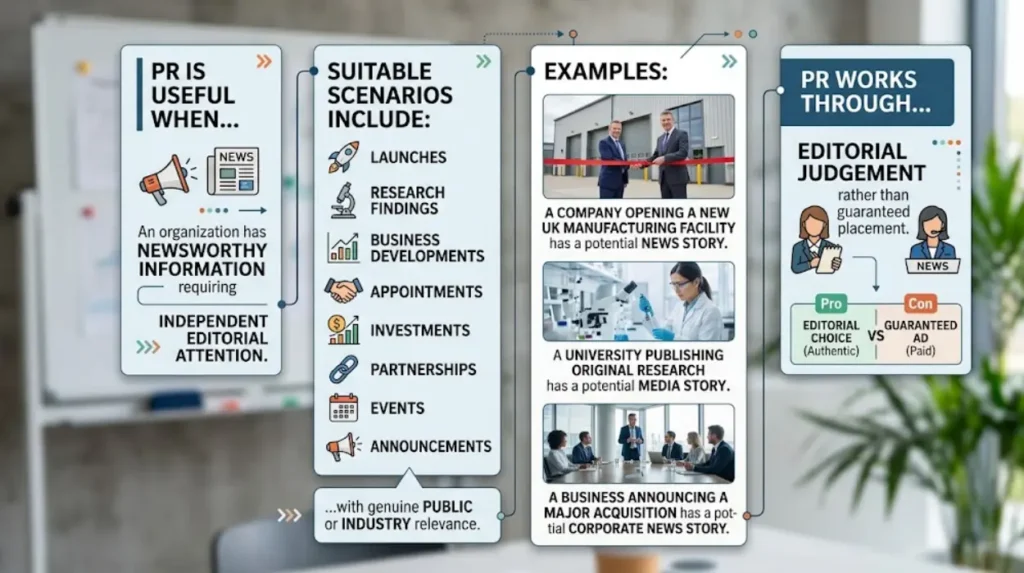
PR is useful when an organisation has newsworthy information that requires independent editorial attention. It suits launches, research findings, business developments, appointments, investments, partnerships, events, and announcements with genuine public or industry relevance.
A company opening a new UK manufacturing facility has a potential news story. A university publishing original research has a potential media story. A business announcing a major acquisition has a potential corporate news story.
PR works through editorial judgement rather than guaranteed placement.
When are native ads useful?
Native ads are useful when an advertiser needs paid audience targeting, scalable distribution, controlled creative assets, and measurable campaign delivery. They suit awareness campaigns, traffic generation, lead generation, product promotion, and performance advertising.
For example, a software company can promote a downloadable guide to a defined professional audience through native placements. The advertiser controls the campaign parameters and measures interactions through advertising metrics.
Explore More Expert Insights:
Why Education Providers Publish UK Sponsored Content
What AI Means for Sponsored Content Discovery in 2026
Why do these formats often work together?
Sponsored content, PR, and native advertising address different communication functions. Sponsored content provides controlled media storytelling, PR generates earned editorial attention, and native advertising provides paid audience distribution. Organisations often select formats according to message control, news value, targeting requirements, and measurement objectives.
A single campaign can contain a news announcement, earned media outreach, a sponsored educational article, and native advertising placements. Each component has a different role.
The important distinction is not which format is universally better. The distinction is how each format creates visibility.
Sponsored content purchases controlled media access. PR earns editorial attention. Native advertising purchases targeted promotional distribution.
Understanding these differences provides a clear foundation for evaluating media strategies in the UK. It also helps separate paid editorial-style communication from earned journalism and native advertising formats.
Organisations comparing sponsored content providers can explore:
Why Time Intelligence Media Group Beats Sponsored Content Rivals to understand how media providers differ in approach, distribution, and content performance.



