
Updating an existing research report is better than publishing a new one when the core methodology remains valid, existing search engine rankings and backlink profiles hold high authority, and the core dataset requires incremental updates rather than a complete structural reinvention.
A research report is a published document containing original data, statistical analysis, industry insights, and methodological frameworks. When organizations accumulate search visibility over 24 months, starting a new URL forfeits earned authority. Content refreshing preserves historical search rankings and accumulated backlink equity from external industry publications.
Deciding between an update and a new publication requires evaluating data decay rates. Fast-moving technology sectors often demand entirely new publications due to structural obsolescence. Regulatory compliance reports, macroeconomic studies, and longitudinal market sizing documents benefit from continuous updates on existing URLs.
Defining Content Decay in Market Research
Content decay describes the gradual loss of search engine traffic, keyword rankings, and citation frequency over time. Digital algorithms prioritize fresh data for time-sensitive queries. When search volume shifts toward updated metrics, older static pages drop in visibility.
Research reports experience decay when foundational statistics exceed three years of age. Industry stakeholders utilize original research for strategic forecasting. Maintaining authoritative search positions requires identifying specific performance drop-offs through analytics platforms.
Evaluating Backlink Equity and Domain Authority
Backlinks are inbound hyperlinks from external web domains pointing to a specific research URL. High-authority domains accumulate hundreds of external citations from academic journals, news outlets, and industry competitors.
Publishing a new URL resets backlink accumulation to zero. Redirecting old URLs to new pages passes a percentage of link equity, but direct inbound links on the original page retain maximum authority value. Preserving these assets protects organic search rankings across competitive keyword landscapes.
What metrics determine if a research report needs a content refresh?
A research report requires a content refresh when organic traffic declines by 20% year-over-year, key statistics exceed three years of age, or search query volume for primary target keywords shifts toward newer industry terminology.
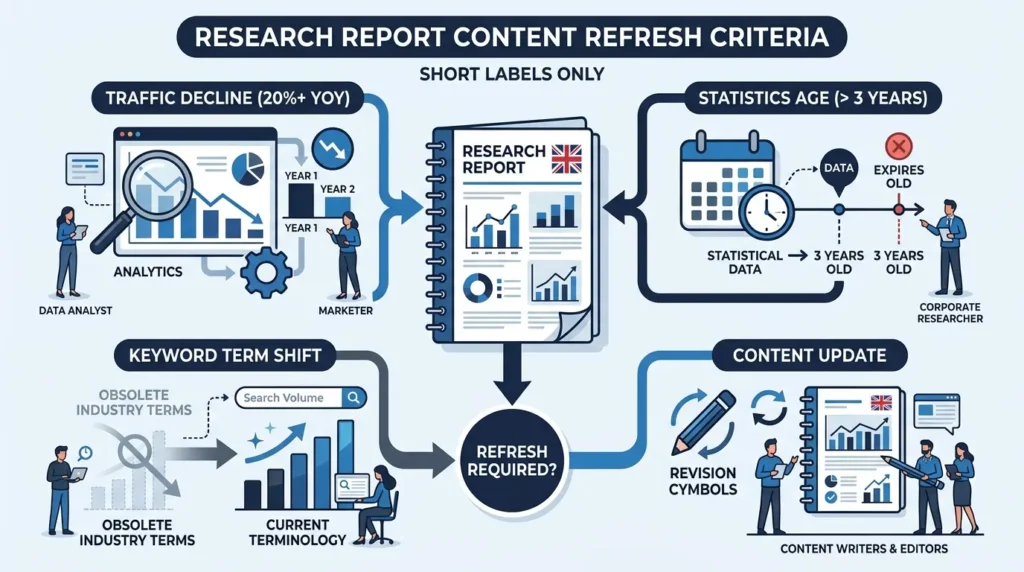
Analytics tools provide quantitative metrics regarding user engagement, bounce rates, and average time on page. Monitoring these data points isolates underperforming digital assets from high-value reports. Editorial teams track specific key performance indicators to establish refresh schedules.
Identifying precise degradation triggers prevents wasted resource allocation. Organizations must analyze traffic logs and citation tracking software to map decay patterns accurately.
Traffic Decline and Keyword Ranking Shifts
Organic traffic degradation manifests as a steady downward curve in search console impressions and clicks. Rankings for primary keywords drop from position one through three down to page two or three.
Keyword cannibalization occurs when multiple URLs target identical search terms. Auditing existing assets identifies whether a legacy research report competes with newer internal content. Consolidating insights onto the original URL resolves cannibalization issues.
Statistical Obsolescence and Data Decay
Statistical obsolescence occurs when numerical data points fail to reflect current market realities. For example, a financial report published in 2021 citing pre-inflation metrics misleads corporate decision-makers in the United Kingdom.
Data validation involves cross-referencing published figures with primary data sources, regulatory bodies, and census data. If more than 40% of statistical tables require replacement, editorial teams must weigh the effort of a refresh against a total rewrite.
Explore More Expert Insights:
How Fintech Companies Acquire Users Using Banner Ads
How Finance Brands Promote Credit Cards Using Display Campaigns
How do you preserve search engine optimization equity during a report update?
Preserving search engine optimization equity during a report update requires maintaining the original uniform resource locator, keeping the primary H1 tag intact, updating the publication timestamp, and adding a detailed revision history note.
Search engine algorithms reward content freshness while penalizing broken links and URL modifications. Altering a uniform resource locator without proper server-side redirection breaks existing inbound links and creates four-hundred-and-four error pages.
Technical optimization protocols ensure that search engine crawlers index updated text without losing historical ranking signals. Implementing structured data markup further clarifies document updates to automated scrapers.
Uniform Resource Locator Preservation and Redirection
Maintaining the exact uniform resource locator preserves the historical link authority accrued over years of publication. If structural restructuring forces uniform resource locator changes, permanent three-hundred-and-one redirects pass equity to the new destination.
Canonical tags signal the primary version of a document to search engine spiders. Setting the canonical tag to the updated asset prevents duplicate content penalties across internal repository subdomains.
Structured Data and Timestamp Updates
Structured data markup utilizes schema types such as Dataset or ScholarlyArticle to communicate document parameters directly to search engines. Updating the dateModified property in the schema code signals recent revisions to automated crawlers.
Visible timestamps on the webpage inform human readers of data currency. Displaying both original publication dates and recent revision dates builds user trust and confirms analytical accuracy.
Readers interested in the educational stage of healthcare awareness campaigns can explore [Insert Link to MOFU Article]. Strategic leaders seeking execution frameworks can evaluate [Insert Link to BOFU Article].
What are the cost and efficiency benefits of updating versus rewriting?
Updating an existing research report reduces content production costs by 50% compared to a complete rewrite, shortens editorial timelines from months to weeks, and leverages established distribution channels instantly.
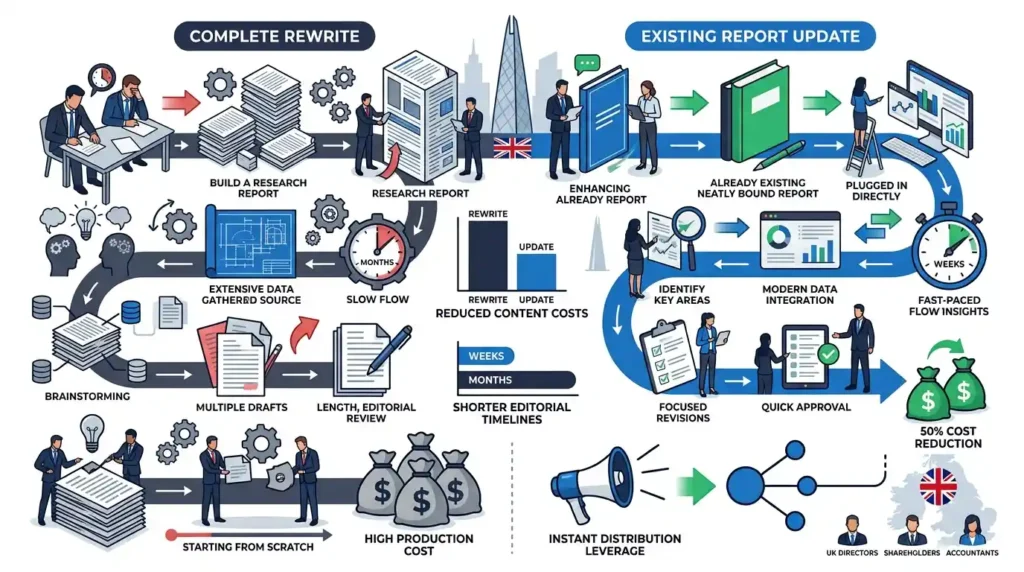
Resource allocation remains a primary constraint for enterprise publishing teams. Conducting primary research, survey design, and data cleansing requires significant capital expenditure and man-hours.
Updating existing assets maximizes return on investment from initial research budgets. Editorial teams focus efforts on statistical verification and commentary expansion rather than raw data collection.
Resource Allocation and Production Timelines
Drafting a comprehensive 10,000-word research report requires an average of twelve weeks from conception to publication. Updating statistical figures and expanding qualitative commentary compresses this timeline to three weeks.
Resource efficiency allows subject matter experts to allocate hours toward advanced data analysis rather than foundational drafting. Cost savings apply directly to graphic design, editorial review, and promotional syndication.
Amplifying Existing Distribution and Social Shares
Published reports accumulate social media shares across LinkedIn, Twitter, and professional forums over extended periods. Updating the asset allows marketing teams to relaunch the existing URL across email newsletters without generating new link structures.
Subscribers clicking legacy links land on a refreshed, highly accurate document. This strategy maintains continuous engagement loops and reinforces brand authority within target industries across the United Kingdom.
When is a complete rewrite mandatory instead of a report update?
A complete rewrite is mandatory when structural market shifts render the original methodology obsolete, regulatory frameworks change entirely, or the target audience demographics pivot toward new professional sectors.
Certain macroeconomic events or technological paradigm shifts invalidate historical baselines entirely. Artificial intelligence automation in professional services represents an instance where legacy 2019 reports offer zero utility for current market participants.
Attempting to update fundamentally flawed foundational frameworks results in disjointed, unreadable documents. Recognizing structural tipping points protects editorial credibility and brand reputation.
Fundamental Shifts in Industry Methodology
Methodological obsolescence occurs when data collection techniques, survey parameters, or analytical models face replacement by superior industry standards. Updating outdated methodologies compromises the statistical integrity of the entire publication.
When core investigative premises change, publishing a new report establishes a fresh baseline for future longitudinal studies. Brands maintain credibility by acknowledging industry evolution through newly commissioned research.
Regulatory and Audience Demographic Changes
Major legislative updates, such as post-Brexit trade agreements in the United Kingdom, alter compliance requirements across supply chain and financial sectors. Legacy reports omitting new legal frameworks require total reconstruction.
Audience shifts occur when enterprise decision-makers change job titles, strategic priorities, or operational tools. Tailoring new publications to emerging buyer personas ensures optimal alignment with modern market demands.
Deciding whether to update an existing research report or publish a new one depends on data validity, backlink equity, and structural market changes. Preserving high-performing URLs protects accumulated search rankings and external citations. Minor statistical updates justify a content refresh, whereas fundamental methodological shifts require a complete rewrite.