
A UK media blackout is a period when an organisation, business, public figure, or campaign receives little or no meaningful coverage from UK news outlets despite having information that normally qualifies for publication. Media blackouts reduce visibility, weaken public awareness, and limit opportunities to shape public narratives. Understanding why blackouts happen and how organisations recover from them helps improve future media engagement and communication planning.
What is a UK media blackout?
A UK media blackout is a sustained period during which UK media organisations publish little or no coverage about a person, organisation, event, or topic despite ongoing communication efforts. It results from editorial decisions, changing news priorities, or ineffective media engagement strategies.
A media blackout differs from a temporary lack of coverage. A single rejected press release does not indicate a blackout. Instead, repeated attempts across multiple news cycles fail to generate meaningful editorial interest.
In the United Kingdom, national newspapers, regional publications, broadcast organisations, trade journals, and digital news platforms all follow editorial standards that determine which stories receive coverage.
A blackout affects organisations of every size. Examples include:
- A charity launching an annual fundraising campaign without local media coverage.
- A technology startup announcing product updates that receive no industry reporting.
- A manufacturing company expanding operations without appearing in regional business news.
How is a media blackout different from negative publicity?
Negative publicity still generates media attention.
A media blackout produces little or no editorial visibility.
Both situations require different communication responses because the underlying issues differ significantly.
Why does a UK media blackout happen?

UK media blackouts occur because editors prioritise newsworthiness, relevance, timing, audience value, and editorial quality. Stories lacking these characteristics receive limited attention regardless of organisational size or communication frequency.
Several factors contribute to media blackouts.
Poor news value
Editors select stories that affect readers directly.
Announcements without measurable impact often receive low priority.
For example:
- Routine internal promotions
- Minor website updates
- General business anniversaries without wider significance
Weak regional relevance
Regional publications prioritise stories affecting local communities.
A nationwide announcement without local impact often receives limited regional coverage.
Examples include:
- Local employment growth
- Community investment
- Educational partnerships
- Infrastructure projects
Oversaturated news periods
Major national events reduce space for other stories.
Examples include:
- General elections
- Government budgets
- Severe weather emergencies
- National sporting tournaments
During these periods, editorial resources shift toward higher-priority developments.
Repetitive messaging
Editors recognise repeated announcements containing similar information.
Publishing nearly identical press releases over several months reduces editorial interest.
Inaccurate media targeting
Sending healthcare news to automotive journalists or retail announcements to technology editors lowers publication opportunities.
Relevant journalist targeting remains an essential part of effective media communication.
How can you identify a media blackout?
A media blackout becomes identifiable through measurable indicators including declining publication rates, reduced journalist engagement, falling share of voice, and consistent rejection or non-publication across multiple media outlets over an extended period.
Several measurable indicators reveal declining visibility.
Declining media mentions
Monitor published articles over time.
Compare:
- Monthly mentions
- Quarterly coverage
- Year-on-year visibility
A sustained decline indicates reduced editorial interest.
Reduced journalist responses
Journalists often acknowledge relevant stories through replies, requests for interviews, or additional information.
Consistent silence across multiple campaigns signals reduced engagement.
Falling share of voice
Share of voice measures how frequently an organisation appears compared with competitors.
If competitors receive regular coverage while your organisation disappears from reporting, visibility has declined.
Limited search visibility
News coverage influences branded search visibility.
Fewer published articles often correspond with fewer recent search results for organisational announcements.
What steps help recover from a UK media blackout?
Recovery begins by evaluating previous media activity, improving story quality, refining targeting, strengthening evidence, and rebuilding relationships with relevant journalists through consistent, newsworthy communication supported by measurable facts and verified information.
Recovery follows a structured process rather than isolated actions.
Audit previous media activity
Review previous announcements objectively.
Evaluate:
- Headlines
- News angles
- Supporting evidence
- Journalist lists
- Publication results
Patterns often reveal recurring weaknesses.
Readers seeking structured evaluation methods can explore:
Audit Your Current UK PR Distribution.
Improve newsworthiness
Editors prioritise developments with measurable public value.
Useful evidence includes:
- Employment numbers
- Investment values
- Survey findings
- Independent research
- Regulatory changes
- Industry data
Specific figures improve editorial clarity.
Strengthen regional relevance
Regional editors seek stories affecting their communities.
Local examples include:
- Opening new facilities
- Creating jobs
- Supporting schools
- Community partnerships
- Infrastructure improvements
Regional context increases publication relevance.
Update journalist targeting
Journalists specialise in specific sectors.
Examples include:
- Healthcare reporters
- Property correspondents
- Technology editors
- Manufacturing journalists
- Local government reporters
Matching stories to specialist journalists improves editorial relevance.
Refresh supporting materials
Supporting assets increase editorial efficiency.
Useful materials include:
- Executive quotations
- Professional photographs
- Infographics
- Research summaries
- Statistical tables
Editors value complete information packages.
Which communication mistakes extend a media blackout?
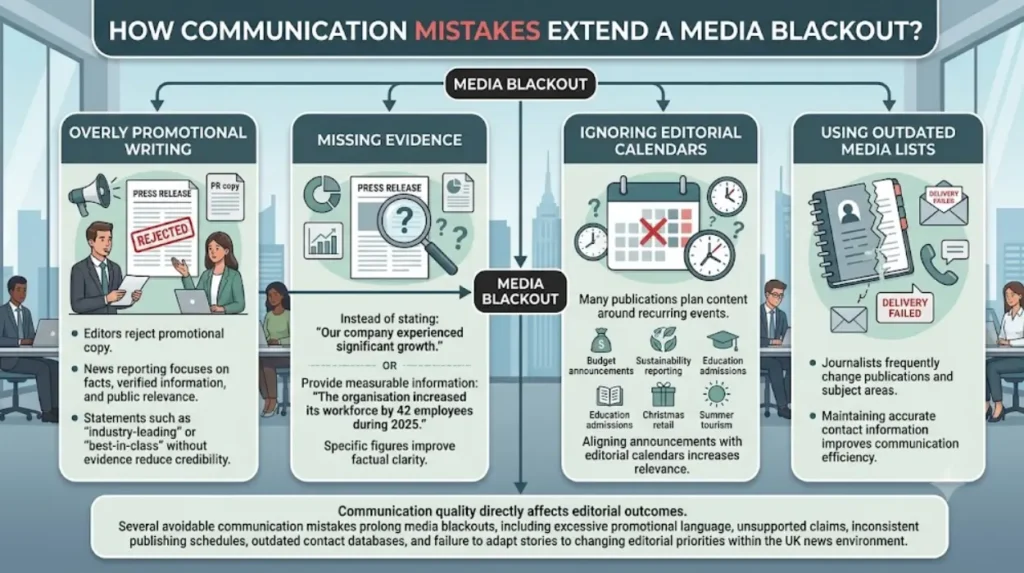
Several avoidable communication mistakes prolong media blackouts, including excessive promotional language, unsupported claims, inconsistent publishing schedules, outdated contact databases, and failure to adapt stories to changing editorial priorities within the UK news environment.
Communication quality directly affects editorial outcomes.
Overly promotional writing
Editors reject promotional copy.
News reporting focuses on facts, verified information, and public relevance.
Statements such as “industry-leading” or “best-in-class” without evidence reduce credibility.
Missing evidence
Claims require verification.
Instead of stating:
“Our company experienced significant growth.”
Provide measurable information:
“The organisation increased its workforce by 42 employees during 2025.”
Specific figures improve factual clarity.
Ignoring editorial calendars
Many publications plan content around recurring events.
Examples include:
- Budget announcements
- Sustainability reporting
- Education admissions
- Christmas retail
- Summer tourism
Aligning announcements with editorial calendars increases relevance.
Using outdated media lists
Journalists frequently change publications and subject areas.
Maintaining accurate contact information improves communication efficiency.
What role does content quality play during recovery?
High-quality content improves editorial assessment because it provides accurate information, structured evidence, clear headlines, verified statistics, and relevant context that journalists can evaluate quickly within busy newsroom environments.
Editors assess information rapidly.
Clear content improves comprehension.
Write factual headlines
Effective headlines explain the actual development.
Examples:
- Manufacturing company creates 120 new jobs in Yorkshire
- University research identifies new renewable energy process
- Local council approves housing regeneration project
Each headline communicates measurable news immediately.
Include verified statistics
Reliable data strengthens credibility.
Examples include statistics from:
- Office for National Statistics
- NHS England
- Companies House
- UK Government departments
- Industry associations
Verified evidence improves editorial confidence.
Answer essential questions
Every announcement benefits from answering:
- What happened?
- Who is involved?
- Where did it happen?
- When did it happen?
- Why is it important?
Complete information reduces follow-up requests.
How long does recovery from a UK media blackout take?
Recovery depends on publishing consistent, newsworthy information across multiple communication cycles. Improvement appears gradually as stronger stories receive editorial attention and journalist relationships become active through relevant, factual engagement.
Recovery rarely occurs after one announcement.
Editors evaluate organisations over time.
Consistent publication quality produces stronger long-term visibility than isolated campaigns.
Monitoring performance helps identify improvement.
Useful metrics include:
- Published articles
- Journalist responses
- Regional coverage
- National mentions
- Industry publication appearances
- Search visibility
- Share of voice
Tracking these indicators reveals measurable progress.
Explore More Expert Insights:
How Press Release SEO Works Differently in the UK vs the US
What UK B2B Buyers Actually Read in Trade Publications
How can organisations reduce the risk of future media blackouts?
Organisations reduce future media blackouts by maintaining editorial relevance, publishing verified information consistently, monitoring media performance, understanding audience interests, and adapting communication strategies to changing UK news priorities throughout the year.
Prevention relies on continuous improvement rather than occasional activity.
Effective long-term practices include:
- Publishing only genuinely newsworthy announcements.
- Supporting every claim with measurable evidence.
- Maintaining accurate journalist databases.
- Monitoring publication performance regularly.
- Updating communication strategies based on results.
- Adapting stories for regional audiences where appropriate.
- Following changing editorial priorities throughout the year.
Organisations that continuously evaluate media performance identify declining visibility earlier and adjust communication before prolonged blackouts develop.
Readers interested in understanding regional media coverage considerations can explore:
Time Intelligence Media Group Different UK Regional Coverage.
A UK media blackout occurs when organisations receive little or no meaningful editorial coverage despite ongoing communication efforts. Recovery depends on understanding editorial priorities, improving newsworthiness, strengthening evidence, targeting relevant journalists, and monitoring measurable performance over time.
Media blackouts result from identifiable communication and editorial factors rather than random events. Organisations that produce factual, relevant, and evidence-based announcements improve their opportunities for consistent media visibility. Regular performance audits, stronger regional relevance, accurate journalist targeting, and measurable news value help restore editorial attention while reducing the likelihood of future blackouts.