
The UK property and construction sector influences housing, infrastructure, commercial development, sustainability, and regional economic growth. Journalists regularly report on projects, planning decisions, investment, technology, regulations, and market trends. Firms that provide accurate, newsworthy information earn editorial media coverage through relevance, evidence, and timing rather than advertising.
What is media coverage for UK property and construction firms?
Media coverage is the publication or broadcast of editorial content about property and construction businesses in newspapers, magazines, online news platforms, trade publications, television, radio, and digital media based on news value instead of paid advertising or sponsored placement.
Media coverage refers to independent reporting by journalists and editors. Editorial decisions depend on whether information serves the public interest, explains industry developments, or affects communities.
Property firms include residential developers, commercial developers, estate investment companies, housing associations, and property management organisations.
Construction firms include main contractors, subcontractors, engineering companies, civil infrastructure specialists, architects, and building technology providers.
Examples of media coverage include:
- A regional newspaper reporting on a new housing development.
- A trade publication covering a modular construction project.
- A business publication analysing commercial property investment.
- A national broadcaster discussing major infrastructure works.
Editorial coverage differs from advertising because journalists independently decide whether to publish a story.
Why do journalists cover property and construction stories?
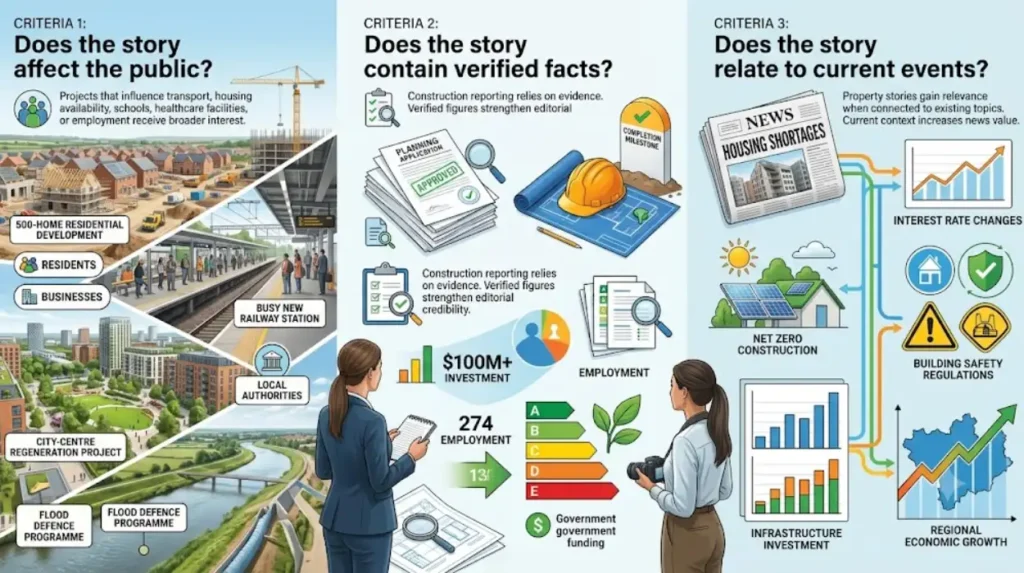
Journalists cover property and construction because the sector affects housing supply, employment, infrastructure, environmental policy, local communities, public investment, and economic development. Stories with measurable public impact receive stronger editorial attention than routine business announcements.
Editors evaluate stories using established news values.
Does the story affect the public?
Projects that influence transport, housing availability, schools, healthcare facilities, or employment receive broader interest.
For example:
- A 500-home residential development.
- A new railway station.
- A city-centre regeneration project.
- A flood defence programme.
These developments affect residents, businesses, and local authorities.
Does the story contain verified facts?
Construction reporting relies on evidence.
Examples include:
- Planning approvals.
- Completion milestones.
- Investment values.
- Employment numbers.
- Energy performance ratings.
- Government funding.
Verified figures strengthen editorial credibility.
Does the story relate to current events?
Property stories gain relevance when connected to existing topics such as:
- Housing shortages.
- Interest rate changes.
- Net zero construction.
- Building safety regulations.
- Infrastructure investment.
- Regional economic growth.
Current context increases news value.
What types of property and construction news attract media attention?
Newsworthy property and construction stories include project launches, planning approvals, major investments, sustainability achievements, research findings, community initiatives, industry innovation, executive appointments, and measurable business milestones supported by verified information.
Not every company update qualifies as news.
Project announcements
Large developments generate significant coverage.
Examples include:
- Mixed-use developments.
- Affordable housing projects.
- Logistics parks.
- Office developments.
- Retail regeneration.
Journalists look for project scale, investment value, timelines, and community impact.
Planning and development updates
Planning decisions often receive regional reporting.
Examples include:
- Planning approval.
- Reserved matters approval.
- Development amendments.
- Infrastructure agreements.
- Regeneration framework adoption.
These decisions affect residents and businesses.
Sustainability achievements
Environmental performance receives increasing attention.
Examples include:
- Net zero developments.
- BREEAM certification.
- Passivhaus construction.
- Low-carbon materials.
- Circular economy initiatives.
Environmental data strengthens reporting.
Industry research
Original research attracts media attention when supported by evidence.
Examples include:
- Regional housing demand reports.
- Construction skills surveys.
- Commercial occupancy studies.
- Build cost analysis.
- Development trend reports.
Original data provides journalists with new information.
How do firms create newsworthy property stories?
Newsworthy stories combine verified facts, measurable impact, public relevance, expert insight, and current industry context. Editorial value comes from explaining why developments matter rather than promoting a company or project.
Many businesses possess useful information but present it as marketing instead of news.
Focus on measurable outcomes
Editors prefer facts over promotional claims.
Useful information includes:
- Project size.
- Investment value.
- Number of homes.
- Construction timeline.
- Employment created.
- Carbon reduction.
- Local economic impact.
Specific figures improve credibility.
Explain wider significance
A project becomes more relevant when linked to broader issues.
Examples include:
- Addressing housing shortages.
- Supporting regional regeneration.
- Improving transport.
- Increasing renewable energy capacity.
- Modernising healthcare facilities.
Public benefit increases editorial interest.
Include expert commentary
Industry specialists help explain technical developments.
Examples include commentary on:
- Building regulations.
- Sustainable construction.
- Planning policy.
- Housing demand.
- Infrastructure delivery.
Expert insight provides useful context for journalists.
How does the UK media evaluate construction announcements?
Editors assess construction announcements using editorial standards that prioritise factual accuracy, public interest, independent verification, supporting evidence, and relevance to readers instead of commercial messaging or promotional language.
Every newsroom applies editorial judgement before publication.
Accuracy
Journalists verify:
- Dates.
- Financial figures.
- Planning references.
- Project locations.
- Company names.
- Supporting documents.
Accurate information reduces corrections.
Public relevance
Editors ask whether readers benefit from knowing about the development.
Stories affecting transport, housing, education, healthcare, or employment usually receive greater attention.
Evidence
Supporting documents improve credibility.
Examples include:
- Planning decisions.
- Government announcements.
- Official reports.
- Environmental assessments.
- Industry research.
Evidence supports factual reporting.
Which media outlets report on UK property and construction?
UK property and construction reporting appears across national newspapers, regional publications, trade magazines, business media, specialist websites, television, radio, and digital news platforms serving different audiences and geographical areas.
Different publications cover different types of stories.
National media
National outlets focus on:
- Major infrastructure.
- National housing policy.
- Large investment projects.
- Economic trends.
- Government initiatives.
These stories influence readers across the UK.
Regional publications
Regional news focuses on local developments.
Examples include:
- Housing schemes.
- Planning decisions.
- Commercial developments.
- Community regeneration.
- Road improvements.
Local relevance drives coverage.
Trade publications
Industry publications report on technical developments.
Topics include:
- Engineering.
- Architecture.
- Building materials.
- Construction technology.
- Health and safety.
- Procurement.
Trade audiences seek technical detail.
How can firms improve the quality of their media information?

High-quality media information uses factual language, verified statistics, clear structure, accurate quotations, supporting evidence, and concise explanations that help journalists understand complex developments quickly and accurately.
Well-prepared information reduces editorial workload.
Use clear factual language
Avoid exaggerated descriptions.
Instead of broad promotional claims, describe:
- Project specifications.
- Verified milestones.
- Financial investment.
- Completion dates.
- Technical achievements.
Simple language improves clarity.
Organise information logically
A clear structure often includes:
- Main announcement.
- Supporting facts.
- Industry context.
- Expert comment.
- Background information.
Logical organisation improves readability.
Verify every statistic
Editors expect numbers to match official documentation.
Examples include:
- Planning records.
- Financial statements.
- Government datasets.
- Industry reports.
Verified information strengthens credibility.
Readers comparing distribution practices later in the buying process can explore:
Comparing Turnaround Times Across UK PR Distribution Services.
What common mistakes reduce media coverage opportunities?
Editorial opportunities decline when announcements lack news value, include unsupported claims, contain inaccurate information, ignore public relevance, or focus entirely on marketing rather than factual developments affecting people, projects, or industry trends.
Several issues repeatedly reduce publication opportunities.
Promotional language
Statements such as “industry-leading,” “world-class,” or “best-in-class” provide little editorial value.
Journalists replace marketing language with factual reporting.
Missing evidence
Announcements without supporting information lose credibility.
Evidence includes:
- Official approvals.
- Financial data.
- Research findings.
- Project specifications.
- Public records.
Evidence supports independent verification.
Weak news angles
Routine business updates rarely receive editorial attention.
Announcements become stronger when connected to:
- Policy changes.
- Community impact.
- Market trends.
- Economic development.
- Innovation.
Context improves relevance.
Explore More Expert Insights:
What a UK Media Blackout Is and How to Recover From One
How Press Release SEO Works Differently in the UK vs the US
How does media coverage support long-term business visibility?
Consistent editorial coverage builds public awareness, documents organisational milestones, demonstrates sector expertise, creates searchable information, and contributes to an accessible record of industry activity across trusted media sources over time.
Media coverage creates a documented history of business activity.
Published reporting helps stakeholders understand:
- Project delivery.
- Market participation.
- Industry expertise.
- Community involvement.
- Innovation.
- Economic contribution.
Search engines also index editorial content, making verified information easier to discover.
Over time, repeated factual reporting creates a comprehensive public record that benefits investors, partners, policymakers, customers, researchers, and journalists seeking reliable background information.
Businesses exploring implementation processes after understanding media fundamentals can continue with:
How Time Intelligence Media Group Onboards New UK Clients, although the educational concepts in this article remain applicable regardless of any specific provider.
UK property and construction firms earn media coverage by presenting accurate, evidence-based, and newsworthy information that serves the public interest. Journalists prioritise developments with measurable impact, verified facts, and clear relevance to housing, infrastructure, sustainability, investment, and local communities.
Successful editorial coverage depends on factual communication rather than promotion. Projects with documented outcomes, original research, planning developments, sustainability achievements, and significant community impact provide stronger foundations for media reporting. By understanding how journalists evaluate stories, property and construction organisations can present information that contributes meaningfully to public understanding of the UK’s built environment.