Local advertising helps property developers reach nearby buyers, businesses, and community stakeholders. However, attracting out-of-state investors requires broader visibility, stronger credibility, and consistent exposure across multiple information channels. Investors researching opportunities beyond their region rely on national property news, financial publications, industry reports, and digital search results instead of local advertising alone.
Understanding these differences helps developers build communication strategies that match investor behaviour and support wider market awareness.
Why does local advertising fail to reach out-of-state property investors?
Local advertising targets audiences within a defined geographic area, while out-of-state investors search nationally for verified investment opportunities. Limited geographic distribution, restricted media exposure, and low digital visibility prevent many local campaigns from reaching decision-makers outside their immediate market effectively.
Local advertising includes newspaper advertisements, regional radio campaigns, community magazines, roadside billboards, and locally targeted digital advertisements. These channels primarily reach residents living within a specific location.
Out-of-state investors follow different information sources. They evaluate projects through national property publications, investment news websites, commercial real estate journals, market research reports, and search engines.
For example, a residential development in Manchester advertised only through local newspapers reaches nearby homebuyers. An investor based in Edinburgh or Belfast never encounters that campaign during property research.
This gap limits awareness before investment decisions begin.
What defines local advertising?
Local advertising is promotional activity designed for audiences living or working within a limited geographic area.
Examples include:
- Local newspapers
- Regional magazines
- Community radio
- Local television
- City-based social media campaigns
- Outdoor advertising within one region
These channels prioritise local visibility rather than national exposure.
How do investors discover property developments?
Investors collect information from multiple trusted sources before reviewing investment opportunities.
Common sources include:
- National property news
- Commercial real estate publications
- Investment databases
- Industry conferences
- Professional networks
- Search engines
- Financial media
These channels extend beyond local advertising boundaries.
How do out-of-state investors research property developments?
Out-of-state investors use structured research processes that compare market data, developer credibility, project performance, planning information, economic conditions, and long-term growth indicators. Their decisions depend on verified information gathered from several independent sources rather than local promotional campaigns alone.
Investment decisions involve financial analysis instead of simple product discovery.
Most investors compare dozens of developments before contacting developers.
Market analysis comes first
Investors evaluate regional growth before reviewing individual projects.
Typical research includes:
- Population growth
- Employment rates
- Infrastructure investment
- Rental demand
- Commercial expansion
- Transport improvements
For example, a logistics development near a new motorway attracts investors because infrastructure supports future demand.
Project verification follows market research
After selecting a location, investors verify project-specific information.
They examine:
- Planning approval
- Construction timeline
- Development size
- Property type
- Developer history
- Expected completion date
Local advertising rarely contains sufficient detail for this evaluation.
Digital visibility influences discovery
Search engines organise enormous volumes of investment information.
Developments appearing across multiple trusted websites receive greater visibility during investor research.
Projects limited to local advertising often remain absent from broader search results.
What information do investors expect before considering a development?
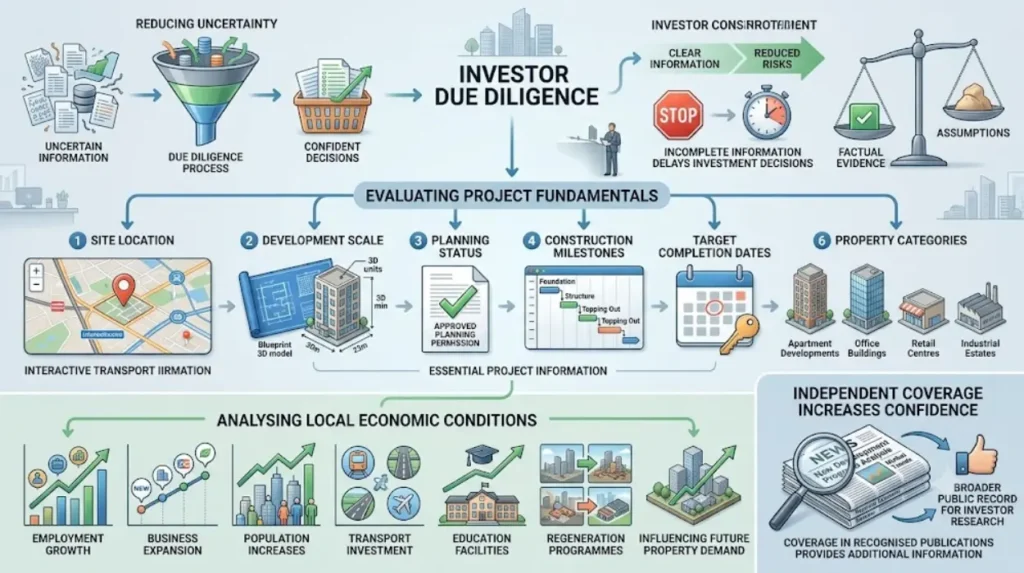
Investors expect factual information supported by measurable evidence. They review financial indicators, construction progress, planning status, developer experience, location data, and market demand before allocating capital to residential, commercial, industrial, or mixed-use property developments across different regions.
Clear information reduces uncertainty during evaluation.
Incomplete information delays investment decisions.
Investors evaluate project fundamentals
Essential project information includes:
- Site location
- Development scale
- Planning status
- Construction milestones
- Target completion dates
- Property categories
Examples include apartment developments, office buildings, retail centres, and industrial estates.
Investors analyse local economic conditions
Economic performance supports long-term investment decisions.
Relevant indicators include:
- Employment growth
- Business expansion
- Population increases
- Transport investment
- Education facilities
- Regeneration programmes
These factors influence future property demand.
Independent coverage increases confidence
Coverage across recognised publications provides additional information beyond developer-produced materials.
Independent reporting creates a broader public record that investors use during research.
Why is national visibility important for property developments?
National visibility expands audience reach beyond local markets and increases opportunities for investors, lenders, consultants, and commercial partners to discover new developments through trusted information channels during their normal research activities across the United Kingdom.
Property investment operates across regional boundaries.
Capital frequently moves between cities based on market performance.
National exposure broadens awareness
A project visible nationally reaches:
- Institutional investors
- Private investors
- Property consultants
- Commercial brokers
- Financial analysts
Each audience contributes to wider market recognition.
Broader visibility supports search discovery
Search engines evaluate information from numerous sources.
Projects referenced across multiple publications often become easier to discover through relevant searches.
This increases opportunities for investors conducting independent research.
National attention supports competitive positioning
Developers compete with projects across the country rather than only within one city.
Greater visibility helps developments enter wider market comparisons.
Readers seeking practical communication strategies can continue with:
The Developer’s Guide to Crafting High-Impact Press Releases for Groundbreaking Ceremonies.
Which communication channels support wider investor awareness?
Property developments achieve broader awareness through multiple communication channels working together. National media, industry publications, search optimisation, professional events, investor communications, and public information resources each contribute different forms of visibility across the investment landscape.
No single communication channel reaches every investor.
Multiple channels improve information accessibility.
National media
National business publications report major developments, regeneration projects, and significant construction activity.
These publications reach wider audiences than local newspapers.
Industry publications
Property trade publications focus specifically on commercial and residential development.
Examples include:
- Housing developments
- Office construction
- Industrial logistics
- Student accommodation
- Mixed-use regeneration
These publications serve specialist audiences.
Search engines
Search engines organise publicly available information.
Projects appearing across trusted sources become easier to locate through relevant searches.
Professional events
Property conferences introduce developments to:
- Investors
- Developers
- Architects
- Surveyors
- Construction firms
Industry events expand professional awareness beyond local markets.
How does credibility influence investor decisions?
Credibility demonstrates that project information is accurate, consistent, and verifiable. Investors compare official documentation, independent reporting, planning records, financial information, and developer history before progressing from initial awareness to detailed investment evaluation and commercial discussions.
Credibility reduces information gaps.
Consistent information improves research efficiency.
Consistent information matters
Project descriptions remain consistent across:
- Official announcements
- Planning documents
- Property databases
- Industry publications
Conflicting information creates uncertainty.
Independent verification strengthens confidence
Investors compare developer information with external reporting.
Independent sources confirm important project milestones such as:
- Planning approval
- Groundbreaking
- Construction progress
- Completion announcements
Long-term visibility creates a public record
Major developments often progress over several years.
Regular public updates document key milestones throughout construction.
This creates a searchable project history.
What communication strategy attracts wider investment attention?
Successful communication strategies combine factual reporting, consistent project updates, national visibility, digital accessibility, and transparent information sharing. Each stage provides investors with reliable information supporting efficient research across different markets and development sectors throughout the investment lifecycle.
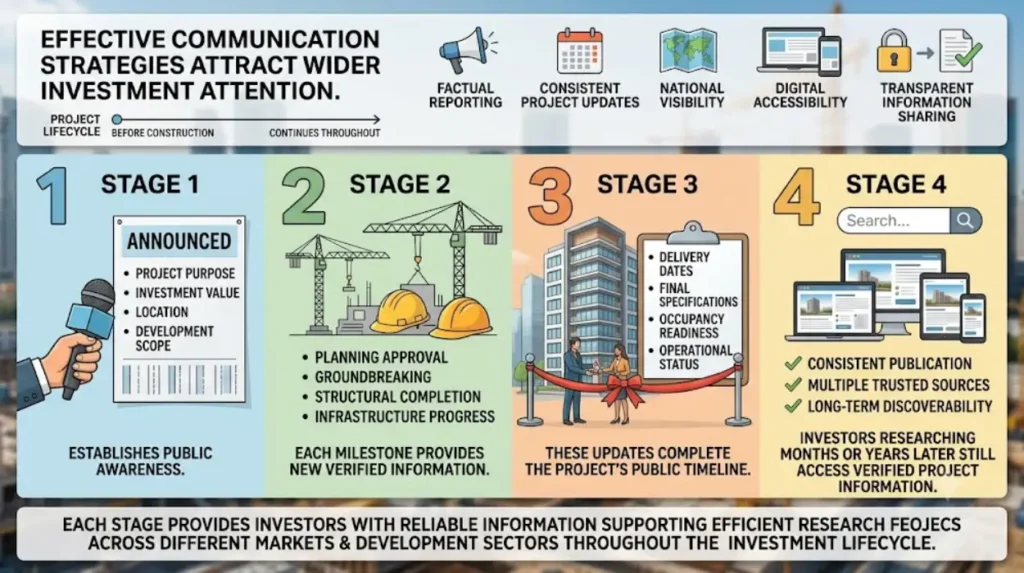
Communication begins before construction.
It continues throughout the project lifecycle.
Stage 1: Introduce the project
Initial announcements explain:
- Project purpose
- Investment value
- Location
- Development scope
This establishes public awareness.
Stage 2: Share construction milestones
Important updates include:
- Planning approval
- Groundbreaking
- Structural completion
- Infrastructure progress
Each milestone provides new verified information.
Stage 3: Publish completion updates
Completion announcements confirm:
- Delivery dates
- Final specifications
- Occupancy readiness
- Operational status
These updates complete the project’s public timeline.
Stage 4: Maintain searchable information
Consistent publication across multiple trusted sources improves long-term discoverability.
Investors researching months or years later still access verified project information.
Readers exploring implementation strategies can continue with:
What are the key lessons for property developers?
Property developers attract broader investor attention by understanding how investment research differs from local consumer marketing. National visibility, transparent information, consistent communication, and accessible project documentation support informed investment evaluation across regional boundaries and changing market conditions.
Local advertising remains valuable for community engagement and nearby audiences.
It does not provide comprehensive visibility for investors researching opportunities across the United Kingdom.
Developers benefit from recognising how investors collect information before making financial decisions. Investors compare locations, analyse market conditions, verify project details, and review independent information from multiple trusted sources. Communication strategies that provide accurate, consistent, and searchable information support this research process.
Explore More Expert Insights:
Why Relying Solely on Social Media Algorithms is a Risky Strategy for New D2C Brands
How Modern Retail Industry Analysts and Influencers Discover Breakthrough Startups
A structured approach combining factual project updates, broader visibility, and transparent reporting helps developments become discoverable beyond their immediate geographic market. This improves awareness among investors evaluating opportunities across different regions and property sectors while supporting informed decision-making through reliable public information.