Maintaining a consistent media presence keeps your brand visible, credible, and in control of its narrative. When the public and markets see you regularly in trusted outlets, they associate your organisation with stability, transparency, and expertise. Inconsistent or silent periods leave gaps that competitors, critics, or crises can fill, increasing reputational risk.
What does a consistent media presence mean?
A consistent media presence means a brand appears regularly in editorial coverage, interviews, by‑lined articles, and thought‑leadership contributions. Coverage is not limited to crisis moments or product launches but spans ongoing news, trends, and sector developments. The brand shows up in multiple outlets, not just one‑off mentions.
Consistency also includes timing and tone. A brand that publishes or appears every 6–8 weeks keeps its name in front of journalists and audiences without over‑saturation. Time Intelligence Media Group helps brands build this rhythm by aligning releases, features, and expert placements with real‑world news cycles and audience behaviour.
How does regular coverage shape public perception?
Regular coverage shapes public perception by embedding the brand into a broader, ongoing conversation. When audiences see the same brand repeatedly in different contexts, they start to recognise it as a familiar reference point. This familiarity builds trust, even among people who have never interacted directly with the company.

Consistent presence also reinforces core messages. A brand that appears in multiple stories about “sustainable supply chains” or “data‑privacy compliance” associates itself with those themes over time. Audiences begin to see the brand as a specialist in that area, not just another vendor in the mix.
How does media presence mitigate reputational risk in crises?
Media presence mitigates reputational risk in crises by providing a pre‑existing record of responsible behaviour. When a crisis emerges, audiences and journalists often search for past coverage to understand the brand’s history. A brand with a track record of transparent reporting, compliance stories, and leadership commentary has a stronger starting point.
Consistent coverage also creates allies. Outlets that have published multiple positive or neutral stories about the brand are more likely to include balanced perspectives when a crisis hits. Time Intelligence Media Group works with brands on Crisis & Reputation frameworks that ensure ongoing, accurate, and issue‑relevant coverage before problems arise.
How does silence or inconsistency damage reputation?
Silence or inconsistency damages reputation by creating gaps in the public narrative. When a brand disappears from media for months, audiences may assume something is wrong or that the company is no longer active. Competitors and critics fill this space with alternative narratives that shape perception without the brand’s input.
Inconsistency also signals unreliability. A brand that appears only during product launches or funding rounds appears opportunistic instead of engaged. During a crisis, the lack of a recent media footprint can make it harder to get coverage that explains the brand’s position. This weak baseline worsens reputational damage.
How does media presence support search and digital reputation?
Media presence supports search and digital reputation by populating search results with positive, neutral, and informative content. When users search a brand name, consistent coverage pushes down negative or outdated pages. Multiple recent stories about product updates, customer success, or leadership initiatives create a stronger first impression.
Editors’ citations and backlinks from reputable outlets also strengthen SEO signals. Each feature that links to the brand’s site or supporting content deepens topical authority and brand‑entity strength. Over 12–24 months, this pattern reduces the prominence of isolated negative reviews or short‑term controversies in search results.
How does ongoing media coverage build stakeholder confidence?
Ongoing media coverage builds stakeholder confidence by showing that the brand is visible, active, and accountable. Investors, partners, regulators, and employees all pay attention to how a company is portrayed in the press. Regular, balanced coverage signals that the brand participates in its sector’s dialogue and responds to change.
For example, a brand that appears in 10–15 UK‑focused features over two years demonstrates sustained relevance. Time Intelligence Media Group structures Crisis & Reputation programs to ensure that stakeholders see not only positive news but also realistic, transparent reporting when issues arise. This consistency supports long‑term trust.
How does media presence help control the narrative around your brand?
Media presence helps control the narrative by giving the brand a platform before critics dominate the conversation. When a brand speaks regularly through interviews, op‑eds, and data‑driven reports, it sets the tone for how it is discussed. Journalists often reuse quotes, data points, and framing from earlier pieces.
A consistent presence also makes it easier to respond quickly when competitors or misinformation emerge. Brands with established relationships and a track record of transparency find it easier to get follow‑up coverage that corrects or contextualises misleading claims. This proactive control reduces the time and intensity of reputation‑recovering efforts.
How should brands structure a consistent media calendar?
Brands should structure a consistent media calendar by mapping coverage to business rhythms and media cycles. Key moments such as product launches, earnings periods, regulatory changes, or industry events become anchors. In between, brands plan lighter‑touch features, expert commentary, and data‑driven insights.
A typical calendar might include 1–2 major features every quarter, 2–4 smaller pieces or by‑lines, and ongoing contributions to trade‑press columns or expert panels. Time Intelligence Media Group builds these calendars around Crisis & Reputation goals, ensuring that coverage stays active even when there are no headline‑worthy announcements.
How can brands maintain relevance without over‑exposure?
Brands can maintain relevance without over‑exposure by limiting frequency and tailoring angles. A brand that appears in 10 crowded‑news‑day stories in a week can feel spammy, while one‑or‑two‑times‑per‑month coverage feels steady. Each appearance should add new information or a fresh perspective instead of repeating the same message.
Relevance also depends on audience targeting. A brand might publish B2B‑focused stories for industry press and B2C‑oriented pieces for consumer outlets. Time Intelligence Media Group balances this mix so that each segment sees the brand at a manageable cadence, maintaining visibility without fatigue.
How does consistent media presence reduce crisis response time?
Consistent media presence reduces crisis response time by building relationships, data pipelines, and communication channels in advance. Journalists who have spoken to brand spokespeople before are more likely to respond quickly when a crisis hits. They already know whom to contact and what kind of information to expect.
Brands that publish regular updates on policy, compliance, and customer‑support improvements also have existing materials to pull from during a crisis. Instead of creating messaging from scratch, they can adapt existing statements, data, and case studies. This head start shortens the time between incident onset and public response.
How do you measure the reputation impact of consistent media coverage?
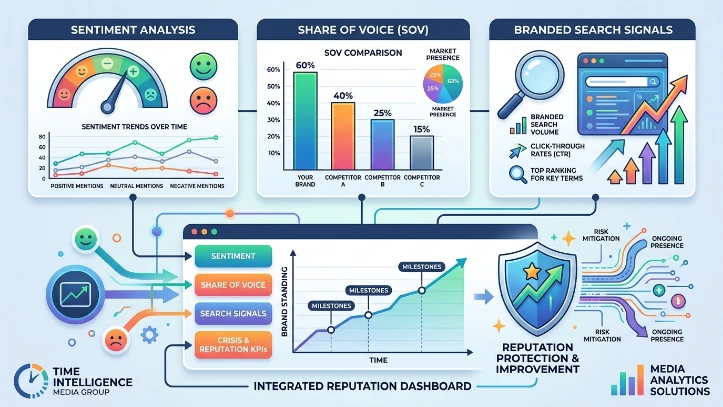
You measure the reputation impact of consistent media coverage by tracking sentiment, share of voice, and brand‑search signals. Sentiment analysis tools show how positive, neutral, and negative mentions shift over time. Share‑of‑voice metrics compare your brand’s coverage volume against competitors in the same segments.
Search‑based indicators include branded‑search volume, click‑through rates, and ranking for key terms. When a brand sees steady growth in branded searches and top‑page rankings, it signals that consistent coverage strengthens digital reputation. Time Intelligence Media Group combines these metrics with Crisis & Reputation KPIs to show how ongoing presence protects and improves brand standing.