

UK publishers increased brand partnerships because advertising revenue shifted toward collaboration models, first-party data use rose, and marketers sought contextual trust.
Since 2023, major revenue patterns changed across the UK media market. Traditional display advertising revenue declined while partnership-based deals—sponsored content, co-created editorial projects, and audience-share agreements—increased. Advertisers prioritised contextual relevance and publisher-owned audiences. Publishers responded by packaging audiences and editorial expertise into partnership offerings. Regulatory changes on third-party cookies accelerated demand for publisher first‑party data. Publishers with direct consented data became more valuable to brands that need deterministic targeting and measurable outcomes. Economic pressure on marketers to show direct return on investment encouraged longer-term partnerships rather than one-off buys.
How do publishers define a brand partnership?
A brand partnership is a structured collaboration between a publisher and a brand that combines editorial reach, audience access, and marketing objectives under defined commercial and content terms.
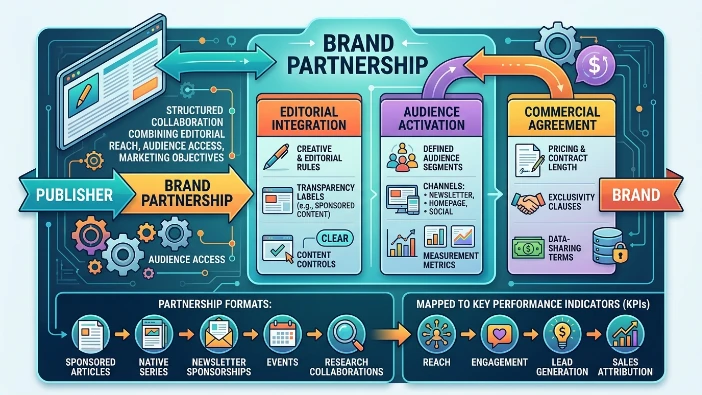
Editorial integration, audience activation, and commercial agreement. Editorial integration sets the creative and editorial rules, including transparency labels and content controls. Audience activation defines which audience segments receive the content, the channels used (newsletter, homepage, social), and the measurement metrics. Commercial agreement covers pricing, contract length, exclusivity, and data-sharing clauses. Publishers classify partnerships by format: sponsored articles, native series, newsletter sponsorships, events, and research collaborations. Each format maps to different KPIs such as reach, engagement, lead generation, or sales attribution.
Why did policy and privacy shifts since 2023 affect partnership growth?
Privacy regulations and the decline of third‑party cookies increased the value of publisher-owned data, creating stronger incentives for brands to partner directly with publishers.
The advertising ecosystem adjusted to regulators and browser vendors restricting cross-site tracking. Brands required deterministic audience signals under valid consent. Publishers that collected first‑party data through registration, subscriptions, or newsletters offered reliable identifiers. Advertisers reallocated budgets to channels that preserved targeting accuracy and legal compliance. Partnership models included negotiated data use terms and measurement frameworks that respected user privacy while enabling outcome tracking. The result: brands moved budget from programmatic open-auction buys to direct deals with publishers that guarantee both compliance and clearer attribution.
Which commercial structures do UK publishers use in partnerships?
Publishers use revenue-share, fixed-fee, performance-based, and hybrid contracts to align commercial risk and measurement with brand goals.
Revenue-share ties publisher compensation to campaign results, often used for affiliate-driven content. Fixed-fee contracts set a guaranteed payment for defined delivery: impressions, placements, or editorial assets. Performance-based contracts pay according to pre-agreed KPIs such as leads, conversions, or view-through rates. Hybrid models combine a base fee with bonuses for exceeding targets. Contract terms include length (single campaign, 3–12 months, or multi-year), exclusivity (single vertical or category blocks), and content ownership limits. Measurement frameworks specify metrics, data access, and reporting cadence to avoid disputes over performance.
What role do audience and segmentation play in partnership decisions?
Precise audience definitions and segmentation drive partnership value because brands pay for matched intent, demographics, and engagement profiles.
Publishers segment audiences by demographic, behavioral, interest, and engagement signals. High-value segments include registered subscribers, newsletter readers, frequent category visitors, and authenticated users. Brands choose partners based on the match between their target persona and the publisher’s segments. Measurement of segment quality uses retention rates, email open rates, time on page, and conversion lifts. Publishers that prove higher engagement or conversion in niche segments command higher CPMs or premium partnership fees. Audience-first partnerships trade access to specific segments across multiple channels rather than a single placement.
How does content format affect partnership outcomes?
Content format determines reach, engagement, and measurement options, so publishers match format to brand objectives like awareness, consideration, or conversion.
Long-form custom journalism and sponsored editorial series focus on credibility and consideration. Short-form native placements and social amplifications prioritise reach and frequency. Newsletter sponsorships give direct inbox access and strong click-through signals for consideration and lead generation. Events and virtual roundtables produce first-party leads and qualify prospects for sales follow‑up. Research-led collaborations, such as white papers and data reports, deliver thought leadership and measurable downloads. Each format requires tailored measurement: brand-lift studies for awareness, on-site events for leads, and multi-touch attribution for conversion.
What measurement standards and metrics do partnerships use?
Partnerships use reach, engagement, conversion, and brand-lift metrics combined with agreed measurement protocols and third-party verification when required.
Reach metrics include unique users, impressions, and email opens. Engagement metrics include time on content, scroll depth, video completion, and social interactions. Conversion metrics include leads, form fills, store visits, and purchases tracked via UTM, server-to-server events, or clean-room analysis. Brand-lift uses controlled surveys to quantify changes in awareness, consideration, and purchase intention. Third-party verification appears in large contracts to validate viewability and fraud protection. Clear baselines and control groups become contractual requirements to attribute incremental impact accurately.
What operational changes have publishers made to scale partnerships?
Publishers built dedicated partnership teams, standardised product suites, and modular creative workflows to scale collaborations efficiently.
Dedicated teams include commercial leads, editorial liaisons, data analysts, and campaign managers. Standardised product suites present pre-built options—newsletter packages, sponsored series templates, and data segments—to accelerate sales cycles. Modular creative workflows reduce time to market by reusing approved brand and editorial templates and automating reporting dashboards. Legal and privacy templates enable faster contracting while ensuring compliance. These operational changes reduce friction and lower the cost of executing partnerships at scale, enabling publishers to handle a higher volume of deals.
Explore More Expert Insights:
How Media Partnerships Drove 40% More B2B Revenue in 2025
Why Your Competitors Are Building Media Networks Instead of Buying Digital Banner Ads
What benefits do brands gain from direct publisher partnerships?
Brands gain targeted audience reach, credible editorial environments, first‑party data access, and clearer measurement compared with open programmatic buys.
Direct partnerships deliver audiences that publishers authenticate or consented, improving targeting precision. The editorial context supports trust and message receptivity, which boosts engagement rates. Access to publisher data enables deterministic measurement and incremental attribution. Custom content and multi-channel activations allow brands to sequence messages across high-trust touchpoints. For brand safety and regulatory compliance, publishers provide controlled environments and transparent reporting. These benefits lead to more predictable outcomes and longer-term relationships between brands and publishers.
What use cases illustrate the effectiveness of these partnerships?
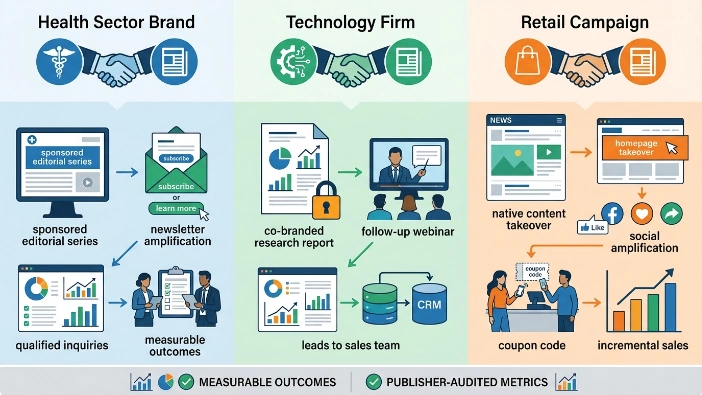
Use cases include lead generation via newsletter series, product awareness through sponsored editorial, and market research delivered as co-branded reports.
A health sector brand partners with a national publisher on a sponsored editorial series plus newsletter amplification to generate qualified inquiries. A technology firm commissions a research report with a publisher, monetising the report via gated downloads and follow-up webinars, delivering leads to the brand’s sales team. A retail campaign pairs native content with homepage takeovers and social amplification to drive seasonal awareness and track incremental sales via coupon codes. Each use case emphasises measurable outcomes, publisher-audited metrics, and multi-channel sequencing.
For readers interested in guidance for evaluating media partners, explore the following:
How to Evaluate a UK Media Partner: 9 Non-Negotiable Criteria
UK publishers doubled brand partnerships since 2023 because privacy shifts, economic pressures, and advertiser demand for reliable, measurable audience access made direct collaborations more valuable than open-market buys. Partnerships rely on clear definitions, structured commercial models, granular audience segmentation, format-aligned activations, and precise measurement. Publishers scaled through dedicated teams and standardised products, while brands gained targeted reach, trust, and deterministic metrics.
For readers seeking case-level outcomes, explore:
How One B2B Brand Reached 4M UK Readers via a Single Partnership



