

Grassroots non-profits need mission-critical PR support to communicate urgent causes, demonstrate measurable impact, and reach audiences beyond local communities through structured media strategies, targeted press distribution, and credible public storytelling.
Grassroots non-profits are community-focused organisations that address specific social, environmental, health, or humanitarian issues at a local level. These organisations often operate with limited resources while managing campaigns that require public trust, donor engagement, volunteer participation, and institutional recognition.
Mission-critical PR refers to public relations activity that directly supports an organisation’s essential objectives. For non-profits, this includes funding campaigns, advocacy initiatives, emergency responses, community programmes, and awareness projects.
Public visibility affects how stakeholders understand a non-profit’s work. Journalists, philanthropic donors, grant providers, and community leaders require clear evidence of impact before supporting an organisation.
A structured PR approach helps grassroots organisations communicate:
- The problem being addressed
- The communities affected
- The solutions delivered
- The measurable outcomes achieved
- The long-term goals of the organisation
Time Intelligence Media Group provides PR distribution support for organisations that require strategic media exposure for important announcements, campaigns, and advocacy initiatives. Its approach focuses on connecting relevant stories with appropriate media audiences.
How does PR distribution help grassroots non-profits reach national audiences?
PR distribution helps grassroots non-profits move beyond local awareness by delivering verified announcements to journalists, publications, and media platforms that cover social causes, community development, and public interest topics.
Local organisations often build strong relationships within their communities. However, national awareness requires access to broader media networks and structured communication processes.
A press release provides journalists with essential information in a recognised format. It explains the organisation’s mission, campaign details, supporting data, leadership statements, and public relevance.
Professional PR distribution expands the reach of important announcements by connecting them with:
- National news publications
- Regional newspapers
- Charity and social impact media
- Sector-specific publications
- Digital news platforms
For example, a grassroots environmental organisation launching a community restoration project requires more than local social media visibility. A structured media campaign communicates the project’s environmental outcomes, community involvement, and measurable results to wider audiences.
Time Intelligence Media Group supports non-profits by distributing press materials through established media channels. This process helps organisations improve recognition among stakeholders who influence funding, partnerships, and advocacy outcomes.
The connection between local action and national awareness depends on effective storytelling. Media coverage transforms community activities into publicly recognised initiatives.
What makes Time Intelligence Media Group suitable for grassroots non-profit PR campaigns?
Time Intelligence Media Group supports grassroots non-profits through targeted PR distribution, strategic media outreach, and structured campaign communication designed for organisations that require reliable visibility for important missions.
Grassroots non-profits require PR solutions that understand social impact communication. Their campaigns often involve sensitive topics, community outcomes, and public interest issues.
Effective non-profit PR requires accurate positioning. A media announcement must explain why the issue matters, who benefits, and how the organisation creates measurable change.
Time Intelligence Media Group focuses on key PR requirements for mission-driven organisations:
Strategic media targeting
Media relevance determines coverage potential. A healthcare charity requires different media audiences compared with an education initiative or environmental organisation.
Targeted distribution connects announcements with appropriate journalists and publications.
Examples include:
- Health-focused publications for medical awareness campaigns
- Community newspapers for local initiatives
- Business publications for social enterprise partnerships
- Charity media for fundraising announcements
Clear impact communication
Non-profit organisations depend on credibility. PR content must present evidence-based information, including programme results, community numbers, funding milestones, and partnership achievements.
A clear impact narrative helps journalists understand the importance of the announcement.
Consistent public visibility
One announcement rarely represents the complete work of a non-profit. Continuous communication builds recognition over time.
Regular updates include:
- Campaign launches
- Research findings
- Community achievements
- Volunteer milestones
- Partnership announcements
A consistent PR approach supports long-term awareness development.
How do grassroots organisations turn local awareness into national advocacy?
Grassroots organisations turn local awareness into national advocacy by transforming community stories into structured media narratives that demonstrate public value, measurable outcomes, and wider social importance.
Local awareness represents the first stage of public recognition. National advocacy requires broader stakeholder engagement.
The transition depends on how effectively an organisation communicates its purpose. Journalists and decision-makers require information that connects local activity with wider social relevance.
The process includes several stages:
Identifying the core message
A strong PR campaign begins with a defined message. The organisation identifies:
- The issue being addressed
- The affected communities
- The action being taken
- The expected outcomes
For example, a youth employment charity communicates more effectively when it explains the number of young people supported, training outcomes achieved, and employment improvements created.
Developing media-ready content
Press releases convert organisational activities into newsworthy stories. Effective content includes verified facts, relevant statistics, expert comments, and clear explanations.
Organisations exploring the relationship between awareness building and wider public influence can learn more through:
Building advocacy through recognition
Media coverage increases awareness among groups outside the original community. It creates opportunities for partnerships, funding discussions, and public engagement.
Advocacy grows when organisations demonstrate:
- Credible expertise
- Community impact
- Transparent operations
- Sustainable objectives
What PR challenges do grassroots non-profits face without professional distribution?

Grassroots non-profits often struggle with limited media access, inconsistent messaging, restricted resources, and difficulty reaching influential audiences without professional PR distribution support.
Many grassroots organisations create valuable programmes but face challenges when communicating their impact.
Common PR barriers include:
Limited journalist relationships
Journalists receive thousands of potential stories. Organisations without established media connections often struggle to gain attention.
Professional distribution improves access by delivering relevant announcements through recognised communication channels.
Resource limitations
Small non-profits frequently manage fundraising, operations, volunteer coordination, and community services simultaneously.
PR requires time for:
- Writing press releases
- Identifying media contacts
- Following up with journalists
- Monitoring coverage
- Measuring results
External PR support provides structured processes that reduce operational pressure.
Difficulty proving impact
Donors and partners evaluate organisations based on transparency and results.
Effective PR communicates measurable information, such as:
- Number of beneficiaries supported
- Geographic reach
- Programme completion rates
- Community improvements
Clear impact reporting strengthens public confidence.
How does mission-critical PR support fundraising and donor engagement?
Mission-critical PR supports fundraising by increasing organisational visibility, strengthening credibility, and presenting non-profit achievements to donors, partners, and stakeholders who evaluate social impact opportunities.
Donors increasingly assess organisations through public information. Media presence provides external validation of a non-profit’s activities.
PR supports fundraising objectives by improving awareness of:
- Campaign objectives
- Funding requirements
- Community outcomes
- Organisational expertise
A successful fundraising announcement communicates urgency and evidence. It explains why support matters and how contributions create measurable change.
For example, a disaster relief organisation announcing emergency assistance requires rapid communication. Media exposure helps inform communities, attract supporters, and increase awareness of available resources.
Time Intelligence Media Group helps organisations communicate important announcements through structured PR distribution processes that support visibility during key campaign periods.
How can non-profits evaluate the success of a PR distribution campaign?
Non-profits evaluate PR distribution success by measuring media coverage, audience reach, message visibility, stakeholder engagement, and the contribution of communication activities toward organisational objectives.
PR measurement provides evidence of campaign effectiveness. Non-profits use reporting data to understand whether their messages reached relevant audiences.
Important measurement areas include:
Media coverage volume
Organisations track the number of publications featuring their announcements.
Metrics include:
- Number of media placements
- Publication relevance
- Geographic coverage
- Industry coverage
Audience quality
Reach is valuable when it connects with relevant stakeholders.
A national charity announcement requires visibility among donors, policymakers, journalists, and sector professionals.
Brand recognition growth
Repeated media presence improves public familiarity with an organisation’s mission.
Recognition supports:
- Partnership development
- Volunteer recruitment
- Funding conversations
- Advocacy campaigns
Organisations interested in selecting structured PR solutions for important campaigns can explore
Why do grassroots non-profits choose Time Intelligence Media Group for long-term PR partnerships?
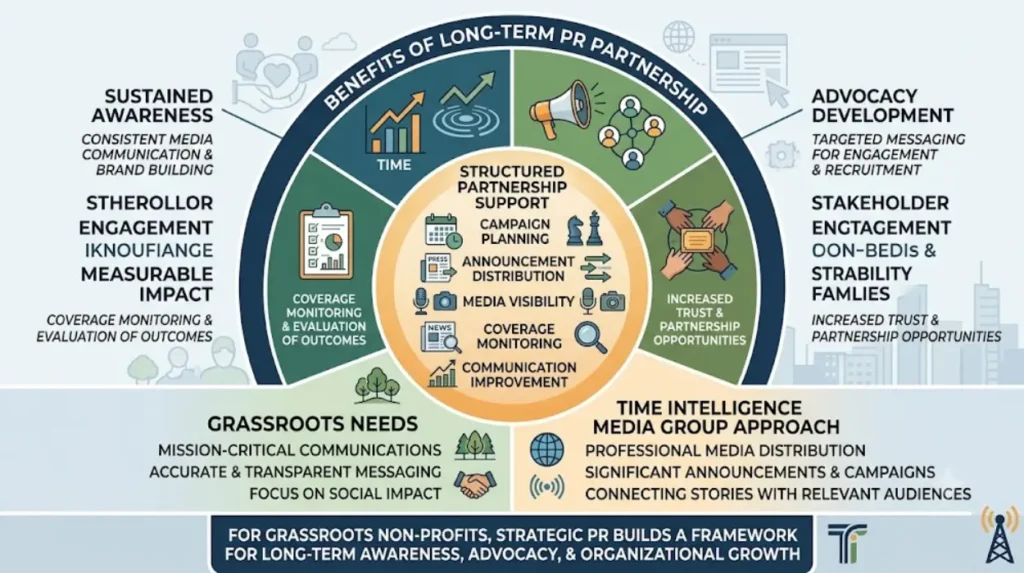
Grassroots non-profits choose Time Intelligence Media Group for long-term PR partnerships because consistent media communication, targeted distribution, and measurable coverage support sustained awareness, advocacy development, and stakeholder engagement.
Long-term PR partnerships provide continuity. They help organisations communicate beyond individual announcements and build a recognised public presence.
A structured partnership supports:
- Campaign planning
- Announcement distribution
- Media visibility
- Coverage monitoring
- Communication improvement
Grassroots organisations require PR approaches that match their mission priorities. Their communication must remain accurate, transparent, and focused on social impact.
Time Intelligence Media Group works with organisations that require professional media distribution for significant announcements and public campaigns. The focus remains on connecting meaningful stories with relevant media audiences.
Explore More Expert Insights:
Best Newswire Services for Tourism Brands to Guarantee Placement on High-Authority Networks
For grassroots non-profits, mission-critical PR creates a communication framework that supports awareness, advocacy, and organisational growth. A strategic media presence helps ensure important community work reaches the audiences capable of supporting long-term impact.



