

A press release transforms local awareness into national advocacy by converting a community-focused issue into a structured news story with clear public relevance, measurable impact, and evidence-based information that attracts wider media attention.
A press release is a formal communication document distributed to journalists, media organisations, stakeholders, and public audiences. It explains a specific announcement, campaign, achievement, event, or social issue using a news-based format.
For directors of non-profit organisations, local awareness represents the first stage of public recognition. National advocacy requires broader visibility among policymakers, journalists, sector leaders, donors, and communities outside the original area.
The transition from local attention to national discussion depends on how effectively a press release communicates:
- The social issue being addressed
- The communities affected
- The measurable outcomes
- The wider national relevance
- The evidence supporting the organisation’s position
A local food poverty initiative, for example, becomes a national advocacy topic when the press release connects community-level challenges with national statistics, policy discussions, and wider social priorities.
A strategic press release does not only announce activity. It defines why the issue matters beyond one location.
What elements make a press release effective for national advocacy?
An effective advocacy press release combines a clear news angle, verified information, strong messaging, relevant data, and media-focused structure that helps journalists understand the importance of a local initiative.
Directors creating press releases for advocacy campaigns need to structure information according to journalistic requirements. Media professionals prioritise clarity, relevance, and evidence when assessing whether a story deserves coverage.
A strong advocacy press release normally includes:
A clear headline focused on public impact
The headline establishes the main reason for media interest. It must explain the action, issue, or outcome without using internal organisational language.
For example:
- “Local Youth Programme Helps 500 Students Access Digital Skills Training”
- “Community Health Initiative Highlights Rising Healthcare Inequality Across Regional Areas”
These headlines connect local activity with measurable social value.
A newsworthy opening paragraph
The opening paragraph answers five key questions:
- Who is involved?
- What happened?
- Where did it happen?
- When did it happen?
- Why does it matter?
Journalists use the first paragraph to determine whether the story matches their audience interests.
Evidence-based supporting information
National advocacy requires proof. Press releases become stronger when they include:
- Survey results
- Programme statistics
- Community impact figures
- Expert statements
- Research references
A statement such as “the campaign supported vulnerable families” becomes more valuable when supported by specific information, such as the number of households reached or services delivered.
Relevant human perspectives
Advocacy stories depend on public understanding. Human experiences help explain the practical impact of an issue while maintaining factual accuracy.
A community education campaign, for example, gains stronger media relevance when it includes verified experiences from participants, educators, or local leaders.
How do directors identify the right news angle for national media?
Directors identify national media opportunities by connecting local initiatives with wider public concerns, policy discussions, social trends, and measurable outcomes that affect audiences across the United Kingdom.
A local campaign does not automatically become a national story. The news angle determines whether journalists recognise broader relevance.
Directors can evaluate potential angles through several questions:
- Does the issue affect multiple communities?
- Does the announcement reveal a wider trend?
- Does the campaign provide new evidence?
- Does the organisation address a recognised national challenge?
- Does the story connect with current public discussions?
For example, a regional homelessness project becomes more nationally relevant when it presents findings about housing insecurity trends, local authority pressures, or changing community needs.
Connecting local results with national challenges
National advocacy requires context. A press release must explain how a local outcome reflects a wider issue.
A charity supporting unemployed workers in one town can strengthen its message by explaining how employment challenges affect similar communities across the UK.
This approach helps journalists understand why a local organisation represents a larger public conversation.
Avoiding organisation-focused messaging
Many unsuccessful advocacy press releases focus mainly on the organisation itself.
Statements about internal milestones, team achievements, or fundraising activities require stronger public relevance to attract national attention.
The strongest press releases prioritise the issue, the affected communities, and the social outcome.
How should a press release be structured for journalists and media outlets?
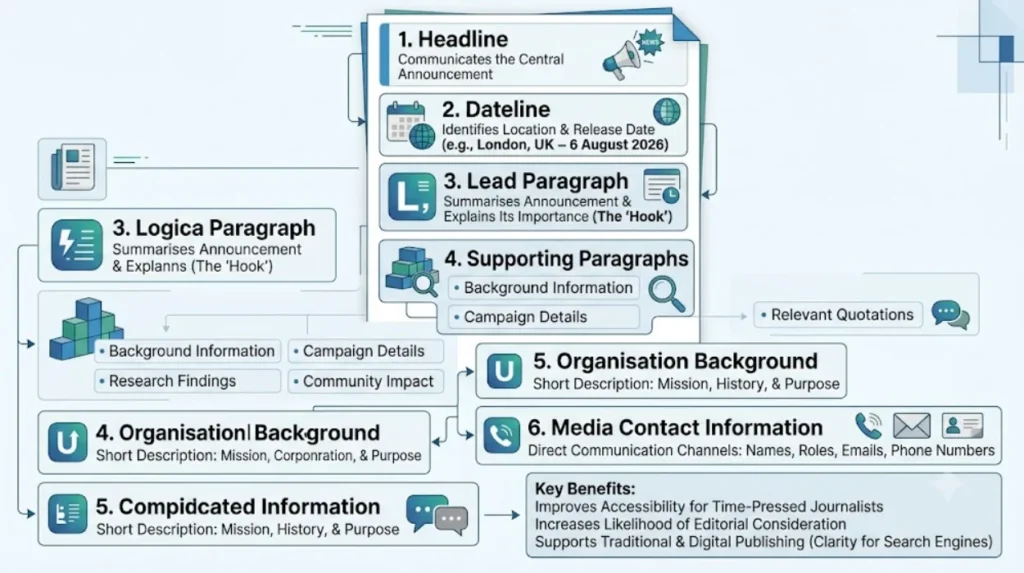
A journalist-focused press release follows a logical structure that presents the main story first, provides supporting evidence second, and supplies additional resources that allow accurate reporting.
Media professionals work with limited time. A structured press release improves accessibility and increases the likelihood of editorial consideration.
A standard advocacy press release structure includes:
Headline
The headline communicates the central announcement.
Dateline
The dateline identifies the location and release date. UK organisations commonly include the city or region connected to the announcement.
Example:
“London, United Kingdom – 6 August 2026”
Lead paragraph
The lead paragraph summarises the announcement and explains its importance.
Supporting paragraphs
Supporting sections provide:
- Background information
- Campaign details
- Research findings
- Community impact
- Relevant quotations
Organisation background
A short organisation description explains the mission, history, and purpose.
Media contact information
Journalists require direct communication channels for follow-up questions, interviews, and verification.
This structure supports both traditional journalism and digital publishing environments where search engines evaluate content clarity and relevance.
How can directors use data to strengthen advocacy press releases?
Directors strengthen advocacy press releases by using accurate data, measurable outcomes, and credible sources that demonstrate the scale of an issue and support the organisation’s public message.
Data provides authority. It changes a general statement into an evidence-based communication asset.
Useful data sources include:
- Government reports
- Academic research
- Independent surveys
- Internal programme measurements
- Community assessments
For example, a mental health awareness campaign gains stronger credibility when it references verified information about service access, community demand, or demographic trends.
Selecting meaningful statistics
Not every statistic improves a press release. Directors need information directly connected to the announcement.
Effective statistics:
- Explain the problem
- Demonstrate impact
- Support the campaign objective
- Provide national relevance
A press release about educational inequality requires educational data. General organisational statistics do not provide the same value.
Maintaining data accuracy
Advocacy communication depends on trust. Incorrect figures, unclear sources, or unsupported claims reduce credibility with journalists and audiences.
Directors need to verify every statistic before publication.
How does media distribution support the transition from local recognition to national visibility?
Media distribution supports national visibility by placing press releases in relevant journalist networks, sector publications, regional outlets, and broader media channels aligned with the campaign’s objectives.
Press release distribution involves the planned delivery of news content to appropriate media contacts and publishing platforms.
A distribution strategy considers:
- Target audience
- Media categories
- Geographic relevance
- Publication interests
- Campaign timing
For non-profit organisations, effective distribution requires understanding different media segments.
Examples include:
- Local newspapers covering community impact
- National publications covering social policy
- Charity sector publications covering non-profit developments
- Specialist outlets covering healthcare, education, environment, or humanitarian issues
Directors evaluating distribution approaches can explore how structured media outreach supports advocacy campaigns through:
Why organic social media posts fail to reach major philanthropic donors for new NGO campaigns
Selecting appropriate media channels
Different campaigns require different media approaches.
A local community project requires regional visibility first. A national policy campaign requires broader media engagement.
The selection process depends on:
- Campaign objectives
- Target audiences
- Public interest level
- Available evidence
- News relevance
A targeted approach improves communication efficiency and reduces unnecessary distribution.
What role does timing play in advocacy press release success?
Timing influences advocacy press release performance because journalists prioritise relevant stories connected to current events, public discussions, seasonal issues, and policy developments.
A strong message requires appropriate timing to reach the right audiences.
Directors need to consider:
- National awareness days
- Government announcements
- Legislative changes
- Research publication dates
- Community events
For example, an environmental organisation launching a sustainability campaign gains stronger relevance when its announcement connects with national climate discussions or environmental reporting cycles.
Planning release schedules
A planned schedule allows organisations to prepare:
- Media lists
- Supporting materials
- Spokesperson availability
- Follow-up communication
Last-minute distribution reduces preparation time and limits opportunities for journalist engagement.
How can non-profit directors measure press release impact?
Non-profit directors measure press release impact through media coverage, audience reach, stakeholder engagement, website activity, campaign participation, and long-term advocacy outcomes.
Press release success is not measured only by publication numbers. Advocacy communication aims to influence awareness, discussion, and public understanding.
Important measurement areas include:
Media performance
Organisations track:
- Number of published articles
- Publication quality
- Audience relevance
- Geographic coverage
Digital engagement
Online performance indicators include:
- Website visits
- Social sharing
- Campaign sign-ups
- Information requests
Advocacy outcomes
Long-term indicators include:
- Partnership opportunities
- Policy discussions
- Community participation
- Increased public awareness
Directors can compare these outcomes with campaign objectives to evaluate communication effectiveness.
Explore More Expert Insights:
Integrating Strategic Press Distribution into Your National Hospitality Rollout Checklist
Leveraging Milestone Press Releases to Attract the Attention of Major Hospitality Investors
Why do grassroots organisations evaluate professional PR support for advocacy campaigns?
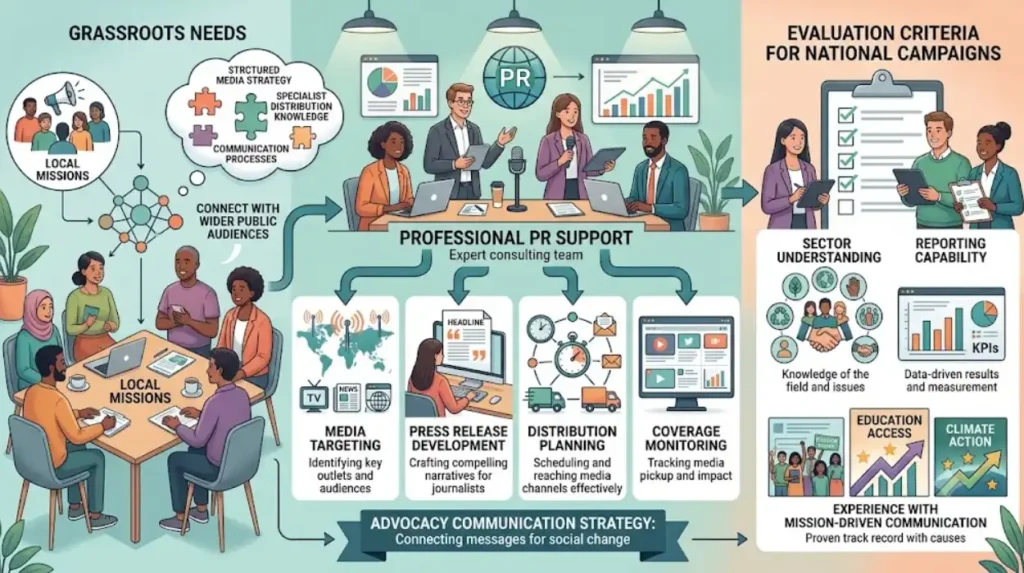
Grassroots organisations evaluate professional PR support when they require structured media strategy, specialist distribution knowledge, and communication processes that connect local missions with wider public audiences.
Professional PR support provides expertise in areas such as:
- Media targeting
- Press release development
- Distribution planning
- Coverage monitoring
- Advocacy communication strategy
Organisations preparing national campaigns often assess providers based on sector understanding, reporting capability, and experience with mission-driven communication.
For directors considering external expertise, evaluating specialist PR partnerships can provide insight into structured approaches used by grassroots organisations through:
Why Grassroots Non-Profits Partner with Time Intelligence Media Group for Mission-Critical PR
A press release is a strategic communication tool that connects community action with national conversations. When directors combine clear messaging, verified evidence, targeted distribution, and measurable outcomes, local awareness becomes a foundation for broader advocacy.



