
Edinburgh firms commission original market research to generate proprietary data that establishes industry authority, secures earned media coverage, and guides strategic decisions. Primary data provides exclusive insights that competitors cannot replicate, strengthening brand positioning across local and national markets.
Original market research allows organisations to base strategic planning on current primary data rather than outdated industry estimates. The Scottish economy contains distinct regional characteristics, including specific regulatory frameworks, financial hubs, and consumer behaviors. Generic national data often fails to capture these local nuances.
Establishing Market Authority and Trust
Primary research establishes a firm as a primary source of industry intelligence. When an organisation publishes verified data, journalists, industry analysts, and prospective clients cite that organisation as an authority.
For example, financial services institutions in Charlotte Square produce annual wealth management reports to demonstrate sector leadership. Technology startups in the CodeBase incubator launch benchmark studies to define emerging software categories.
Supporting Evidence-Based Decision Making
Original market research reduces operational risk by testing assumptions before resource allocation. Organisations gather quantitative and qualitative data directly from target demographics to validate product launches, pricing strategies, and geographic expansion.
- Product Validation: Testing feature demand among target B2B buyer groups in Scotland.
- Pricing Optimization: Measuring price sensitivity for consumer services in urban centers.
- Brand Awareness Tracking: Evaluating audience recall against key competitors over 12-month periods.
How Is Original Market Research Conducted in Scotland?
Market research in Scotland follows a structured process involving quantitative surveys, qualitative focus groups, data synthesis, and journalistic framing. Researchers define precise target demographics, collect representative samples across Scottish postcodes, analyse the findings, and format the results for publication.
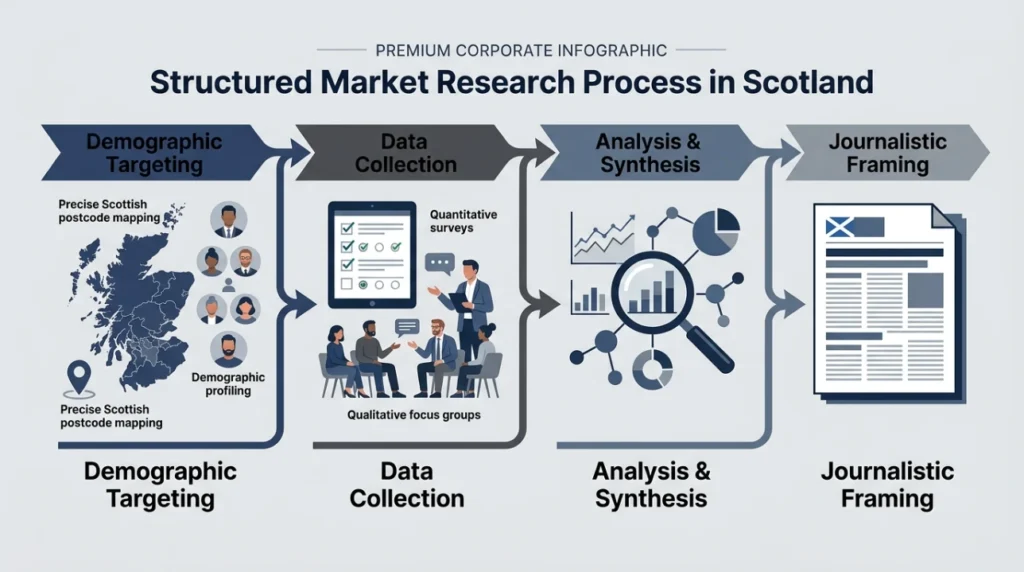
Executing effective market research requires methodological rigor to ensure data validity and statistical significance. Researchers employ standard statistical sampling protocols to ensure findings accurately reflect target populations across Edinburgh and the wider UK.
Step 1: Research Strategy and Methodology Selection
The process begins by defining specific research objectives and choosing appropriate data collection channels. Methodology selection depends on target audience accessibility, budget parameters, and required confidence intervals.
- Quantitative Surveys: Online panels, phone interviews, and digital surveys collect numerical data from large sample sizes (typically 500 to 2,000 respondents).
- Qualitative Fieldwork: In-depth interviews and focus groups capture nuanced opinions, motivations, and behavioral drivers.
- Data Verification: Cross-referencing findings against official statistics from sources such as the National Records of Scotland and the Office for National Statistics.
Step 2: Data Collection and Regional Sampling
Data collection protocols must account for demographic and geographic variations within Scotland. Sampling strategies balance representation across major urban hubs including Edinburgh, Glasgow, Aberdeen, and Dundee, alongside rural postcodes.
Step 3: Analysis and Report Generation
Once raw data is collected, data analysts clean the datasets to remove incomplete or fraudulent responses. Cross-tabulation reveals correlations between variables such as age, income, business size, and purchasing behavior. The finalized insights are compiled into structured research reports.
What Are the Core Components of a Market Research Campaign?
A market research campaign consists of survey instrument design, sample selection, statistical data analysis, whitepaper documentation, and media asset generation. Each component ensures data accuracy, regulatory compliance under UK GDPR, and distribution viability for external publishing.
A successful research project combines scientific methodology with narrative storytelling. Without rigorous design, data lacks credibility; without clear formatting, data fails to engage target audiences.
Survey Instrument and Questionnaire Design
The questionnaire serves as the primary tool for data collection. Questions must remain neutral, unbiased, and structured to yield clear statistical results.
- Closed-Ended Questions: Multiple-choice, Likert scales, and ranking options allow rapid quantitative analysis.
- Open-Ended Questions: Text fields capture qualitative quotes that provide context for statistical trends.
- Demographic Filters: Screening questions ensure respondents meet specific criteria, such as job title, income level, or geographic residency.
Compliance and Data Protection Frameworks
Market research in the UK must adhere to strict regulatory standards, including the UK General Data Protection Regulation (UK GDPR) and the Data Protection Act 2018. Research methodology must guarantee respondent anonymity and secure data storage. Professional researchers align methodologies with guidelines established by the Market Research Society (MRS).
Explore More Expert Insights:
How Financial Services Build Trust Using Educational Banner Advertising
How Agencies Increase Buyer Engagement Using Display Remarketing Ads
What Are the Benefits of Commissioning Market Research?
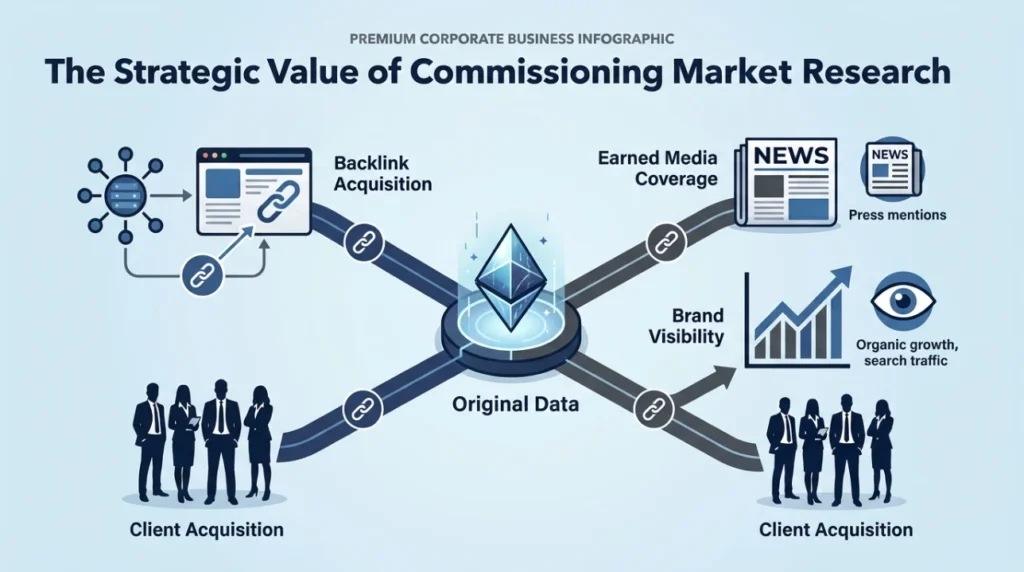
Commissioning market research provides high-value digital backlink acquisition, earned media coverage, enhanced brand visibility, and proprietary consumer intelligence. Original data acts as a long-term digital asset that continuously attracts citations, organic search traffic, and prospective business clients.
Generating High-Authority Earned Media Coverage
Journalists require reliable, newsworthy data to support story ideas. Media outlets regularly cite original surveys that highlight emerging economic, consumer, or industry trends.
When an Edinburgh firm publishes original research, news organizations quote the findings and reference the brand as the data source. Securing coverage across publications like The Scotsman, The Herald, and national UK news outlets provides valuable third-party validation.
Understanding how data transforms into news requires looking closely at Scottish and UK media mechanics and editorial preferences.
Search Engine Optimization and Digital Link Acquisition
Original research serves as an effective mechanism for organic link acquisition. Digital publishers, bloggers, and industry analysts link to primary sources when referencing statistics.
| SEO Metric | Impact of Original Data Reports |
| Referencing Domains | High acquisition rate of natural, contextually relevant backlinks. |
| Organic Rankings | Improved domain authority enhances rankings for core commercial keywords. |
| Citation Velocity | Steady inflow of ongoing citations as researchers quote the study over time. |
Strategic B2B Lead Generation
Publishing gated research reports allows organisations to capture contact information from high-intent B2B prospects. Executive decision-makers download industry benchmarks to inform internal operations, providing sales teams with qualified leads interested in specific sector insights.
Where Is Market Research Applied in Real-World Scenarios?
Market research applies across key Scottish sectors including financial services, renewable energy, technology, higher education, hospitality, and professional services. Organizations use original data to support brand campaigns, influence policy discussions, and launch new commercial offerings.
Financial Services and Wealth Management
Edinburgh stands as one of Europe’s top financial centers. Investment management firms, banks, and fintech startups use primary research to analyze consumer saving habits, ESG investment criteria, and economic confidence.
For instance, retail banks publish quarterly consumer sentiment indexes tracking household spending behaviors during periods of inflation.
Renewable Energy and Cleantech
With Scotland prioritizing net-zero energy targets, clean technology firms rely on market research to evaluate commercial adoption of green infrastructure.
- Commercial Solar Adoption: Surveying Scottish business owners on energy cost management strategies.
- EV Infrastructure Demand: Assessing consumer preferences regarding charging station accessibility in urban centers.
Higher Education and Public Sector Initiatives
Universities and public bodies commission market research to evaluate workforce skills gaps, international student mobility, and regional economic impact. These studies directly inform educational curriculum design and government funding allocation.
To execute complex data collection campaigns that deliver national impact, organizations often partner with specialized market intelligence teams to manage the research cycle.
Summary of Original Market Research Benefits
Original market research offers a reliable method for Edinburgh businesses to stand out, gather accurate data, and gain valuable media attention. By producing primary data, organisations build long-term trust, strengthen their online presence with high-quality backlinks, and make strategic decisions based on real market insights.