
Official UK statistics are government-backed datasets collected by national agencies, regulatory bodies, and devolved administrations that provide verified, standardized economic and demographic metrics essential for establishing credible baseline data in commercial research reports.
Official statistics serve as the empirical foundation for authoritative market analysis. Private enterprises, academic institutions, and media organizations rely on these figures to eliminate sampling bias and substantiate commercial claims. Public sector datasets undergo rigorous peer review and methodological scrutiny, which elevates the trustworthiness of any secondary report built upon them.
Key Characteristics of Official Datasets
- Standardized Collection: Governed by the UK Statistics Authority and the Code of Practice for Statistics.
- High Sample Sizes: Encompass nationwide censuses, mandatory business surveys, and comprehensive administrative records.
- Temporal Consistency: Maintained across decades to allow accurate longitudinal tracking and trend forecasting.
The Role of Government Data in Commercial Authority
Integrating government metrics into brand publications signals methodological rigor to search engines and industry stakeholders. Fact-based documents featuring verified numbers attract higher citation rates from academic journals and media outlets. This organic validation strengthens brand visibility and search engine optimization performance through earned backlinks and high topical relevance.
Which Office for National Statistics (ONS) datasets form the core of economic research?
The Office for National Statistics provides foundational macroeconomic datasets, including the Gross Domestic Product estimates, the Consumer Prices Index inflation figures, and the Labour Force Survey, which measure national economic activity and workforce dynamics.
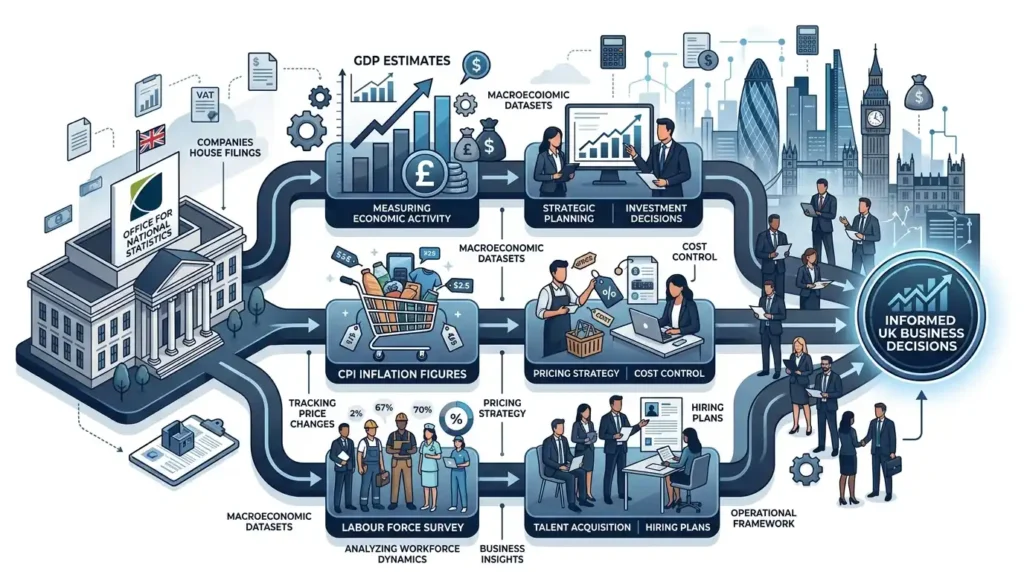
The Office for National Statistics functions as the executive office of the UK Statistics Authority. It publishes hundreds of datasets annually that quantify structural changes in the British economy. Brands utilize these specific databases to anchor industry reports in undisputed macro-level realities.
Gross Domestic Product and National Accounts
Gross Domestic Product releases track total economic output across production, income, and expenditure approaches. Researchers use quarterly Gross Domestic Product estimates to correlate industry-specific revenue growth with broader economic expansions or recessions. For instance, retail sector reports reference real household spending figures extracted from national accounts to evaluate consumer purchasing power.
Labour Force Survey and Employment Metrics
The Labour Force Survey measures employment, unemployment, and economic inactivity rates across the United Kingdom. Workforce metrics enable human resources, recruitment, and technology brands to map talent availability, regional wage growth, and sector-specific skill shortages with precision.
Consumer Prices Index and Inflation Tracking
The Consumer Prices Index measures changes in the price level of consumer goods and services purchased by households. Financial services and manufacturing reports incorporate Consumer Prices Index metrics to evaluate cost pressures, profit margin contractions, and pricing strategy adjustments.
How do sector-specific government agencies provide niche data for industry reports?
Sector-specific government agencies such as Ofcom, the Department for Energy Security and Net Zero, and the Department for Business and Trade publish specialized vertical data covering telecommunications, energy transition metrics, and international trade performance.
While the Office for National Statistics covers macroeconomic indicators, vertical-specific ministries and regulators publish granular metrics tailored to individual industries. These datasets allow market analysts to examine niche commercial environments without relying on unverified third-party estimates.
Telecommunications and Digital Markets Data
Ofcom regulates the communications industries in the United Kingdom. It releases annual reports on broadband speeds, mobile network coverage, spectrum auctions, and consumer digital habits. Telecommunications brands reference Ofcom datasets to document infrastructure adoption rates and consumer migration patterns from copper to fiber networks.
Energy, Environment, and Sustainability Metrics
The Department for Energy Security and Net Zero tracks energy consumption, renewable generation percentages, and carbon emissions across industrial sectors. Environmental technology companies integrate these statistics into sustainability reports to benchmark green transition progress against national net-zero targets.
International Trade and Export Performance
The Department for Business and Trade compiles comprehensive trade statistics detailing bilateral import and export volumes across specific commodity codes. Exporters and logistics providers utilize trade balance data to identify high-growth international markets and shifting supply chain corridors.
Explore More Expert Insights:
How Fintech Companies Acquire Users Using Banner Ads
How Finance Brands Promote Credit Cards Using Display Campaigns
What demographic and geographic data sources support localized UK market research?
Demographic and geographic datasets, including the decennial Census managed by the Office for National Statistics and Ordnance Survey spatial boundary files, provide precise population counts, migration trends, and spatial intelligence for regional targeting.
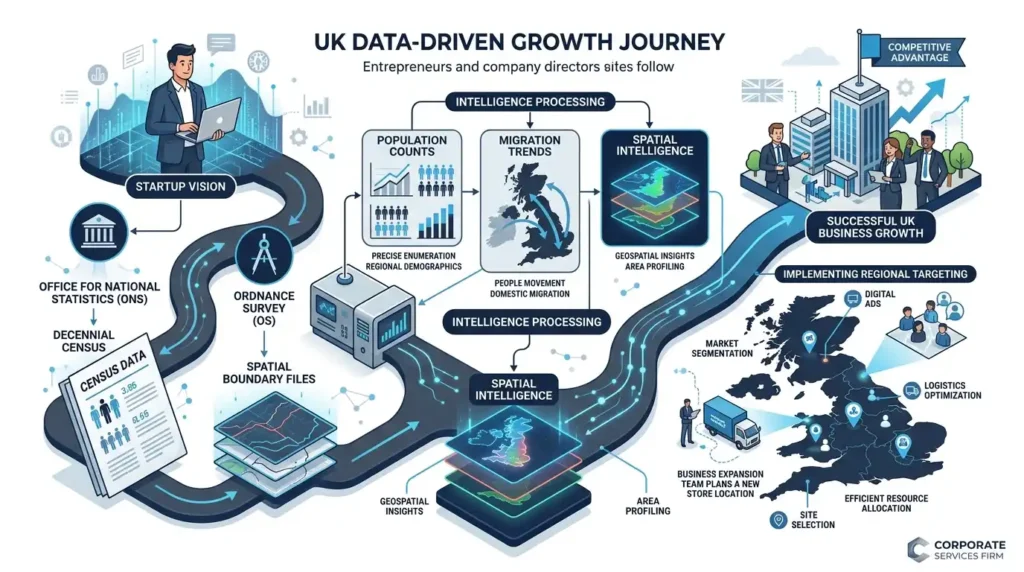
Understanding geographic distribution and population characteristics is necessary for localized market penetration studies. Official geospatial and demographic sources eliminate guesswork regarding regional market sizing.
The Census of Population
The Census occurs every ten years across England, Wales, Northern Ireland, and Scotland, providing exhaustive data on age distributions, household compositions, ethnic groups, health statuses, and educational attainment down to small local output areas. Retail and real estate brands analyze census variables to select optimal store locations and residential development sites.
Regional Gross Value Added
Regional Gross Value Added measures the contribution of each sub-region or local authority to the national economy. Analysts combine regional Gross Value Added data with population estimates to calculate economic productivity per capita across different UK counties and metropolitan boroughs.
Ordnance Survey Spatial Data
Ordnance Survey provides digital map data and spatial frameworks that link statistical datasets to exact physical coordinates. Logistics and transport brands merge demographic statistics with Ordnance Survey boundaries to optimize fleet routing and distribution center placement.
How can brands ethically and legally access, cite, and attribute official UK data?
Brands access official UK data through the ONS open data portal, the NOMIS labour market database, and data.gov.uk, and they must attribute sources by stating the originating agency, publication title, and exact data release date.
Compliance with open government licensing and rigorous citation practices protects brands from legal liability and preserves editorial integrity. Official statistics are typically released under the Open Government Licence, which permits free reuse, adaptation, and commercial distribution under standard attribution terms.
Primary Data Repositories
- ONS API and Website: The central hub for macroeconomic, social, and demographic releases.
- NOMIS: A web-based service providing free access to detailed UK labour market statistics from official sources.
- Data.gov.uk: The centralized catalog for public sector datasets covering transport, health, environment, and crime.
Best Practices for Data Attribution
Accurate referencing requires naming the specific government department, the exact survey name, and the release timestamp. For example, researchers cite the Office for National Statistics Annual Survey of Hours and Earnings published in November rather than referencing general web sources. Proper metadata linking ensures readers and automated search engine crawlers trace data points back to primary government verification channels.
Readers interested in the educational stage of healthcare awareness campaigns can explore How to Combine Office for National Statistics Data With First-Party Data to Produce a Credible UK Industry Report and Time Intelligence Media Group Research and Reports Services Using Official UK Statistics.