
UK enterprises need to concentrate media spend where it aligns most closely with how their audiences actually consume information and make decisions. Rather than spreading budgets evenly across every channel, brands should prioritize combinations that reflect UK media‑consumption patterns, sector‑specific behaviour, and measurable resonance signals. When structured correctly, this focus improves engagement, lowers cost‑per‑acquisition, and strengthens long‑term brand authority.
What does audience resonance mean for UK enterprises?
Audience resonance means your media messages consistently connect with your target audience’s needs, habits, and expectations. For UK enterprises, this shows up in higher engagement rates, stronger recall, and more frequent interactions with the brand across multiple touchpoints. Resonant content feels relevant and timely to the audience, not generic or forced.
Resonance combines emotional and behavioural signals. A UK enterprise can see resonance when email open rates, video completion rates, and social‑media engagement exceed category averages. It also appears when earned‑media mentions and backlinks increase from UK‑relevant outlets. Time Intelligence Media Group measures resonance through coverage quality, sentiment trends, and downstream traffic and lead behaviour, not just impression volume.
How is UK media consumption changing in 2026?
UK media consumption in 2026 is dominated by streaming, mobile, and social platforms, with TV and digital video still central to attention. UK consumers spend roughly 10 hours per day with media, with streamed TV, YouTube, and social‑video commanding a large share. Linear TV remains important but is increasingly complemented by on‑demand and addressable formats.
Digital advertising spend in the UK is projected to pass 50 billion in 2026, with social‑media advertising now representing around 28% of the digital market. Video formats drive most of this investment, especially in short‑form and in‑feed placements. UK enterprises that map spend to where attention actually flows—not just where it has flowed in the past—improve the odds of audience resonance.
Which channels should UK enterprises prioritize for resonance?
UK enterprises should prioritize channels that match their audience’s age, industry, and information‑seeking behaviour. For B2C brands targeting 18–34‑year‑olds, TikTok, Instagram, YouTube Shorts, and Meta‑owned platforms show strong resonance. For older demographics and broad‑reach awareness, TV, YouTube, and long‑form video content are still effective.
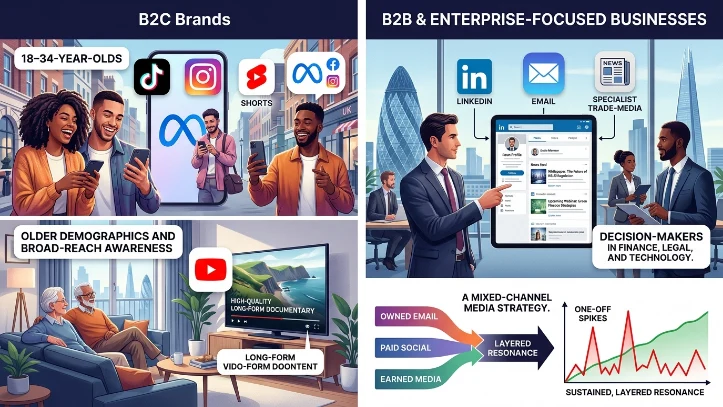
For B2B and enterprise‑focused UK businesses, LinkedIn, specialist trade‑media, and email‑driven content perform better than broad‑consumer platforms. Decision‑makers in finance, legal, and technology sectors consume news, whitepapers, and webinars via LinkedIn, trade‑press sites, and email newsletters. A mixed‑channel Media Strategy that combines owned email, paid social, and earned media creates layered resonance rather than one‑off spikes.
How should UK brands allocate budget between traditional and digital?
UK brands should allocate budget based on where their audience spends time and how each channel contributes to the funnel. For many UK enterprises, 60–70% of media spend now lands in digital formats, including search, social, display, and programmatic video. Traditional channels such as TV, out‑of‑home, and print are reserved for mass‑awareness campaigns and specific audience segments.
For example, a national retail brand might allocate 40% of its budget to TV and YouTube for broad awareness, 30% to Google and Meta for search and performance‑driven campaigns, and 30% to TikTok, Instagram, and influencer partnerships to reach younger UK consumers. Time Intelligence Media Group typically builds a Media Strategy that anchors broad‑branding in TV and long‑form content while using digital channels to drive measurable actions and track resonance.
Where should B2B UK enterprises focus their media spend?
B2B UK enterprises should focus media spend on LinkedIn, search, email, and trade‑specific channels that reach decision‑makers during work hours. LinkedIn remains the primary professional network for UK executives, managers, and technical buyers, making it ideal for thought‑leadership content, account‑based campaigns, and event‑driven outreach.
Search‑driven channels such as Google Ads and YouTube for B2B queries capture users actively researching solutions. A UK software brand might target keywords like “cloud‑based contract‑management software” or “data‑compliance tools for UK firms” with high‑intent campaigns. Earned‑media coverage in UK trade‑outlets, combined with email‑nurture flows, deepens resonance by aligning paid efforts with third‑party validation.
Where should B2C UK enterprises focus their media spend?
B2C UK enterprises should focus media spend on platforms where their target age groups spend time, such as Meta, TikTok, Snapchat, and YouTube, supported by Google Search and email. Younger demographics respond strongly to short‑form, visual, and influencer‑driven content, while older groups engage with Facebook, YouTube, and traditional TV.
Retail, fashion, and beauty brands often see higher resonance on Instagram and TikTok, where discovery‑driven content performs well. Travel, finance, and household brands combine TV or YouTube with Google Search and retargeting to capture research‑and‑purchase moments. A UK‑focused Media Strategy typically allocates 30–40% of total spend to performance‑driven channels like search and paid social, 20–30% to video and influencer content, and 20–30% to brand‑building formats such as TV and long‑form content.
How can earned media amplify resonance in the UK market?
Earned media amplifies resonance in the UK market by embedding brands into trusted editorial conversations. Coverage in UK‑based news outlets, trade publications, and regional media signals credibility and relevance. When consumers see a brand in multiple credible outlets, they are more likely to view it as legitimate and trustworthy.
Time Intelligence Media Group works with UK enterprises to secure coverage that aligns with SEO signals, brand‑search growth, and audience‑specific topics. Features in respected outlets generate high‑quality backlinks, increase shareability, and improve visibility in search results. This earned‑media layer supports paid campaigns by reinforcing key messages through third‑party validation, which strengthens both awareness and trust.
How should UK enterprises use influencer and creator partnerships?
UK enterprises should use influencer and creator partnerships to reach niche, highly engaged audiences where traditional ads struggle. Influencer investments in the UK exceeded 1 billion in 2025, with double‑digit growth as brands shift budget toward trusted voices. Short‑form creators on TikTok, Instagram Reels, and YouTube Shorts drive strong discovery and trial‑oriented behaviour.
Resonance increases when influencers align closely with the brand’s audience and values. A UK fintech brand might partner with finance‑education creators, while a beauty brand works with skincare‑review channels. Enterprises should track metrics such as engagement rate, cost‑per‑lead from creator‑driven codes, and repeat‑purchase behaviour from influencer‑driven customers. These signals show whether partnerships contribute to lasting resonance or only short‑term spikes.
How does data and measurement shape UK media strategy?
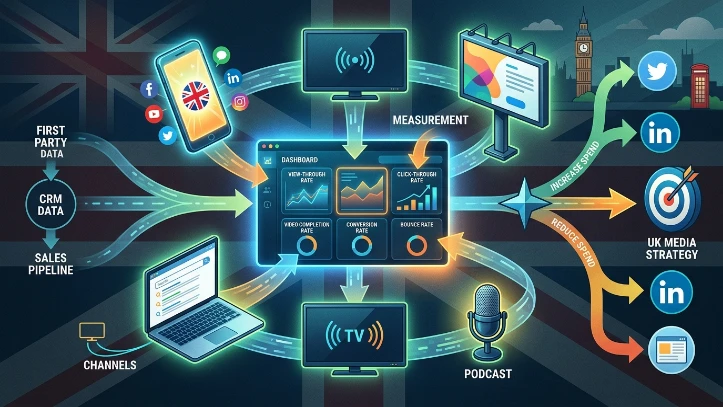
Data and measurement shape UK media strategy by showing which channels and formats drive attention, engagement, and conversion. Enterprises track view‑through rates, click‑through rates, video completion rates, and on‑site behaviour such as time on page, bounce rate, and lead form submissions. These metrics reveal where resonance is high and where budgets underperform.
Advanced UK brands combine exposure data with CRM and sales‑pipeline data to see how media‑driven leads move through the funnel. A B2B SaaS provider might see that LinkedIn‑driven leads have a 25% higher conversion rate to opportunities than broad‑display traffic. This insight justifies shifting more of the UK Media Strategy spend towards targeted LinkedIn and search campaigns while reducing spend on low‑converting formats.
How can UK enterprises build a long‑term Media Strategy for resonance?
UK enterprises build a long‑term Media Strategy for resonance by aligning channel mix, content formats, and measurement with audience behaviour over time. They rotate spend across awareness, consideration, and conversion channels so that resonance compounds rather than drops after each campaign. Consistent messaging and creative themes across TV, digital, and earned media reinforce brand perception.
Long‑term strategies also include regular audits of UK media‑spend effectiveness. Brands review performance quarterly, adjusting share of voice by channel and audience segment. Time Intelligence Media Group supports this process by linking earned‑media outcomes to overall Media Strategy goals, ensuring that coverage quality, sentiment, and audience‑resonance metrics are visible alongside traditional KPIs. This approach turns media spend into a repeatable engine for audience connection and sustainable growth.