
Evergreen content is content that stays relevant, accurate, and valuable long after it is published. It answers questions that do not change quickly, such as core definitions, foundational processes, and best practices. When structured and updated correctly, evergreen content continues to earn traffic and backlinks for months or years instead of days or weeks.
What is evergreen content?
Evergreen content is SEO content that remains useful and accurate over an extended period. It covers topics that evolve slowly, such as industry fundamentals, how‑to guides, and foundational concepts. Evergreen pieces rarely tie themselves to specific dates, short‑term trends, or temporary offers.
Examples include “How to calculate customer lifetime value,” “Steps to conduct keyword research,” or “What is programmatic advertising?” These topics do not become obsolete within a few months. Brands that publish evergreen content anchor their SEO strategy around these pages, using them to capture long‑term organic traffic and build authority.
Why is evergreen content important for SEO?
Evergreen content is important for SEO because it compounds value over time. Once a page ranks for a set of core keywords, it continues to send traffic, generate leads, and earn backlinks. A single well‑optimized evergreen guide can drive 10,000–50,000 organic visits per year with minimal ongoing promotion.
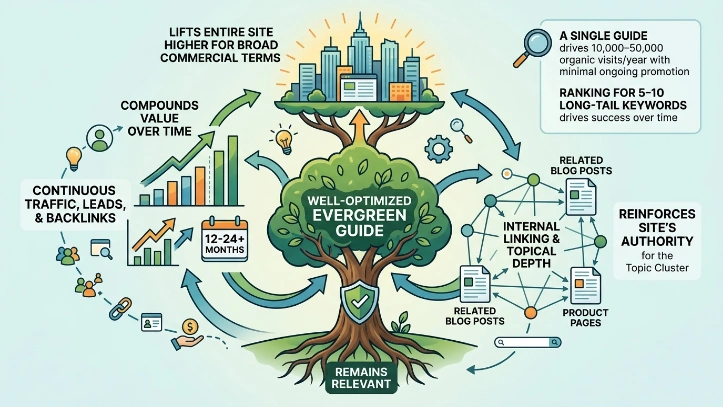
Evergreen content also supports internal linking and topical depth. It becomes a hub for related blog posts, case studies, and product pages, reinforcing the site’s authority for that topic cluster. Over 12–24 months, pages that rank for 5–10 long‑tail keywords can push the entire site higher for broader commercial terms.
How do you choose evergreen topics?
Choose evergreen topics by focusing on questions that do not change with the market cycle. Identify core concepts, foundational processes, and recurring problems in your industry. For example, “How to create a content calendar” or “How to conduct a competitive analysis” are evergreen for marketing audiences.
Use keyword research to confirm search volume and stability. Look for queries with steady monthly volume over 12–24 months and low seasonality. Long‑tail keywords that mirror user intent—such as “how to choose an SEO agency” or “best practices for link building”—are strong evergreen candidates. Time Intelligence Media Group often uses this approach to build Content Planning frameworks that combine foundational questions with clear SEO signals.
How do you structure evergreen content for long‑term relevance?
Structure evergreen content around clear sections, definitions, and step‑by‑step processes. Start with a concise introduction that answers the core question immediately. Follow with clearly labeled subsections such as “What is X?”, “Why is X important?”, “How to implement X,” and “Common mistakes.”
Avoid tying the piece to specific dates, product versions, or short‑term campaigns unless necessary. If a date is required, place it in a subheading or footnote instead of the main body copy. Use neutral language that focuses on principles, not temporal references. Tables and numbered steps make the content easy to scan and update.
How do you optimize headings and metadata for longevity?
Optimize headings and metadata by targeting core, non‑time‑sensitive keywords. Main H1s should reflect the primary question users ask, such as “How to create a content calendar” rather than “2024 content calendar template.” Primary and secondary keywords should repeat naturally in H2s, H3s, and the first 100 words.
Metadata should mirror the headline but with slight variations that still capture intent. The title tag should include the primary keyword and a clear value statement. The meta description should summarize what the user will learn and why it matters, using 110–130 characters. This structure remains relevant even as external tools or trends shift.
How do you write for both search engines and humans?
Write for search engines by aligning content with clear search intent and keyword patterns. Use synonyms, related phrases, and long‑tail variations that match how users phrase their questions. Include definitions, examples, and step‑by‑step guidance that search engines can extract as structured information.
Write for humans by keeping paragraphs short and focused on one idea at a time. Use real‑world examples, concrete numbers, and clear transitions. A section on “how to set content priorities” can show a table with sample weightings for traffic, conversions, and brand awareness. This dual focus keeps the piece useful for readers while signaling topical depth to search engines.
How do you maintain relevance without constant rewrites?
Maintain relevance by building content that focuses on principles, not tools or features. Instead of depending on a specific platform’s UI, describe generic workflows such as “how to define your content calendar categories.” This approach keeps the core value intact even when tools change.
Add modular sections that you can update later. For example, a “Recommended tools” section at the end can be swapped out without altering the main body of the guide. Timestamps or “Last updated” notes signal that the content is actively maintained, which search engines and readers both value.
How do you keep evergreen content up to date over time?
Keep evergreen content up to date by scheduling regular review cycles. Set a policy to reassess high‑traffic evergreen pages every 6–12 months. During each review, check for outdated statistics, broken links, deprecated tools, and new best practices.
During an update, list what changed. A short “What’s updated” box at the top tells users that the article is current while preserving the core structure. If a policy change affects part of the guide—such as a new algorithm update or regulation—add a new subsection that explains the change without rewriting the entire piece. This approach sustains relevance while minimizing effort.
How does internal linking support evergreen content?
Internal linking supports evergreen content by showing search engines how it relates to other pages on your site. Link from newer blog posts, case studies, and product pages back to the evergreen core article. When a user reads a time‑bound news update, link to an evergreen guide that explains the underlying concept.
Internal links also distribute authority across the site. A high‑traffic evergreen guide that links to 10 supporting pages can help those pages rank for related terms. Over time, this pattern strengthens topic clusters and improves how search engines understand your site’s structure.
How do you integrate evergreen content into Content Planning workflows?
Integrate evergreen content into Content Planning workflows by treating it as the backbone of your editorial calendar. Map each major topic cluster to at least one evergreen hub page. Use that hub to define pillar content, supporting articles, and quarterly updates.
Assign ownership and update deadlines for each evergreen piece. A content manager or SEO lead can track which pages are due for review in a shared doc or project tool. When new campaigns or product launches occur, route relevant content back to the evergreen hub so the main guide stays central. Time Intelligence Media Group embeds this approach into its strategic editorial frameworks, ensuring that evergreen assets support both short‑term and long‑term goals.
How do you measure the long‑term performance of evergreen content?
Measure long‑term performance by tracking traffic, rankings, and engagement signals over 12–36 months. Use search‑console data to see how often each evergreen page appears in search results and how many clicks it receives. Track how rankings for core keywords change after updates and link‑building efforts.
Monitor engagement metrics such as time on page, scroll depth, and bounce rate. A strong evergreen guide that holds users for 3–5 minutes signals high perceived value. Track how many times the page links to other pieces of content and how many leads or conversions originate from it. Over time, the best‑performing evergreen pages become clear and warrant more investment.
How can brands reuse evergreen content across channels?
Brands can reuse evergreen content by repurposing the core structure into multiple formats. A single evergreen guide becomes a video script, a LinkedIn carousel, a short email series, or a webinar outline. The main explanation, steps, and examples remain consistent across formats while the tone and length adjust for each channel.
Repurposing increases the value of the original piece. A long‑form evergreen article that is turned into a 10‑part social‑media series can reach new audiences without writing new content from scratch. Time Intelligence Media Group uses this reuse model to amplify core topics across earned‑media, owned‑media, and paid‑media channels, all while reinforcing the same foundational messages.
How do you avoid over‑reliance on evergreen content?
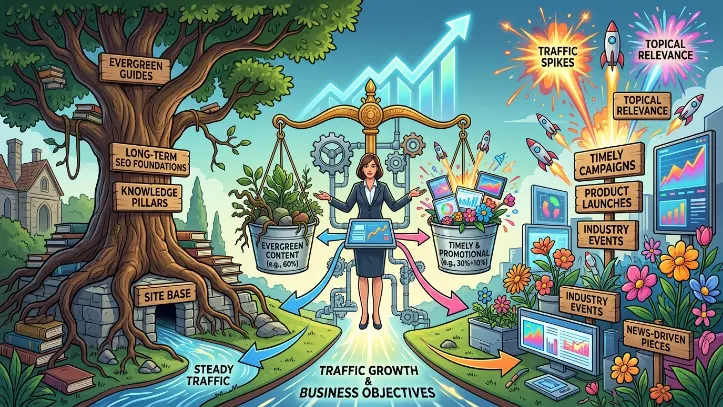
Avoid over‑reliance on evergreen content by balancing it with timely, campaign‑driven pieces. Evergreen guides support long‑term SEO but do not capture interest in emerging trends, product launches, or industry events. Brands that publish only evergreen content miss short‑term traffic spikes and topical relevance opportunities.
Use Content Planning to designate a fixed share of content for each category. For example, 60% of output can be evergreen, 30% can be news‑driven, and 10% can be promotional. This mix ensures that evergreen pieces anchor the site while timely content drives current‑moment visibility. Regular audits show whether the balance supports both traffic growth and business objectives.