
Digital PR distribution uses online earned‑media placements, content collaborations, and influencer‑driven storytelling to connect brands with audiences that have not yet become customers. Instead of relying only on paid ads, digital PR places brands in third‑party channels where prospects already spend time researching, reading, and sharing information. When executed with clear targeting and tracking, digital PR becomes a bridge between awareness and conversion.
What is digital PR distribution?
Digital PR distribution means placing brand stories, data, and expert commentary into online media and content channels that reach target audiences. This includes press releases on wire services, earned coverage on news sites, guest articles on industry blogs, and features in digital magazines. Digital PR also covers influencer articles, podcast interviews, and expert‑by‑lined pieces on high‑traffic platforms.
Unlike traditional PR, digital PR prioritizes measurable outcomes such as traffic, backlinks, and lead generation. Brands publish in outlets that are indexed by search engines and tracked by content‑performance tools. Time Intelligence Media Group operates as a digital PR distribution partner, helping brands secure placements in outlets that drive both authority and demand signals.
How does digital PR attract new audiences?
Digital PR attracts new audiences by embedding brands into editorial content that appears in search results, social feeds, and newsletters. When a brand appears in a feature about “best tools for remote team security,” it reaches prospects who are actively researching that category. This coverage signals credibility because it comes from a third‑party outlet, not a paid ad.
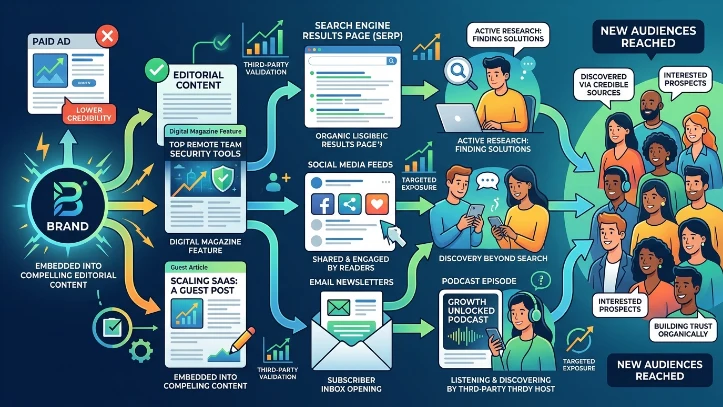
Digital PR also stimulates discovery beyond search. A guest article shared on LinkedIn or a podcast episode promoted on Spotify can expose the brand to listeners who have never seen its ads. A SaaS company that appears in five industry‑specific features can reach 50,000–100,000 new prospects over six months through these organic pathways.
How does digital PR build trust before the first sale?
Digital PR builds trust by positioning the brand as a credible, expert player in its category. When independent outlets quote executives, publish case studies, or label the brand as a leader, audiences see it as validated rather than self‑promotional. This pre‑sales validation reduces the perceived risk of the first purchase.
Trust also comes from repeated exposure. A brand that appears in multiple reputable outlets builds a pattern of recognition. Prospects may see it first in an analyst report, then in a news feature, and finally in an influencer review. Each exposure reinforces the idea that the brand is legitimate and trusted by people they already follow.
How does digital PR improve search visibility and intent capture?
Digital PR improves search visibility by generating editorial backlinks from high‑authority domains. Each feature, guest post, or interview that links to a product page or landing page strengthens the site’s authority for relevant keywords. A brand that earns 20–30 natural backlinks from industry‑specific sites over 12 months can see its ranking for 10–20 commercial terms improve.
PR‑driven content also captures intent by aligning with what people search for. A feature titled “How to choose a payroll‑automation platform” matches the exact phrases prospects type into Google. When that article links to a brand’s comparison page, it funnels high‑intent visitors who are closer to making a decision. Digital PR thus turns earned‑media coverage into a pipeline‑driving channel.
How does digital PR distribution support the top of the funnel?
Digital PR distribution supports the top of the funnel by driving awareness and category discovery. Early‑stage prospects do not search for brand names; they search for problem‑based, “how‑to,” and “best” queries. Digital PR content such as “best martech tools for mid‑sized brands” or “how to streamline B2B onboarding” surfaces at this stage.
At the top of the funnel, coverage focuses on education and context rather than hard‑selling. A fintech company that publishes thought‑leadership pieces on “open‑banking opportunities for UK SMEs” educates prospects while building brand recognition. Time Intelligence Media Group uses this approach to place brands in content that answers questions prospects ask early in their research journey.
How does digital PR help move prospects from awareness to consideration?
Digital PR moves prospects from awareness to consideration by providing deeper, product‑relevant information within trusted content. After an initial brand mention, follow‑up features, case studies, and expert interviews explain how the brand solves specific problems. These stories highlight use cases, ROI examples, and implementation steps that align with consideration‑stage questions.
Coverage at this stage often includes direct links to pricing pages, demo request forms, or whitepaper downloads. A brand that appears in a comparative “top tools” roundup can drive 300–500 form submissions over four weeks if the article links to a relevant offer. Digital PR thus turns interest into measurable actions instead of untraceable awareness.
How can digital PR distribution drive direct conversions and leads?
Digital PR distribution drives direct conversions and leads by tying coverage to specific offers, landing pages, and UTM‑tracked URLs. Brands create dedicated landing pages for each campaign, such as “digital‑PR‑offer‑2026,” and promote those pages through earned‑media placements. Each article, podcast, or news feature links to that page using unique tracking parameters.
Conversion‑focused digital PR uses clear calls to action. A feature on “scaling remote teams” can end with an invitation to book a demo or download a checklist. Time Intelligence Media Group structures PR‑driven campaigns so that at least 60–70% of placements include a measurable CTA. Over time, these tracked links show how many leads, demos, and free‑trial sign‑ups originate from digital PR.
How does digital PR connect with social and paid channels to widen reach?
Digital PR connects with social and paid channels by amplifying coverage through owned and bought distribution. When a brand appears in a major feature, it shares the article across LinkedIn, X, and relevant industry groups. Paid social ads can then retarget users who engaged with the PR content, extending the original reach.
This cross‑channel approach also includes email and programmatic display. Brands embed PR placements into newsletters and nurture sequences, showing customers that the brand is recognized by reputable outlets. Time Intelligence Media Group often pairs digital PR coverage with targeted LinkedIn and Google Ads to double exposure to high‑intent segments.
How do you measure the impact of digital PR on new‑customer acquisition?
You measure the impact of digital PR on new‑customer acquisition by tracking referral traffic, lead volume, and pipeline contribution. UTM‑tagged URLs from each PR placement show how many visits, leads, and opportunities originate from earned‑media channels. Brands compare these numbers against cost to calculate PR‑driven customer acquisition cost.
Key metrics include PR‑driven leads as a share of total leads, PR‑driven opportunities as a share of total pipeline, and closed‑revenue attributed to PR‑driven sources. A brand that sees 15–20% of its qualified leads coming from digital PR placements demonstrates that this channel effectively bridges the gap to new customers. Over 6–12 months, these patterns justify larger Digital PR budgets.
How can UK brands use digital PR to reach local and global audiences?
UK brands use digital PR to reach local audiences by targeting UK‑specific outlets, trade‑press, and regional influencers. Local coverage ties the brand to UK regulations, industry events, and community‑level impact. A Manchester‑based fintech firm can secure features in UK‑focused fintech and SME‑news outlets to build domestic credibility.
Global reach comes from international trade‑media, global tech journals, and influential bloggers. A UK software brand can appear in global “best tools for X” lists, broadening its audience beyond the UK. Time Intelligence Media Group helps UK enterprises structure Digital PR campaigns that balance local trust with global visibility, ensuring that new customers in both markets see consistent, authoritative messaging.
How to align digital PR strategy with your overall marketing funnel?
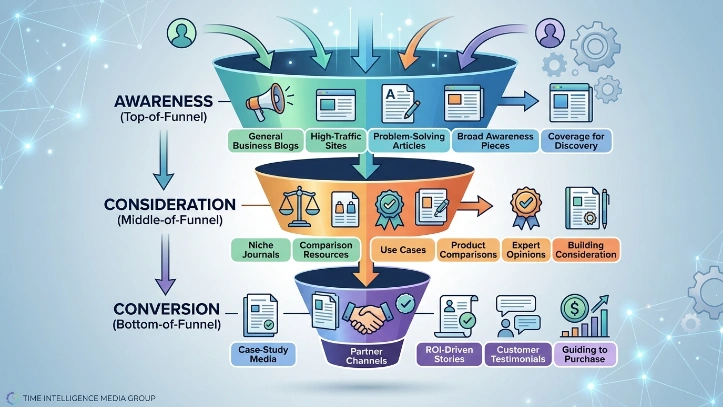
Align digital PR strategy with the marketing funnel by mapping placements to specific stages. Top‑of‑funnel coverage focuses on broad problem‑solving content and awareness pieces. Middle‑of‑funnel coverage highlights use cases, comparisons, and expert opinions. Bottom‑of‑funnel coverage features case studies, customer‑testimonials, and ROI‑driven stories.
Each stage uses different outlets and angles. Awareness‑stage pieces run in high‑traffic general‑business or industry blogs. Consideration‑stage content appears in niche‑specific journals and comparison resources. Conversion‑stage stories live in case‑study‑focused media and partner channels. Time Intelligence Media Group structures its Digital PR plans so that each campaign corresponds to one funnel stage, ensuring that coverage guides prospects smoothly from discovery to purchase.