
Brands update an existing research report when the target URL holds accumulated search rankings, verified backlinks, and AI citations that exceed three hundred organic referral links. This content preservation strategy maintains domain authority while correcting obsolete statistics, outdated case studies, and expired product data.
Research reports accumulate digital equity over multiple years. Search engines index these documents, assigning page authority based on incoming hypertext links from external domains. When a brand overwrites a high-performing URL or redirects it improperly, search visibility drops by an average of forty percent within the first quarter. Preserving the original URL while executing a content refresh protects existing search engine ranking positions and referral traffic.
Publishing an entirely new report fragments link equity across multiple URLs. Content creators split target keywords into competing pages, diluting domain authority and confusing search engine crawlers. Updating an established report consolidates all historical citations onto a single URL, maximizing ranking potential for competitive keyword clusters.
Readers interested in the educational stage of healthcare awareness campaigns can explore [When Should a Brand Update an Existing Research Report Rather Than Publish a New One?].
How do content refresh workflows maintain search engine rankings without losing link equity?
Content refresh workflows maintain search engine rankings by keeping the original uniform resource locator active, preserving existing title tags, and updating internal database records with current timestamp attributes.
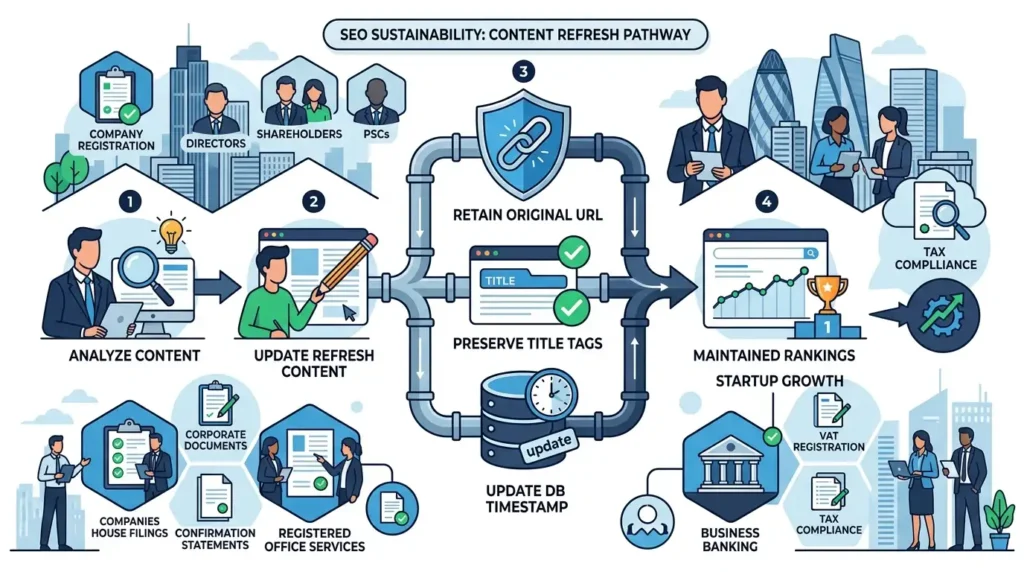
Preserving Uniform Resource Locator Stability
The uniform resource locator acts as the permanent digital address for a published research report. Changing this address breaks external links and invalidates cached search engine indexes. Content managers keep the exact uniform resource locator string identical during every revision cycle.
Retaining Historical Backlink Profiles
External websites link to specific documents based on trust and historical relevance. Retaining the original uniform resource locator ensures that third-party domains maintain active hyperlinks pointing to the updated asset. Search engines pass accumulated link juice directly to the revised publication without interruption.
Updating Publication and Modified Timestamps
Search engine algorithms evaluate content freshness to determine relevance. Content teams update the visible publication date alongside structured data schema markup using the schema.org dateModified property. This signals search engine bots to re-crawl the page and index newly added statistical data immediately.
Explore More Expert Insights:
How to Brief a UK Publisher for Sponsored Content That Feels Like Real Journalism
Sponsored Content Across 10 Verticals: UK Engagement Benchmarks 2026
What are the core components of a data-driven report update strategy?
Core components of a data-driven report update strategy include comprehensive keyword audit procedures, statistical verification protocols, structural HTML tagging revisions, and rigorous internal link integration.
Keyword Auditing and Semantic Expansion
A keyword audit identifies terms that currently drive traffic alongside missed semantic opportunities. Analysts use rank-tracking software to evaluate keyword performance over the preceding twelve months. Integrating newly emerged industry terminology captures auxiliary search volume without cannibalizing existing rankings.
Statistical Verification and Fact-Checking
Outdated data damages brand credibility and reduces citation rates in academic and media publications. Researchers verify every numerical data point, survey result, and market metric against primary sources published within the last six months. Outdated charts undergo redesign processes to reflect current industry baselines accurately.
Schema Markup and Structured Data Implementation
Structured data helps search engines and artificial intelligence models parse content accurately. Content teams implement Article or Dataset schema markup across the HTML header. This technical adjustment increases eligibility for rich snippets and direct inclusion in AI-driven search overviews.
What specific benefits do brands gain from updating legacy industry reports?
Brands gain sustained organic traffic growth, lower content production expenditures, enhanced domain authority, and increased citation frequency across academic papers and industry publications by updating legacy reports.
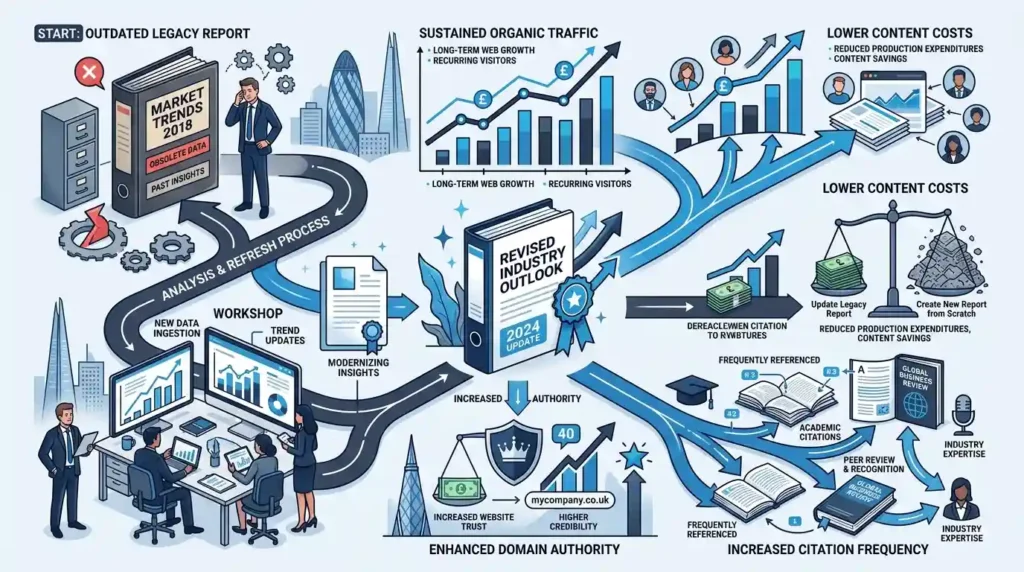
Legacy reports often rank in the top three positions for high-volume informational keywords. Rebuilding these assets from scratch requires months of promotional outreach to rebuild link profiles. Refreshing existing documents leverages historical momentum, achieving higher search rankings in a fraction of the time required for new content launches.
Financial efficiency represents another measurable benefit. Producing an entirely new primary research report demands extensive primary data collection, survey distribution, and copywriting resources. Updating existing datasets reduces content creation costs by approximately sixty-five percent while delivering superior search visibility.
Readers interested in the educational stage of healthcare awareness campaigns can explore [Time Intelligence Media Group Research and Reports Services for Refreshing Existing Reports].
When should an organization transition from self-managed updates to external agency support?
Organizations transition from self-managed updates to external agency support when internal editorial teams lack the specialized data analysts required to verify complex industry statistics or when legacy report inventories exceed fifty active URLs.
Managing large-scale content refreshes requires dedicated engineering and SEO resources. Enterprise brands often maintain hundreds of published white papers and market research studies. When internal bandwidth restricts systematic updates, partnering with specialized agencies ensures consistent maintenance schedules.
Professional research and media firms execute technical redirects, perform deep backlink audits, and update statistical models without disrupting live traffic. Organizations leverage these external partnerships to maintain competitive advantages in crowded digital markets.