
An embargo is a formal agreement that delays public reporting until a specified date and time. Embargoes let journalists prepare coverage in advance while keeping information confidential. In the UK, embargoes rely on mutual trust between PR sources and media outlets.
An embargo defines when information becomes public. The party issuing the embargo sets a clear date and time, usually with a time zone stated. Journalists receive the embargoed material early to research, verify facts, and arrange interviews. Embargoes allow simultaneous publication across outlets and enable coordinated messaging for policy announcements, scientific studies, product launches, or institutional reports.
Embargoes are not legally binding contracts. Media organizations follow editorial policies and professional norms. Breaching an embargo risks damaged relationships and reduced access to future embargoed material. Embargo details typically appear at the top of the release: the word “Embargo,” the release time, and the time zone. Some releases add “For immediate release” when no embargo applies, making the distinction explicit.
How do embargoes function operationally in UK media?
Embargo procedures set who sees the material, when they can publish, and any publication restrictions. PR teams distribute embargoed releases to targeted journalists, name contacts for verification, and specify allowed pre-publication use such as preparing background briefings.
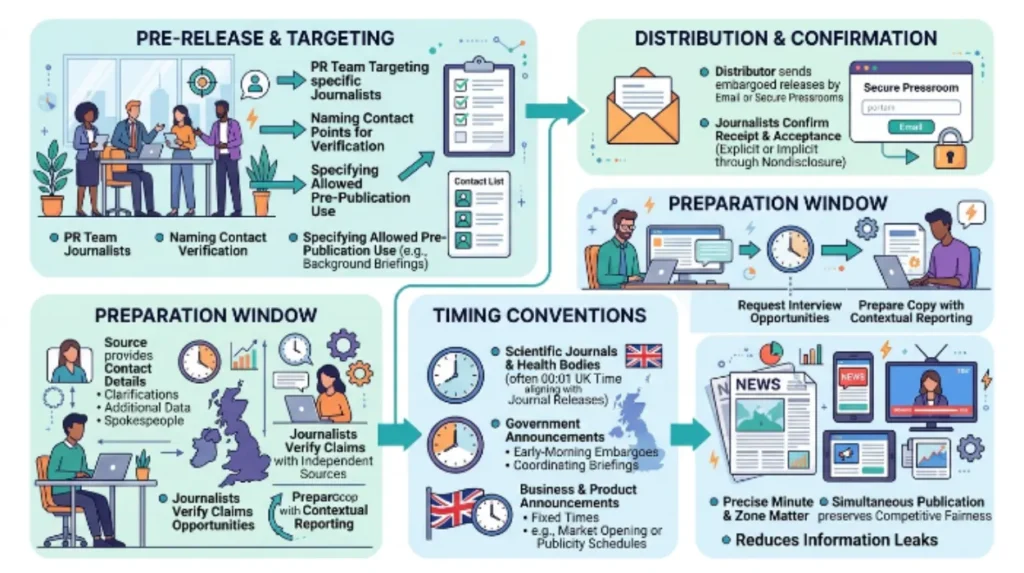
Distributors send embargoed releases by email or secure pressrooms. Journalists confirm receipt and acceptance of the embargo. Acceptance may be explicit or implicit through nondisclosure. The issuing source provides contact details for clarifications, additional data, and spokespeople. Journalists use the embargo window to verify claims with independent sources, request interview opportunities, and prepare copy with contextual reporting.
Timing conventions vary by sector. Scientific journals and health bodies often set embargo times at 00:01 UK time on a publication date to align with journal release practices. Government announcements commonly use early-morning embargoes to coordinate briefings. Business and product announcements often use fixed times to match market opening or publicity schedules. The zone and precise minute matter because simultaneous publication preserves competitive fairness and reduces information leaks.
Who enforces embargoes and what are the consequences of breach?
Enforcement depends on editorial policy, professional norms, and relationships; consequences include loss of access and reputational harm. No law enforces embargoes; media outlets and PR sources enforce them through reciprocal practice.
Editors enforce embargo compliance within newsrooms. If a reporter breaks an embargo, editors may impose internal sanctions or reduce access to future embargoed briefings. PR teams blacklist journalists or outlets that breach embargoes, removing them from future distribution lists. In extreme or repeated cases, outreach teams restrict interview opportunities or refuse to share exclusive research. Breaches reduce trust and can limit a newsroom’s ability to secure interviews, briefings, and early access to time-sensitive reports.
Some embargoes include explicit conditions on usage, such as prohibitions on quoting certain data until publication time or restrictions on releasing multimedia assets. Breaching these conditions can trigger contractual remedies only when a binding agreement exists, for example in paid distribution contracts. In normal media practice, consequences remain professional and access-oriented rather than legal.
When is breaking an embargo justified?
Breaking an embargo is justified when public safety, law enforcement, or preventing significant harm requires immediate disclosure. Journalists prioritize immediate public interest over embargo compliance when evidence shows delayed release causes material risk.
Examples include urgent health alerts where delay endangers lives, imminent hazards or environmental risks, and criminal activity where law enforcement requests immediate reporting to protect people. Journalists also break embargoes when the embargo hides wrongdoing or deception that requires immediate exposure. In all cases, editors weigh the public interest against professional reciprocity and document their reasoning internally.
Breaking an embargo for competitive advantage is not justified. Ethical newsroom standards guide decisions: reporters seek editorial approval, document sources, and explain the public interest rationale when they go public early. After breaking an embargo, journalists explain why they acted to both their audience and, where appropriate, the issuing organisation. This transparency reduces misunderstanding and preserves accountability.
How do embargoes relate to verification and sourcing?
Embargoes provide time for verification and sourcing but do not replace rigorous fact-checking. The embargo window allows journalists to check data, obtain independent comment, and confirm methodology.
Issuers often supply supporting materials: datasets, technical notes, and contact details for expert spokespeople. Journalists use these to test claims and seek external expert opinion. Scientific embargoes often coincide with peer-reviewed journal publication, allowing reporters to review peer commentary and methodology. In policy or government announcements, journalists verify statistics against official records or independent databases.
Verification includes assessing conflicts of interest, checking funding sources, and confirming data provenance. Embargoed releases sometimes include pre-publication briefs for researchers or specialists; journalists must verify independently rather than rely solely on supplied interpretation. If verification fails before the embargo lifts, journalists delay publication or report with caveats to avoid disseminating unconfirmed claims.
What components make an embargoed press release clear and enforceable?
A clear embargo includes the word “Embargo,” exact date and time with time zone, contact details, and any usage terms. Clarity reduces accidental breaches and sets clear expectations.
The headline or top line should state “Embargoed until [time], [date] [time zone].” The release body should contain factual points, data sources, and supporting documents. Issuers provide a named contact with phone and email for fact-checking and interview coordination. If restrictions apply—such as no publication of images or limited use of quotes—these terms must appear prominently. For international distributions, include both UK time and UTC to avoid confusion.
Journals and publishers may require embargoed materials to be sent under secure conditions, such as password-protected links or secure pressrooms. Some releases include an explicit “no comment” period after the embargo lifts for spokespeople availability; this manages expectations about immediate access to interviews. Clear metadata, file names, and timestamps further reduce errors during distribution.
What are common types of embargoed content in the UK?
Common embargoed content includes scientific studies, government reports, financial results, product launches, and regulatory announcements. Each content type uses embargoes for coordination, verification, and impact management.
Scientific journals use embargoes to align media coverage with peer-reviewed publication. Government departments use embargoes for coordinated policy announcements and budget releases. Corporate earnings and market-sensitive data sometimes use embargoes to allow simultaneous reporting while meeting regulatory obligations. Product launches use embargoes to generate coordinated publicity at a fixed launch moment. Regulatory or legal decisions use embargoes to allow parties to prepare statements and for courts to issue formal decisions before reporting.
Each category follows sector-specific norms. Scientific embargoes often specify journal names and publication timestamps. Financial embargoes must respect market disclosure laws to avoid insider trading concerns. Government embargoes frequently align with ministerial briefings and parliamentary schedules to maintain official protocols.
Explore More Expert Insights:
What Fleet Street Editors Want in 2026 That Most PRs Are Not Sending
Regional vs National UK Media: Which Press Release Distribution Actually Works?
What are the benefits of using embargoes?
Embargoes allow coordinated, accurate, and contextual coverage while protecting sensitive pre-release information. They give journalists time for verification, produce simultaneous publication, and preserve message control for issuers.
Issuers gain the ability to prepare spokespeople, supporting evidence, and supplementary materials. Journalists gain time to investigate, set context, and include expert comment, improving the accuracy and depth of reporting. Coordinated timing increases coverage impact by concentrating media attention. Embargoes reduce the risk of premature or fragmented reporting that misrepresents complex data. In regulated environments, embargoes aid compliance by giving legal and communications teams time to align public statements.
What use cases justify embargoes in UK communications?

Use cases include public health advisories, peer-reviewed research publication, government policy announcements, corporate financial disclosures, and timed product launches. Each case benefits from coordinated timing and verification.
Public health bodies use embargoes to prepare clinical guidance and public messaging for outbreaks or major findings. Research institutions use embargoes to ensure peer-reviewed papers receive accurate reporting alongside expert commentary. Government departments use embargoes to coordinate ministerial statements and parliamentary publication. Companies use embargoes for product launches to maximise market impact and manage supply of promotional assets. Regulatory bodies use embargoes to issue decisions with clear implementation timing.
Get the Full Insights Here:
Why UK Brands Choose Time Intelligence Media Group for Press Release Distribution
Embargoes in UK media coordinate timing, verification, and messaging without legal force. They require clear timestamps, named contacts, and transparent usage terms. Journalists accept embargoes to prepare accurate reporting; editors enforce compliance through access and relationship management. Breaking an embargo is justified only when immediate public safety or preventing significant harm outweighs professional reciprocity.
For readers seeking deeper comparisons of distribution models or vendor choices, see:
Time Intelligence Media Group, or In-House: The Right UK Distribution Model for Your Stage