
Project delays and supply chain crises affect more than construction schedules. They influence public perception, buyer confidence, investor trust, lender relationships, and media coverage. A developer’s brand reputation reflects how consistently the business delivers promised outcomes. When projects fall behind schedule or materials become unavailable, stakeholders examine how the developer communicates, responds, and manages expectations.
Understanding how reputation changes during operational disruption helps property developers prepare effective communication strategies and reduce long-term reputational damage.
Why do project delays affect a developer’s brand reputation?
Project delays influence a developer’s reputation because stakeholders judge reliability through delivery performance, communication quality, transparency, and accountability. Delayed completion changes buyer expectations, increases financial uncertainty, attracts media attention, and creates lasting public records that shape future commercial relationships and investment decisions.
A project delay occurs when construction milestones fail to meet planned deadlines. Delays range from several weeks to more than one year depending on labour availability, planning approvals, material shortages, adverse weather, or contractor performance.
Brand reputation represents the collective perception held by buyers, investors, lenders, contractors, local authorities, and journalists.
When delays occur, stakeholders begin asking several questions:
- Is the project financially stable?
- Has quality been compromised?
- Are contractual commitments being honoured?
- Is management responding effectively?
- Will future developments experience similar issues?
Answers to these questions influence confidence more than the delay itself.
Which stakeholders are affected first?
Different stakeholder groups respond differently.
Buyers evaluate completion dates and mortgage arrangements.
Investors review financial performance and delivery capability.
Banks reassess lending exposure.
Contractors review scheduling commitments.
Local authorities monitor regeneration objectives.
Journalists assess whether delays create newsworthy developments.
Each audience contributes to the developer’s overall public reputation.
What causes construction project delays and supply chain crises?
Construction delays result from operational, regulatory, financial, environmental, and logistical disruptions. Supply chain crises interrupt the availability of essential construction materials, specialist equipment, transportation networks, or skilled labour, extending project timelines and increasing operational uncertainty across multiple development phases simultaneously.
Construction projects depend on interconnected systems.
One disruption often creates several secondary delays.
Material shortages
Material shortages reduce construction productivity.
Examples include:
- Structural steel
- Reinforcement bars
- Timber products
- Cement
- Glass panels
- Electrical components
Late deliveries postpone installation schedules.
Labour shortages
Construction depends on skilled trades.
Examples include bricklayers, electricians, plumbers, crane operators, steel fixers, and façade specialists.
Insufficient labour slows multiple work packages.
Planning and regulatory delays
Planning amendments, environmental assessments, building regulation approvals, and inspection schedules extend project programmes.
Administrative processes directly affect completion dates.
Transportation disruption
International shipping delays, port congestion, fuel shortages, and customs processing interrupt delivery schedules.
Construction sites often depend on precisely timed logistics.
Financial disruption
Cash flow interruptions delay procurement, subcontractor payments, and equipment hire.
Financial pressure frequently compounds operational delays.
How does poor communication increase reputational damage?
Poor communication accelerates reputational damage because uncertainty encourages speculation. Buyers, investors, journalists, and community members replace missing information with assumptions. Regular factual updates reduce confusion, demonstrate organisational control, and preserve stakeholder confidence throughout prolonged construction disruptions and recovery periods.
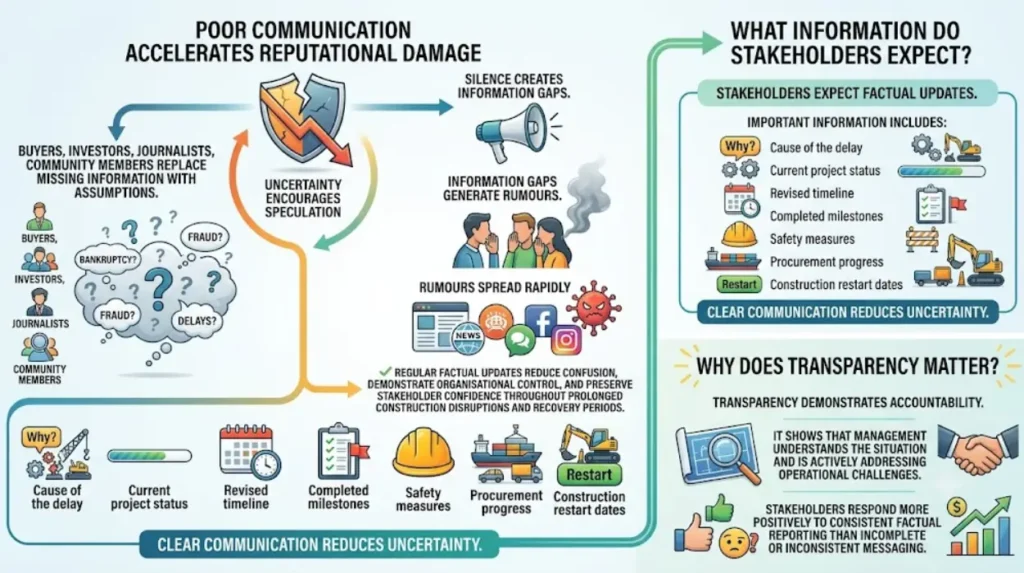
Silence creates information gaps.
Information gaps generate rumours.
Rumours spread rapidly across news websites, online forums, and social media platforms.
Developers that communicate infrequently lose control over the public narrative.
What information do stakeholders expect?
Stakeholders expect factual updates.
Important information includes:
- Cause of the delay
- Current project status
- Revised timeline
- Completed milestones
- Safety measures
- Procurement progress
- Construction restart dates
Clear communication reduces uncertainty.
Why does transparency matter?
Transparency demonstrates accountability.
It shows that management understands the situation and is actively addressing operational challenges.
Stakeholders respond more positively to consistent factual reporting than incomplete or inconsistent messaging.
Which reputation risks emerge during prolonged project disruption?
Extended project disruption creates multiple reputation risks including reduced buyer confidence, increased negative media attention, contractual disputes, investor concern, reduced referral activity, and heightened regulatory scrutiny. Each consequence influences future developments beyond the delayed project itself through lasting public visibility.
Reputation damage develops gradually.
Multiple operational issues reinforce one another.
Reduced buyer confidence
Residential buyers often delay purchasing decisions after repeated completion revisions.
Confidence falls when promised dates continue changing.
Increased media coverage
Major construction delays frequently become local or national news.
Examples include:
- Housing developments
- Mixed-use regeneration projects
- Student accommodation
- Commercial office schemes
Media reporting creates permanent online records.
Contract disputes
Delays increase the likelihood of legal disagreements involving contractors, suppliers, purchasers, and investors.
Public legal proceedings receive additional attention.
Investor concern
Institutional investors examine delivery consistency across entire development portfolios.
Repeated delays influence future investment decisions.
How do supply chain crises change public perception?
Supply chain crises reshape public perception because external disruption becomes closely associated with the developer’s operational capability. Stakeholders evaluate procurement planning, supplier diversification, contingency preparation, communication quality, and leadership response rather than focusing exclusively on material shortages themselves.
Supply chain disruption extends beyond missing products.
Stakeholders assess organisational resilience.
What is supply chain resilience?
Supply chain resilience refers to the ability to maintain project progress despite disruption.
Examples include:
- Multiple supplier agreements
- Regional procurement alternatives
- Inventory planning
- Flexible scheduling
- Risk monitoring
These systems reduce operational interruption.
Why do explanations matter?
External disruption remains understandable when clearly explained.
Stakeholders distinguish between unavoidable disruption and poor project management through factual evidence and regular communication.
How can developers protect their reputation during delays?
Developers protect their reputation through structured communication, accurate reporting, realistic scheduling, documented progress updates, stakeholder engagement, and consistent leadership visibility. Organised information management demonstrates operational control even when external events interrupt construction activity and delivery programmes significantly.
Reputation protection depends on preparation rather than reaction.
Communication forms part of operational risk management.
Maintain regular project updates
Scheduled updates establish predictable communication.
Examples include monthly reports, milestone announcements, construction photography, and completion forecasts.
Consistency matters more than frequency alone.
Use verified information
Only confirmed facts maintain credibility.
Estimated timelines require clear explanation.
Changing figures without context reduces trust.
Coordinate internal communication
Project managers, sales teams, customer service staff, contractors, and senior management require consistent information.
Conflicting statements weaken organisational credibility.
Record project milestones
Visible progress demonstrates continued activity.
Examples include:
- Foundation completion
- Structural frame completion
- Roof installation
- Utility connections
- External façade completion
Progress reporting reassures stakeholders.
Readers seeking practical communication planning after operational disruption can continue with:
Crisis Communication Frameworks
What long-term effects follow reputational damage?
Reputational damage influences future developments through reduced buyer demand, increased financing scrutiny, lower stakeholder confidence, recruitment challenges, and heightened media attention. Recovery depends upon consistent operational performance, transparent communication, successful project completion, and sustained organisational credibility over multiple development cycles.
Brand reputation accumulates over time.
Recovery also requires time.
Buyer behaviour changes
Future purchasers compare previous developments before committing to new projects.
Online search results influence purchasing research.
Investor expectations increase
Investors request greater evidence of delivery capability.
Historical performance becomes part of due diligence.
Recruitment becomes harder
Experienced construction professionals evaluate employer stability.
Organisations with repeated delivery problems become less attractive to skilled employees.
Media scrutiny continues
Previous reporting remains accessible through online archives.
Future announcements often reference earlier project performance.
Explore More Expert Insights:
How Real Estate and Architecture Journalists Filter Through Hundreds of Project Pitches Daily
Why Continuous Media Exposure is Vital for Real Estate Agencies Facing Market Slumps
How can developers learn from previous construction crises?
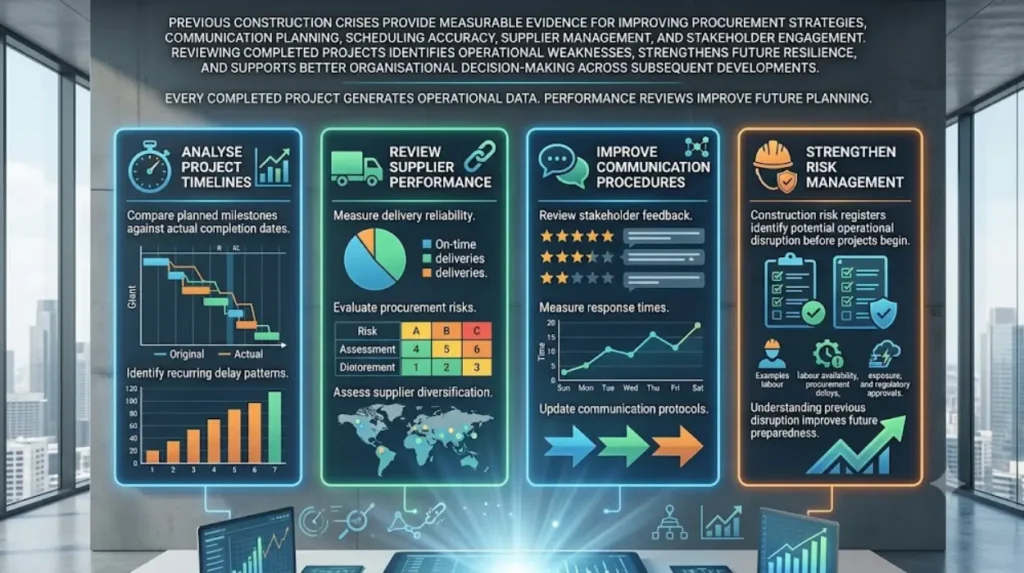
Previous construction crises provide measurable evidence for improving procurement strategies, communication planning, scheduling accuracy, supplier management, and stakeholder engagement. Reviewing completed projects identifies operational weaknesses, strengthens future resilience, and supports better organisational decision-making across subsequent developments.
Every completed project generates operational data.
Performance reviews improve future planning.
Analyse project timelines
Compare planned milestones against actual completion dates.
Identify recurring delay patterns.
Review supplier performance
Measure delivery reliability.
Evaluate procurement risks.
Assess supplier diversification.
Improve communication procedures
Review stakeholder feedback.
Measure response times.
Update communication protocols.
Strengthen risk management
Construction risk registers identify potential operational disruption before projects begin.
Examples include labour availability, procurement delays, weather exposure, and regulatory approvals.
Understanding previous disruption improves future preparedness.
Readers progressing towards implementation strategies can explore:
Project delays and supply chain crises influence every aspect of a developer’s brand reputation. Buyers evaluate delivery reliability. Investors assess financial stability. Contractors monitor operational performance. Journalists examine public accountability. Local communities observe transparency and responsiveness.
Reputation depends on more than completing projects on time. It reflects consistent communication, accurate reporting, realistic scheduling, structured risk management, and accountable leadership throughout the construction lifecycle.
Developers that understand how operational disruption affects public perception establish stronger communication processes, improve organisational resilience, and build greater stakeholder confidence across future developments.



