
A newswire service distributes an organisation’s press release across a structured media network, syndication partners, search platforms, databases, and information hubs. It expands controlled distribution, but legitimate services cannot guarantee independent editorial publication.
For non-profits, a newswire service provides a formal route for distributing announcements beyond an organisation’s owned channels. The service receives a finished press release, processes its content, applies distribution criteria, and sends it through selected media and information networks.
A distribution network can include:
- News aggregation platforms
- Business information websites
- Industry publications
- Regional media outlets
- Financial information databases
- Search-indexed news websites
- Content syndication partners
- Journalist-facing databases
The key distinction is between distribution and editorial placement. Distribution means a release reaches a defined network. Editorial placement means an independent publisher chooses to report the story.
This distinction matters when a provider uses the term “guaranteed placement”. A reputable service can define guaranteed distribution, geographic reach, network inclusion, publication targets, or delivery reporting. It cannot legitimately guarantee that independent journalists will write about a non-profit announcement.
For charities and advocacy organisations, this distinction creates a more accurate basis for evaluating newswire services.
How can non-profits reach high-authority information hubs?
Non-profits reach high-authority information hubs by selecting targeted distribution networks, preparing newsworthy releases, using relevant geographic and sector targeting, and verifying where content is syndicated. Authority depends on the destination, publication context, indexing status, and relevance.
High-authority information hubs are established websites and databases that publish, aggregate, index, or distribute structured information. Their value depends on relevance and credibility rather than domain authority alone.
A non-profit announcing a £2 million community investment requires different distribution from a charity announcing a local fundraising event. The first story has stronger relevance for business, finance, philanthropy, and regional information networks.
What counts as a high-authority information hub?
Relevant destinations include recognised news databases, established business information platforms, sector publications, regional news websites, and specialist information services.
A healthcare charity can target health publications and regional outlets. An environmental organisation can target sustainability, climate, energy, and public-policy information networks.
The distribution strategy must match the announcement.
Why does relevance matter?
Search engines and information systems evaluate context. A release about a UK education charity has greater practical relevance on an education information platform than on an unrelated technology website.
Relevance also improves journalist discovery. Reporters frequently monitor sector-specific sources for announcements, funding developments, organisational changes, research, and public-interest initiatives.
Can a newswire service guarantee placement?
A newswire service cannot guarantee independent editorial coverage from journalists or publishers. It can guarantee delivery to defined distribution networks, processing, syndication, or reporting services when these conditions appear explicitly in the contract.
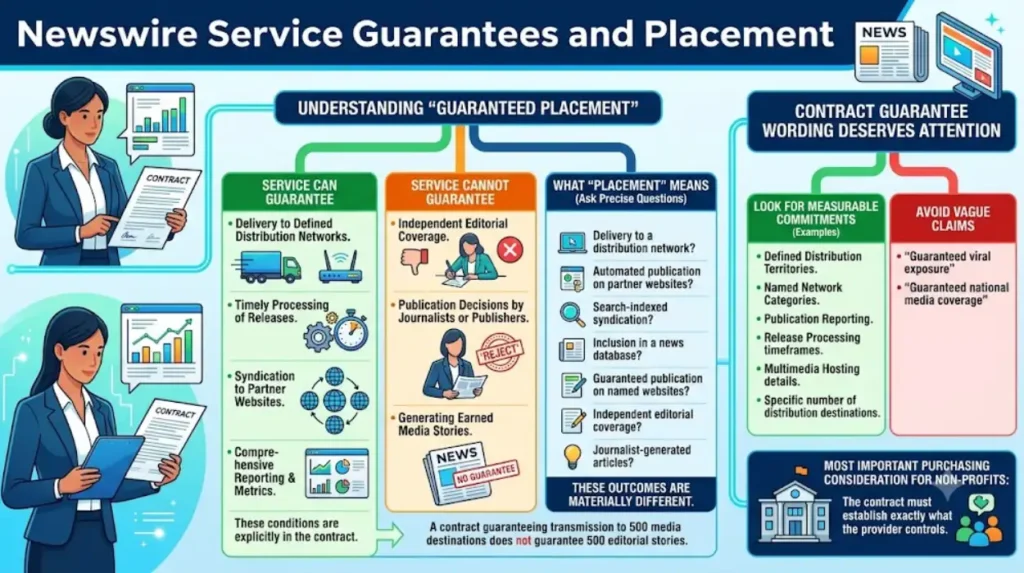
This is the most important purchasing consideration for non-profits.
A service promising “guaranteed placement” requires precise interpretation. Ask whether placement means:
- Delivery to a distribution network.
- Automated publication on partner websites.
- Search-indexed syndication.
- Inclusion in a news database.
- Guaranteed publication on named websites.
- Independent editorial coverage.
- Journalist-generated articles.
These outcomes are materially different.
A distribution contract that guarantees transmission to 500 media destinations does not guarantee 500 editorial stories.
What guarantee wording deserves attention?
Look for measurable commitments. Examples include defined distribution territories, named network categories, publication reporting, release processing, multimedia hosting, or a specific number of distribution destinations.
Avoid vague claims such as “guaranteed viral exposure” or “guaranteed national media coverage”.
For a non-profit, the contract needs to establish exactly what the provider controls.
What should non-profits compare when choosing a newswire service?
Non-profits should compare distribution reach, UK media access, sector targeting, information-hub coverage, publication reporting, multimedia support, release optimisation, pricing, turnaround times, and contractual guarantees before selecting a newswire provider.
A practical comparison requires more than counting distribution endpoints.
Distribution network
Check whether the service has relevant UK, regional, national, trade, charity, business, and specialist networks.
A non-profit working across Scotland requires different geographic targeting from an organisation operating across England and Wales.
Information-hub coverage
Ask for examples of the platforms that receive distributed releases. Request evidence rather than relying on general statements about “thousands of outlets”.
Sector targeting
Sector targeting increases contextual relevance. Examples include:
- Healthcare
- Education
- Environment
- International development
- Social care
- Arts and culture
- Community development
- Human rights
- Philanthropy
Reporting
A professional service provides evidence of distribution and publication. Useful reporting includes destination lists, publication timestamps, links, estimated reach metrics, and engagement information where available.
Multimedia support
Non-profit announcements often depend on photographs, research charts, executive statements, campaign graphics, or video. Confirm whether the distribution package supports these formats.
How does UK distribution differ from generic global distribution?
UK-focused distribution prioritises British national, regional, trade, and specialist media ecosystems. It also accounts for UK geography, terminology, institutional structures, and audience expectations when distributing non-profit announcements.
A global distribution package does not automatically provide strong UK visibility.
The UK media environment includes distinct national and regional markets. London-based publications operate alongside Scottish, Welsh, Northern Irish, and English regional media.
A UK charity launching a programme in Manchester requires distribution that recognises Greater Manchester audiences. A national advocacy organisation requires wider UK coverage.
What UK targeting options matter?
Look for targeting by:
- Nation
- Region
- City
- Industry
- Professional sector
- Subject category
- Audience
- Language
A service that provides precise UK targeting reduces unnecessary distribution and improves contextual relevance.
How should a non-profit prepare a release for distribution?
A non-profit needs a specific news angle, factual headline, strong opening paragraph, attributable statements, verified data, organisational context, contact information, and relevant multimedia before submitting a release to a professional newswire service.
Distribution cannot compensate for weak news value.
The headline needs to communicate the event. The opening paragraph needs to explain who, what, where, when, and why.
Which announcements work best?
Strong non-profit announcements include:
- Major funding awards
- Large-scale programme launches
- Research findings
- Strategic partnerships
- Leadership appointments
- Significant campaign milestones
- New regional initiatives
- Major donor commitments
- Policy reports
- Measurable community outcomes
For example, “Charity Announces New Initiative” provides little information. “UK Charity Launches £3 Million Programme Supporting 20,000 Young People” establishes a clearer news proposition.
The release then supports the headline with verified facts.
Non-profits attracting philanthropic attention can also connect distribution with a broader:
Milestone press releases strategy. This creates a logical relationship between organisational progress, public credibility, and donor discovery.
What reporting should a professional newswire service provide?
Professional newswire reporting shows where a release was distributed, which destinations published it, when publication occurred, and which measurable delivery or engagement indicators the service records for the campaign.
Reporting is essential when a non-profit needs to demonstrate communications value to trustees, senior management, funders, or campaign partners.
A useful report separates distribution from engagement.
Which metrics matter?
Relevant metrics include:
- Number of distribution destinations
- Confirmed publication URLs
- Publication timestamps
- Potential audience or estimated reach
- Website referral traffic
- Click-through activity
- Geographic distribution
- Social engagement
- Search visibility indicators
The report also needs to identify whether a result represents automated syndication or independent editorial coverage.
This distinction prevents inflated reporting.
For example, 80 syndicated copies of one release do not represent 80 independent media stories.
How much does a non-profit newswire service cost?
Newswire pricing depends on distribution geography, network size, media targeting, multimedia requirements, release length, reporting features, and additional services. Non-profits need transparent package pricing and clear definitions of every included distribution component.
Cost comparison requires a like-for-like assessment.
A low-cost package with broad automated syndication can produce a different outcome from a targeted UK distribution package with regional, trade, and specialist media access.
What should the price include?
Check whether the quoted price covers:
- UK distribution
- Regional targeting
- Industry targeting
- Multimedia
- Editorial review
- Search optimisation
- Publication monitoring
- Coverage reporting
- Distribution proof
- Additional word counts
- Additional media assets
Non-profits also need to check VAT, recurring fees, account charges, and add-on costs.
The cheapest package is not automatically the lowest-cost option when essential reporting or targeting features require additional purchases.
Which non-profits benefit most from professional newswire distribution?
Professional newswire distribution benefits non-profits with substantial announcements that require controlled reach, measurable distribution, sector visibility, regional exposure, donor awareness, or documented communications outcomes across established information networks.
The service is particularly relevant to organisations with announcements that extend beyond an existing supporter base.
Charities seeking major donors
A significant programme launch, research finding, capital project, or measurable impact milestone provides a stronger public information asset than a general fundraising message.
The release can support wider awareness among philanthropic audiences while remaining fact-led.
Advocacy organisations
Policy reports and campaign milestones benefit from sector-specific distribution because specialist audiences frequently follow structured announcements from established organisations.
This connects with the earlier educational stage covered in:
Institutional grant makers and corporate sponsors.
Organisations announcing partnerships
A partnership involving a recognised institution, university, corporate organisation, public body, or foundation provides identifiable entities for journalists and information platforms to reference.
National charities
National organisations require geographic reach that reflects their operational footprint. UK-wide distribution provides broader exposure than a single regional campaign.
What questions should a non-profit ask before purchasing a newswire service?
A non-profit should ask exactly where its release will appear, which destinations are guaranteed, which results are automated, what reporting is supplied, how UK targeting works, what the package costs, and how editorial coverage differs from syndication.
Use a structured procurement checklist before signing an agreement.
Ask:
- Which UK distribution networks are included?
- Are named information hubs guaranteed?
- Does the service guarantee distribution or editorial publication?
- How many destinations receive the release?
- Which destinations are automated syndication partners?
- Which publications receive releases for editorial consideration?
- Is regional UK targeting available?
- Are charity and non-profit sectors separately targeted?
- What reporting is included?
- Are publication URLs supplied?
- How quickly is the release distributed?
- Are images, video, and documents supported?
- Are there additional charges?
- Is the service pay-per-release or subscription-based?
The answers create a practical comparison between competing providers.
What makes one newswire service better than another for UK non-profits?
The strongest service combines verifiable UK distribution, relevant information-hub access, transparent guarantees, precise targeting, detailed reporting, reliable turnaround, multimedia support, and pricing that directly matches the organisation’s communication objectives.
The purchasing decision needs to focus on measurable outcomes rather than headline distribution numbers.
A service distributing a release to 1,000 irrelevant destinations does not necessarily outperform a service delivering it to 200 relevant UK information platforms.
The decision also depends on the announcement.
A national charity launching a £10 million social-impact programme needs broad business, regional, charity, and national visibility. A local community organisation launching a £100,000 youth programme needs geographically concentrated distribution.
The best newswire service is therefore the provider whose network, targeting, reporting, and guarantee structure match the specific announcement.
How can non-profits turn newswire distribution into measurable communications value?
Non-profits create measurable value by connecting each release to a defined objective, tracking distribution and publication, monitoring referral activity, recording media outcomes, and comparing campaign performance against the cost of distribution.
A distribution campaign needs an outcome framework.
For example, a non-profit can define four objectives:
- Secure distribution across relevant UK information hubs.
- Increase awareness of a major programme.
- Generate qualified website traffic.
- Create documented media evidence for internal reporting.
The organisation can then track each result independently.
A press release announcing a major funding milestone can also support subsequent donor communications. Coverage evidence strengthens the organisation’s public information footprint and gives fundraising teams documented material for stakeholder engagement.
The key is measurement. Distribution volume alone does not establish campaign success.
Is a professional newswire service worth the investment for a non-profit?
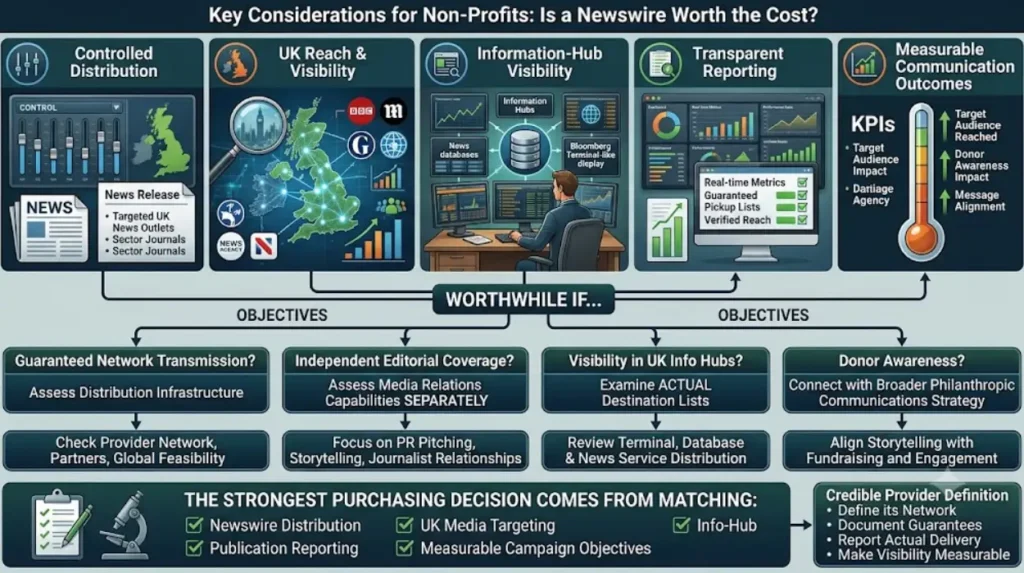
A professional newswire service is valuable when controlled distribution, UK reach, information-hub visibility, transparent reporting, and measurable communication outcomes justify the expenditure for a specific newsworthy announcement and its intended audience.
The decision becomes straightforward when the organisation defines what it needs to purchase.
If the objective is guaranteed transmission across a defined network, assess distribution infrastructure.
If the objective is independent editorial coverage, assess the provider’s media relations capabilities separately.
If the objective is visibility among UK information hubs, examine actual destination lists.
Explore More Expert Insights:
Reviewing Time Intelligence Media Group’s Exclusive Public Interest and Philanthropic Networks
If the objective is donor awareness, connect distribution with the organisation’s broader philanthropic communications strategy.
For a non-profit, the strongest purchasing decision comes from matching newswire distribution, UK media targeting, information-hub access, publication reporting, and measurable campaign objectives.
A credible provider does not need to promise impossible editorial outcomes. It needs to define its network, document its guarantees, report actual delivery, and make the resulting visibility measurable.