
UK advertising codes require marketers to hold robust documentary evidence before publishing any research-backed claim, ensuring data accuracy, transparent methodology, and complete alignment between source findings and promotional statements to prevent consumer deception.
The regulatory framework governing commercial communications in the United Kingdom relies heavily on strict standards enforced by the Advertising Standards Authority (ASA) alongside the Committee of Advertising Practice (CAP). These bodies establish clear rules that dictate how brands must handle data, statistics, and survey outcomes in both non-broadcast media and broadcast advertising. Marketers cannot treat research findings as creative license; instead, they must treat data points as factual claims that require immediate verification.
The Role of the CAP Code in Data Substantiation
The CAP Code sets the baseline for non-broadcast marketing communications, covering print, digital, social media, and direct mail. Rule 3.7 explicitly mandates that marketers hold documentary evidence to prove claims before publication. When a brand cites a survey, poll, or academic study, the underlying research functions as the primary substantiation. If an advertiser states that 80 percent of consumers prefer a specific product feature based on an independent study, the brand must produce the exact methodology, sample size, and statistical breakdown upon request by regulatory authorities.
The Broadcast Committee Rules for Television and Radio
The broadcast equivalent, managed in alignment with statutory frameworks, imposes identical burdens of proof for television and radio commercials. Because audiovisual formats compress complex information into seconds, the risk of misleading viewers through out-of-context statistics increases significantly. Broadcasters and regulatory panels require that any quantitative or qualitative assertion drawn from research remains strictly faithful to the source material. Omitting vital contextual qualifiers, such as a small sample size or a leading question structure, breaches the core tenets of truthful advertising.
How do advertising regulators define valid and verifiable research evidence?
Regulators define valid research evidence as methodologically sound, statistically significant data gathered through recognized scientific or market research protocols that directly substantiate the specific claim made in the advertisement.
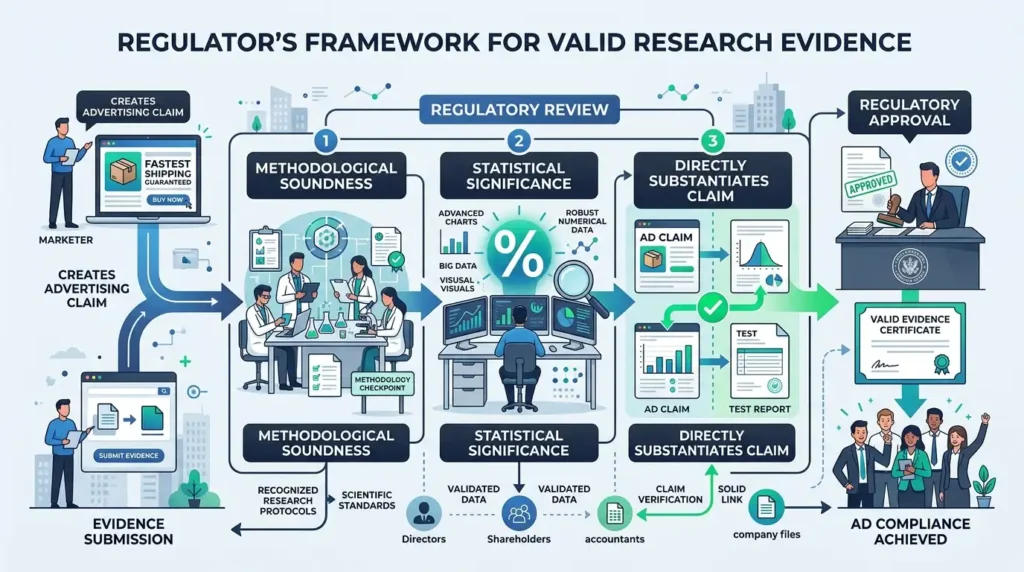
Establishing validity requires adherence to established research standards. When an advertiser cites a study, the ASA evaluates whether the research design introduces bias, whether the sample size reflects the target population, and whether the analytical methods align with industry standards. Flawed data collection invalidates the promotional claim, regardless of whether the brand commissioned the research or sourced it from a third party.
Methodological Rigor and Sample Representation
A valid research study must utilize appropriate sampling techniques to ensure the findings accurately represent the broader population referenced in the ad. For example, if a brand claims that UK motorists experience a specific mechanical failure, the survey sample must consist of actual UK motorists rather than a generalized global panel. Furthermore, sample sizes must be large enough to yield statistically significant results. Small, unrepresentative cohorts cannot support broad, universal assertions.
Objectivity and Question Design
Questionnaire bias invalidates survey-based marketing claims. Regulatory scrutiny focuses heavily on how survey questions are phrased. Leading questions that nudge respondents toward a desired answer violate transparency guidelines. Verifiable research must rely on neutral phrasing, balanced response options, and independent administration. If a brand manipulates survey parameters to manufacture a favorable statistic, the resulting advertisement breaches codes regarding misleading advertising.
Explore More Expert Insights:
How Fintech Companies Acquire Users Using Banner Ads
How Finance Brands Promote Credit Cards Using Display Campaigns
What transparency requirements apply when citing surveys and studies in ads?
UK advertising codes demand that advertisements containing research citations disclose vital contextual parameters—such as the survey date, sample demographics, and sponsoring organization—either directly within the ad or via accessible qualifying text.
Transparency prevents consumers from drawing incorrect conclusions from isolated data points. When a brand presents a percentage or a ranking, the audience requires sufficient context to evaluate the credibility of that figure. Omission of critical qualifiers constitutes a misleading omission under consumer protection laws.
Clear Disclosure of Source and Date
Advertisers must ensure that consumers understand the origin and temporal relevance of the data. Citing a study from a decade ago to prove a modern consumer trend violates the requirement for up-to-date substantiation. Clear disclosures typically include the name of the independent research organization, the exact date or fieldwork period of the study, and the specific demographic group surveyed.
Managing Limitations and Qualifying Text
Complex statistical findings often require qualification. If a research outcome applies only under strict laboratory conditions or specific usage scenarios, the advertisement must explicitly state those limitations. Small print or fleeting audio disclaimers must remain legible and understandable to the average consumer. Hiding critical methodological caveats in obscure locations fails to satisfy regulatory transparency expectations.
What are the legal and commercial consequences of non-compliance with UK advertising codes?
Non-compliance with UK advertising codes results in mandatory ad withdrawals, public reprimands, formal ASA adjudications, reputational damage, and potential statutory enforcement actions by trading standards authorities for severe breaches.
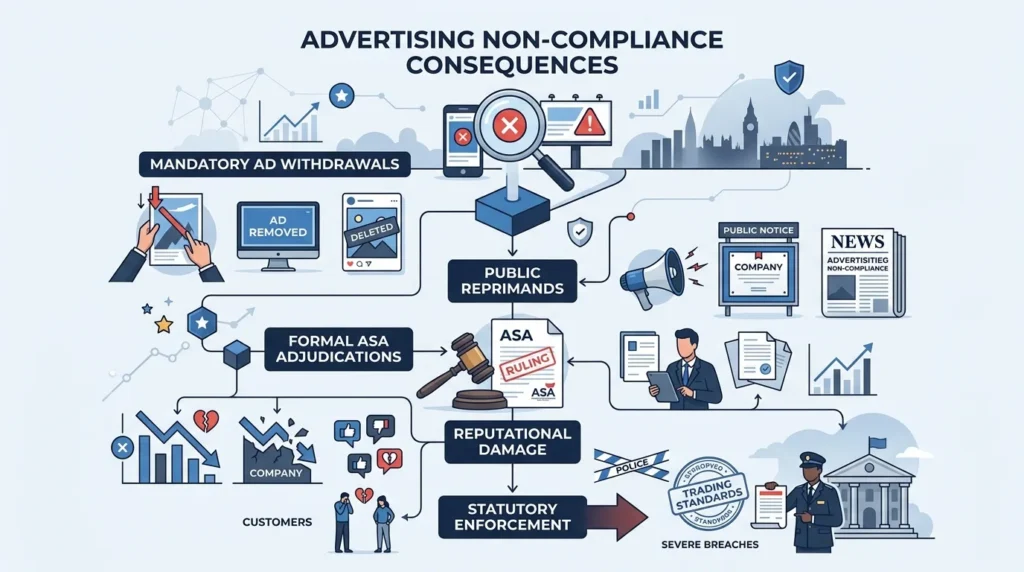
Breaching advertising standards carries immediate operational consequences. The ASA operates a post-publication regulatory system, meaning campaigns launch before formal vetting occurs. However, competitor challenges or consumer complaints trigger investigations that can halt marketing campaigns overnight and impose long-lasting commercial penalties.
ASA Adjudications and Public Sanctions
When the ASA upholds a complaint against a misleading research claim, it publishes a formal adjudication on its website. This public record remains permanently accessible to journalists, competitors, and consumers. Furthermore, repeat offenders or brands refusing to comply face targeted sanctions, including media spend pre-vetting requirements, adverse publicity campaigns, and placement on the ASA’s dedicated non-compliant tracker.
Statutory Enforcement via Trading Standards
While the ASA handles self-regulatory standards, severe or persistent breaches of consumer protection legislation regarding false claims can escalate to statutory authorities. Trading Standards and the Competition and Markets Authority possess powers to pursue criminal prosecutions, issue unlimited fines, and secure court injunctions against corporate entities engaging in deceptive marketing practices.
How can brands ensure their research-backed claims withstand regulatory scrutiny?
Brands can ensure compliance by conducting rigorous pre-launch audits, verifying raw data against final marketing copy, maintaining complete audit trails of all source studies, and consulting specialized compliance frameworks.
Proactive verification protects marketing investments from regulatory disruption. Establishing internal review protocols ensures that creative teams do not exaggerate or misinterpret statistical findings during the design phase of a campaign.
Establishing an Internal Data Audit Trail
Every promotional claim backed by research requires an immutable audit trail. Advertisers must archive the complete research report, questionnaire architecture, raw data tables, and statistical significance calculations. If the ASA opens an inquiry, the brand must produce this documentation within strict turnaround windows, typically within several working days.
Aligning Creative Copy with Source Data
Marketing copywriters and data analysts must collaborate closely to maintain factual integrity. A descriptive claim must match the exact scope of the data. For instance, upgrading a finding from “most respondents in our test group” to “proven to be preferred by all consumers” represents a direct compliance violation. Strict editorial oversight prevents hyperbole from corrupting empirical research findings.