
A consumer insight report in UK retail is a structured document analyzing purchasing behaviors, demographic shifts, and market trends. It translates raw transaction data and survey metrics into strategic intelligence to guide inventory, marketing, and pricing decisions.
Defining Consumer Insights in the Retail Sector
Consumer insight reports synthesize qualitative and quantitative data to explain why buyers make specific purchasing decisions. Unlike basic market research that tracks sales volume or revenue numbers, insight reports evaluate the psychological, social, and economic motivations behind customer actions. In the United Kingdom, retail organizations rely on these documents to track shifting preferences across physical storefronts and digital e-commerce channels.
Understanding these underlying behaviors enables commercial teams to align their strategy with real customer expectations. A standardized consumer insight report evaluates several core areas:
- Purchasing Motivation: Identifying the primary triggers that lead a consumer to select a specific product over a competitor.
- Channel Preference: Measuring how shoppers split their spending between high-street physical stores, mobile applications, and web platforms.
- Price Sensitivity: Assessing how changes in inflation, interest rates, or disposable income alter spending habits across essential and non-essential retail categories.
- Brand Loyalty Metrics: Tracking repeat purchase rates, customer retention levels, and customer lifetime value across defined demographic segments.
The Role of Entity Data and Behavioral Analytics
Modern consumer insight reports combine transactional records from point-of-sale systems with digital tracking metrics. By analyzing customer loyalty card records, website session duration, and return rates, market analysts construct detailed profiles of target audience groups. These profiles allow UK retail executives to make evidence-based choices rather than relying on unverified market assumptions.
Why Are Consumer Insight Reports Important for UK Retail Strategy?
Consumer insight reports are essential for UK retail strategy because they reduce financial risk, optimize inventory planning, and increase customer lifetime value. They provide clear data that helps retail organizations adapt quickly to shifting British macroeconomic conditions.
Navigating the UK Macroeconomic Landscape
The UK retail market operates under distinct economic pressures, including fluctuating energy costs, changing import tariffs, and evolving consumer confidence levels. Consumer insight reports measure how these macroeconomic variables directly impact household spending budgets. For example, when inflation rises, insight reports highlight whether consumers are trading down to private-label grocery items or cutting back on discretionary fashion purchases.
By monitoring these shifts in real time, commercial directors adjust their product mix before inventory overstocking occurs. Accessing dynamic market intelligence allows brands to maintain healthy cash flow and safeguard profit margins during periods of economic volatility.
Improving Customer Acquisition and Retention
Acquiring new customers in the competitive UK retail market requires precise audience targeting. Consumer insight reports outline the exact messaging channels, promotional offers, and product features that resonate with specific demographics, such as Gen Z online shoppers or suburban family households.
Retention relies on consistently meeting customer expectations. Insight reports evaluate customer feedback metrics, product review scores, and service satisfaction levels to highlight operational bottlenecks. Retail brands use this information to optimize fulfillment speed, streamline return policies, and enhance digital user interfaces. To understand how these findings are distributed across industry channels, retail managers examine how consumer insight reports reach target commercial audiences.
How Do UK Retail Brands Gather and Analyze Consumer Insights?
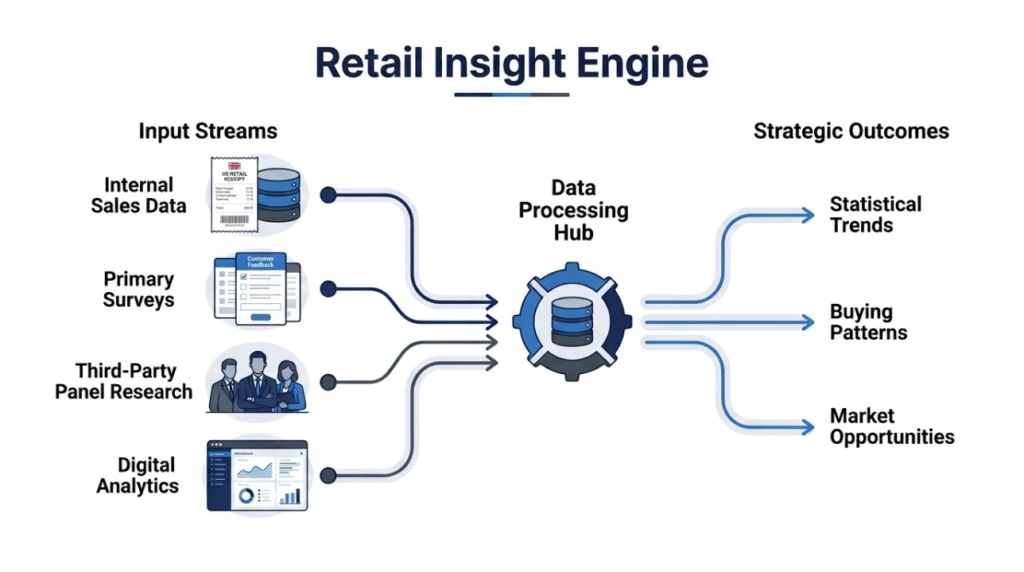
UK retail brands gather and analyze consumer insights by integrating internal sales data, primary customer surveys, third-party panel research, and digital analytics. Data processing systems aggregate these inputs to identify statistical trends, buying patterns, and emerging market opportunities.
Primary and Secondary Data Sources
Creating an actionable insight report requires synthesizing primary research collected directly from customers with secondary industry benchmarks. UK retailers deploy multiple collection methods to assemble a complete view of their target market:
- Point-of-Sale and Loyalty Card Systems: Internal systems record precise buying frequency, average basket size, and cross-category purchases. Loyalty card schemes track long-term individual purchasing histories across geographic regions.
- Digital Analytics and Heatmaps: E-commerce platforms capture user navigation routes, abandoned cart rates, and search query terms. These metrics reveal where friction occurs during the online purchasing journey.
- Focus Groups and Surveys: Direct feedback captures consumer perceptions regarding product quality, brand ethics, packaging design, and competitive pricing structures.
- Third-Party Panel Data: External research agencies provide macro-level benchmarks, comparing a retailer’s performance against broader UK market averages across specific merchandise categories.
Transforming Raw Data into Strategic Intelligence
Collecting data represents only the first phase of the insight process. Specialized data analysts apply statistical modeling techniques to strip away market noise and highlight statistically significant trends. Analysts categorize the data into distinct customer cohorts based on shared behavioral traits, purchase frequency, and spending limits.
Once categorized, the findings are structured into clear, visual reporting formats. These reports translate complex statistical distributions into operational recommendations for category managers, supply chain directors, and marketing specialists.
What Key Components Are Included in a Retail Consumer Insight Report?
A retail consumer insight report includes demographic breakdowns, behavioral trends, channel performance metrics, competitive benchmarking, and actionable strategic recommendations. These structured sections ensure executive leadership can quickly extract relevant data to guide immediate business decisions.
Executive Summaries and Core Findings
Every professional consumer insight report begins with a concise executive summary. This section outlines the major findings, key shifts in consumer sentiment, and primary market risks identified during the research period. It synthesizes complex analytical models into clear executive directives, allowing board members and operational managers to grasp core market shifts within minutes.
Demographic and Psychographic Segmentation
Understanding who buys a product is as critical as knowing what they buy. Insight reports categorize consumer groups using two primary lenses:
- Demographic Segmentation: Categorizing shoppers by age groups, household income levels, geographic location across UK regions, and occupation status.
- Psychographic Segmentation: Grouping consumers by personal values, lifestyle habits, ethical preferences, and environmental priorities, such as demand for recyclable packaging or locally sourced products.
Purchasing Channel and Touchpoint Metrics
Modern British consumers use multiple touchpoints before completing a purchase. Consumer insight reports map the entire cross-channel buyer journey, detailing the specific conversion rates for each channel:
| Channel Type | Core Metrics Evaluated | Strategic Insight Focus |
| Physical Storefronts | Footfall density, dwell time, cashier conversion rate | In-store navigation efficiency and staff deployment |
| Desktop E-Commerce | Session length, search query performance, cart abandonment | Catalog clarity, payment options, and checkout speed |
| Mobile Applications | Push notification click-through rate, app retention | In-app personalization and localized promotion success |
| Social Commerce | Engagement rates, direct referral conversions | Influencer performance and social ad effectiveness |
Competitive Benchmarking and Market Share Analysis
Insight reports evaluate how a brand performs relative to direct competitors within the UK market. This section analyzes market share percentage, consumer mindshare, pricing positioning, and relative brand perception. Identifying where competitors excel or fall short highlights clear opportunities for market differentiation and product line expansion.
Explore More Expert Insights:
How Online Retailers Recover Abandoned Carts Using Banner Advertising
How E-commerce Stores Boost Sales Using Retargeting Banner Ads
How Do Consumer Insight Reports Drive Commercial Growth in Retail?
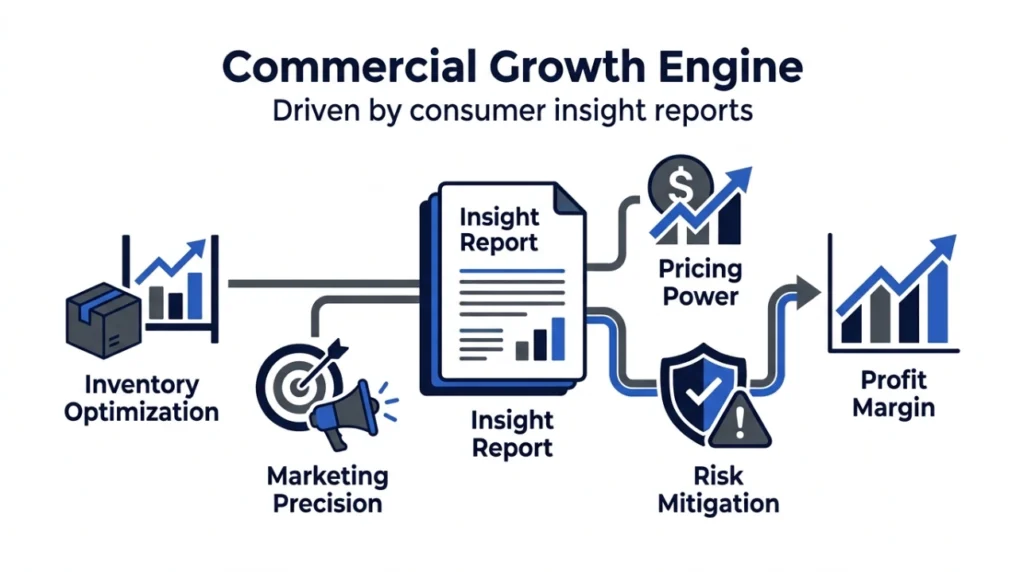
Consumer insight reports drive commercial growth by optimizing inventory selection, refining targeted marketing campaigns, strengthening pricing power, and minimizing costly product launch failures. Aligning operational execution with verified buyer preferences consistently increases retail profit margins.
Optimizing Merchandising and Supply Chain Logistics
Inventory management directly impacts retail profitability. Ordering excess stock ties up working capital, while underordering leads to lost sales and depleted customer goodwill. Consumer insight reports deliver accurate demand forecasts by analyzing historical buying cycles, seasonal trends, and emerging product popularity.
Category managers use these insights to adjust purchasing orders months in advance. For example, if insight data shows a growing preference for plant-based personal care products among urban UK demographics, supply chain teams increase stock allocations to stores in major metropolitan centers while reducing orders for traditional product alternatives.
Refining Targeted Marketing and Content Execution
Generic marketing campaigns yield low conversion rates and high customer acquisition costs. Consumer insight reports define the exact pain points, aspirations, and communication preferences of core target audiences. Marketing teams leverage these insights to construct hyper-targeted campaigns that speak directly to consumer needs.
By delivering relevant messaging through preferred media channels, retail brands improve return on ad spend, lower customer acquisition costs, and build stronger emotional connections with their audience.
Mitigating Risk in Product Innovation
Developing and launching new retail products requires significant financial investment. Consumer insight reports mitigate launch risk by testing product concepts, price thresholds, and packaging options with target consumer panels prior to full market rollout.
Concept testing reveals whether a proposed product solves a real consumer problem or fills a genuine market gap. If research indicates low interest or resistance to a proposed price point, product development teams modify the offering before capital is committed to large-scale production and distribution.
What Are the Emerging Trends in UK Retail Consumer Insights?
Emerging trends in UK retail consumer insights include real-time data tracking, artificial intelligence predictive analytics, ethical consumerism monitoring, and unified omnichannel tracking. These developments allow retail brands to anticipate market shifts faster and with greater statistical accuracy.
Artificial Intelligence and Predictive Analytics
Traditional insight reports relied on historical data, offering a retrospective view of consumer behavior. Modern insight generation incorporates machine learning algorithms to predict future shopping actions based on real-time pattern recognition.
Predictive models evaluate search trends, weather forecasts, social media sentiment, and local economic indicators to forecast demand spikes for specific merchandise categories. UK retailers use predictive insight reports to adjust dynamic pricing models and automate inventory replenishment, ensuring optimal stock availability during peak demand periods.
Tracking Ethical and Sustainable Consumerism
British shoppers increasingly evaluate brands based on corporate social responsibility, environmental sustainability, and ethical labor practices. Consumer insight reports now feature dedicated sections tracking sustainability metrics, such as consumer willingness to pay a premium for carbon-neutral delivery options or plastic-free packaging.
Monitored trends indicate that while sustainability remains a priority for UK buyers, price accessibility continues to influence final purchase decisions. Insight reports help retailers find the optimal balance between ethical commitments and competitive pricing strategies.
Unifying Online and Offline Data Streams
The growth of click-and-collect services, mobile app scanning in physical stores, and digital loyalty cards has blurred the line between offline and online shopping channels. Modern consumer insight reports integrate these distinct data streams into unified customer profiles.
Unified analytics track how an initial touchpoint on a social media feed leads to an in-store trial and a subsequent mobile app purchase. This comprehensive view helps UK retail executives allocate capital effectively across physical real estate and digital software infrastructure. To review specialized commercial intelligence solutions built for market leaders, explore strategic offerings provided by time intelligence media group.
How Should UK Retail Leadership Act on Consumer Insight Reports?
UK retail leadership should act on consumer insight reports by establishing cross-functional implementation teams, setting measurable performance targets, updating category strategies, and establishing continuous feedback loops. Translating data into operational execution ensures long-term market competitiveness.
Building Cross-Functional Execution Teams
A consumer insight report provides value only when its findings are operationalized across business departments. Executive leadership must ensure that insights are shared beyond marketing teams to inform supply chain management, store operations, product design, and finance departments.
Cross-functional alignment ensures that when a report identifies an emerging market trend, all operational units respond simultaneously:
- Product Development: Adapts product formulations, features, or packaging designs to meet identified consumer preferences.
- Supply Chain Operations: Adjusts supplier contracts, inventory distribution levels, and warehouse stock allocations.
- Marketing and Sales: Updates promotional messaging, ad spend distribution, and promotional pricing structures.
- Store Operations: Trains front-line staff and rearranges visual merchandising displays to highlight trending product lines.
Establishing Continuous Feedback Loops
Market conditions, technology platforms, and consumer behaviors evolve constantly across the United Kingdom. Retail leadership must view consumer insight reporting as an ongoing operational cycle rather than an annual project.
By establishing continuous feedback loops, retail organizations continuously measure the real-world impact of strategy adjustments against the findings of subsequent insight reports. This iterative approach allows UK retail brands to stay agile, defend market share, and drive predictable revenue growth in a dynamic commercial market.