

UK consumers are twice as likely to use generative AI for search as Americans means adoption rates in the United Kingdom are 100 percent higher, indicating stronger reliance on AI-assisted information retrieval, conversational queries, and machine-generated summaries across digital search environments systems.
This statement describes a comparative behavioural metric between two populations: UK internet users and US internet users. It defines frequency of use of generative AI tools for search tasks such as information discovery, query answering, and content summarisation.
Search behaviour interpretation
Generative AI search behaviour replaces traditional keyword input with structured prompts. Users ask full questions instead of fragmented keywords. AI systems generate consolidated answers using multi-source synthesis.
Adoption gap significance
A 100 percent higher adoption rate indicates a structural difference in digital information behaviour. UK users integrate AI tools into search workflows at twice the rate of American users. This reflects higher dependency on conversational interfaces for knowledge retrieval.
How does generative AI change search patterns in the UK?
Generative AI changes UK search patterns by shifting users from keyword-based queries to conversational prompts, increasing session depth, reducing click dependency, and prioritising summarised responses generated from multiple sources within unified AI-driven interfaces across mobile and desktop platforms systems adoption.
Search behaviour in the United Kingdom shows a transition from traditional search engine interaction to AI-mediated discovery. This shift affects query structure, result consumption, and navigation behaviour.
Query transformation
Users move from short phrases like “UK weather London” to full contextual questions such as “What is the weather forecast in London this week and how does it affect travel conditions.” This increases semantic complexity.
Information consolidation
Generative AI systems combine multiple sources into a single output layer. Users receive summarised answers instead of ranked link lists. This reduces reliance on external navigation.
Engagement structure
Search sessions become longer and more conversational. Each query expands into follow-up interactions. This creates multi-turn information flows rather than single-query results.
What data is included in a UK audience insights report?
UK audience insights reports include demographic breakdowns, search behaviour patterns, device usage data, content engagement metrics, regional segmentation, and AI interaction signals, providing structured datasets that define how UK users discover, consume, and evaluate digital information across platforms ecosystems mapping.
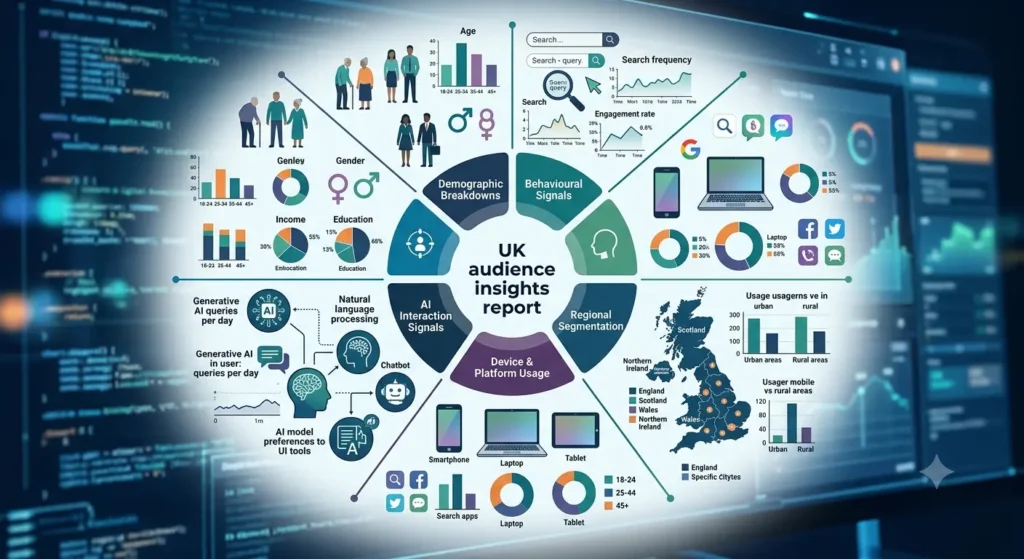
Audience insights reports define how UK users interact with digital systems. These reports structure behavioural and demographic data into measurable categories for analysis.
Demographic breakdowns
Reports include age groups, gender distribution, income levels, and education categories. These variables define audience composition across digital platforms.
Behavioural signals
Search frequency, query length, and engagement duration form behavioural indicators. These metrics show how users interact with content and AI systems.
Device and platform usage
Data includes mobile, desktop, and tablet usage shares. Platform segmentation identifies where users access generative AI tools and search engines.
Regional segmentation
UK audience data is divided into geographic clusters. These include urban, suburban, and rural usage patterns with distinct engagement differences.
What do advertisers learn from UK generative AI search behaviour?
Advertisers learn how UK users structure queries, which intent signals drive conversions, how AI-generated answers reduce click-through rates, and which content formats dominate visibility, enabling precise targeting strategies aligned with evolving generative search ecosystems within digital marketing environments analysis systems.
Advertisers use generative AI search data to interpret intent patterns and visibility changes across AI-driven interfaces. This replaces traditional click-based analysis with structured behavioural modelling.
Query structure analysis
UK users generate longer and more specific queries. Advertisers identify intent clusters based on informational, transactional, and navigational query types.
Conversion signal mapping
Intent signals replace keyword matching. Advertisers analyse how users move from AI-generated answers to decision actions such as purchases or sign-ups.
Visibility reduction impact
AI summaries reduce direct click-through rates. Users receive answers without visiting source websites, changing traditional funnel tracking models.
Content format dominance
Structured content formats such as lists, definitions, and data-driven summaries appear more frequently in AI outputs. Advertisers optimise content to match these formats.
What metrics matter in UK generative AI search adoption?
Key metrics include AI-assisted search volume, query complexity scores, zero-click search rates, engagement duration, conversion attribution shifts, and regional adoption variance across the United Kingdom, providing measurable indicators of generative AI integration into search behaviour patterns digital analytics frameworks systems.
Measuring generative AI search adoption requires multi-layered performance indicators. These metrics track behavioural change and system dependency.
AI-assisted search volume
This metric tracks the proportion of searches processed through generative AI tools compared to traditional search engines. Higher values indicate stronger adoption.
Query complexity scores
This measures average query length and semantic depth. Increased complexity indicates a shift toward conversational search behaviour.
Zero-click search rates
This metric tracks how often users receive answers without clicking external links. AI systems significantly increase zero-click outcomes.
Engagement duration
Session length measures interaction depth with AI systems. Longer sessions indicate multi-turn query refinement.
Dive Deeper With Our Expert Guides:
What Is Multi-Platform Audience Tracking?
How News Platforms Understand User Intent
Conversion attribution shifts
This metric tracks how conversions are assigned in AI-assisted journeys. Attribution models adjust away from last-click frameworks.
What is the process for turning UK audience insights into campaign strategy?
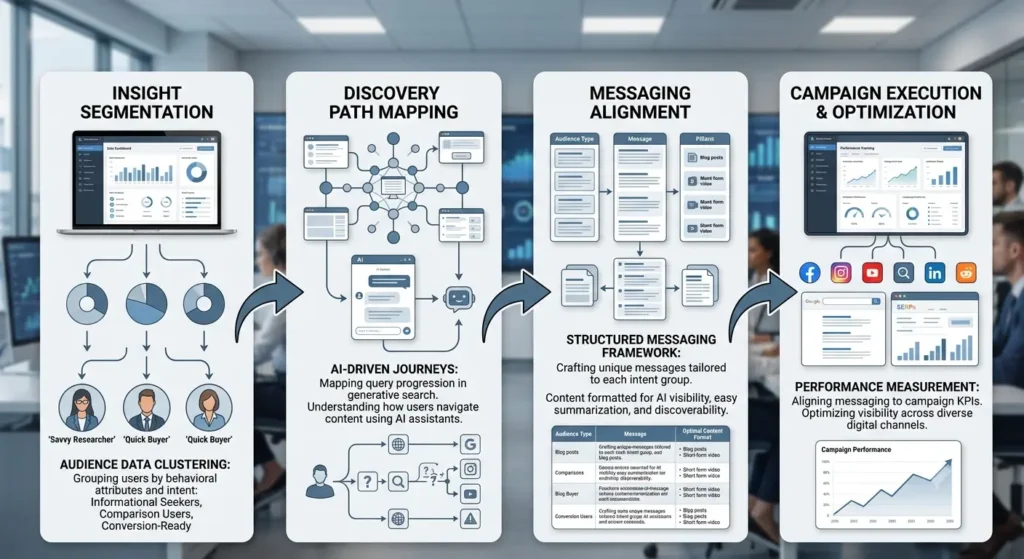
Turning UK audience insights into campaign strategy involves analysing search behaviour data, identifying intent clusters, mapping AI-driven discovery paths, segmenting audiences by engagement levels, and aligning messaging frameworks to optimise visibility across generative search and digital channels performance measurement systems.
Campaign strategy development uses structured interpretation of audience insights. This process converts raw behavioural data into execution frameworks.
Insight segmentation
Audience data is divided into behavioural clusters. These clusters define intent groups such as informational seekers, comparison users, and conversion-ready audiences.
Discovery path mapping
AI-driven discovery paths show how users move through generative search environments. This includes query progression and interaction sequences.
Messaging alignment
Campaign messages are structured to match intent clusters. Content is formatted for AI visibility and summarisation compatibility.
Readers interested in the educational stage of UK audience analysis can explore:
UK news audience report for structured interpretation of audience data frameworks.
Decision-focused optimisation approaches are covered in:
Audience insights reports, which explains how structured datasets translate into measurable campaign outcomes and execution planning.
Performance measurement systems
Campaign effectiveness is tracked through AI visibility metrics, engagement conversion rates, and attribution modelling across generative search environments. These systems define how insights translate into measurable performance outcomes.



