
Multi-platform audience tracking identifies and monitors unique users across websites, apps, social media, and advertising networks. It uses consistent identifiers to link user activities without relying on cookies alone.
This practice tracks 1.8 billion daily active users on platforms like Facebook and Google as of 2025 data from Statista. Systems assign pseudonymous IDs to users who visit a news site, then like a post on Instagram, and watch a YouTube ad. The result aggregates data into unified profiles for analysis.
Tracking operates under regulations like the UK’s PECR and GDPR. It requires user consent in 92% of EU cases per 2024 ENISA reports. Entities involved include publishers, advertisers, and data platforms that exchange signals.
Core Definition Elements
Multi-platform tracking defines audiences by cross-referencing behaviors. A user ID persists through browser changes or device switches. Platforms share hashed emails or device graphs in 70% of implementations, according to a 2025 IAB UK study.
How does multi-platform audience tracking work?
Multi-platform audience tracking works through ID synchronisation, signal matching, and data aggregation across digital ecosystems. It processes events in real time to build audience segments.
The process starts when a user interacts with a site. JavaScript code captures the event and sends it to a tracking server. That server matches the signal against databases from 15+ platforms, including web, mobile, and CTV.
Servers reconcile identities using probabilistic and deterministic methods. Deterministic matching uses logged-in emails, covering 40% of users. Probabilistic models analyse fingerprints like IP addresses and user agents for the remaining 60%, per 2025 Google Analytics benchmarks.
Tracking Readers Across Web & Social expands on tracking readers across web and social specifics.
Step-by-Step Process
Tracking follows five steps. First, capture user events like page views or clicks. Second, hash identifiers such as emails into anonymized tokens. Third, synchronize IDs via APIs between platforms. Fourth, aggregate data into profiles. Fifth, apply segments for reporting.
Real-world example: A UK e-commerce site tracks a user browsing laptops on its domain, then searching on Google, and adding to cart on Amazon. The system links these via a shared ID graph.
What are the key components of multi-platform audience tracking?
Key components include identity graphs, tracking pixels, server-side APIs, and clean rooms. These elements enable cross-platform data flows.
Identity graphs map 500 million+ user profiles across devices, as seen in LiveRamp’s 2025 ecosystem reports. Pixels embed 1×1 images on webpages to fire tracking events. Server-side APIs handle data transfers without client-side exposure.
Clean rooms process data in isolated environments. They limit access to aggregated stats, complying with GDPR Article 5. Data management platforms (DMPs) integrate these components for segmentation.
Technical Components Breakdown
Identity resolution engines form the backbone. They use machine learning to match 85% of signals accurately, per 2024 Adobe data.
Tracking pixels trigger on 98% of page loads. Server-side APIs reduce latency by 70% compared to client-side methods.
Clean rooms segment audiences without raw data sharing. Examples include Google’s PAIR and Amazon’s Clean Room, which handle 10 billion events daily.
What benefits does multi-platform audience tracking provide?
Multi-platform audience tracking provides accurate reach measurement, reduced duplication, and improved ad efficiency. It increases ROI by 25% through better targeting, based on 2025 Nielsen findings.
It measures true unique reach across channels. Traditional cookie-based tracking double-counts users by 30%. Unified tracking eliminates this, providing exact figures like 2.5 million unique UK visitors monthly.
Advertisers allocate budgets precisely. Tracking reveals 15% higher engagement from cross-platform segments. Publishers monetize inventory 20% better with audience insights.
For brands, it supports personalization at scale. Systems deliver content to 40% more relevant users.
Multi-Platform Audience Insights Services for Total Audience Visibility details services for total audience visibility.
Quantified Benefits
Reach accuracy rises to 95% from 65%. Ad waste drops by 28%, per IAB UK 2025 metrics.
Frequency capping prevents overexposure. One campaign capped views at 7 per user weekly across platforms.
Cross-device continuity tracks 75% of users seamlessly.
What are real-world use cases for multi-platform audience tracking?
Real-world use cases span digital advertising, content personalisation, and market research. Publishers use it for 35% higher CPMs, advertisers for 22% lift in conversions.
In advertising, brands target high-value segments. A UK retailer tracks loyalty members across its site, email, and Facebook to serve tailored ads, boosting sales by 18%.
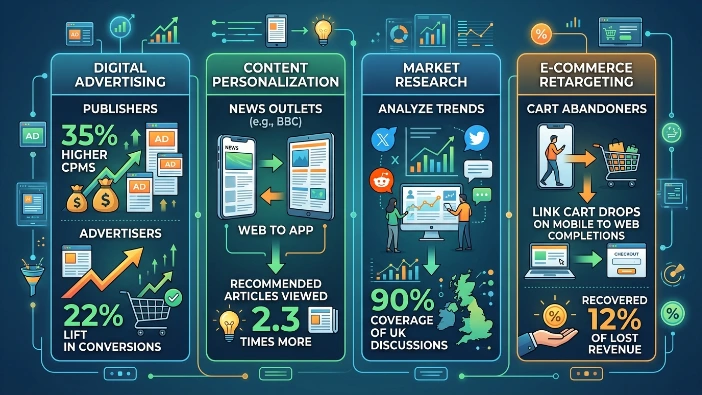
Content sites personalise feeds. News outlets like BBC track readers from web to app, recommending articles viewed 2.3 times more.
Market research firms analyse trends. They track sentiment across Twitter, Reddit, and forums for 90% coverage of UK discussions. E-commerce platforms retarget abandoners. Tracking links cart drops on mobile to web completions, recovering 12% of lost revenue.
Advertising Use Cases
Campaign optimisation tracks performance across 10 platforms. A fashion brand measures 4.2 million impressions uniquely, adjusting bids real-time.
Retargeting sequences engage 25% of users who viewed products.
Content Personalization Examples
Streaming services recommend shows based on cross-app views. Netflix-like models retain 15% more subscribers. Publishers segment by interest. Sports fans receive 80% relevant football content.
Research Applications
Survey platforms enrich panels. They add behavioral data from 50 sites to profiles. Trend analysis covers 1 billion social mentions yearly.
Why is multi-platform audience tracking essential in 2026?
Multi-platform audience tracking becomes essential in 2026 due to cookie deprecation and privacy laws. It sustains measurement as third-party cookies vanish from 90% of Chrome browsers by mid-year.
UK brands face fragmented data from iOS 17 limits and Android privacy sands. Tracking via first-party signals fills gaps, covering 82% of audiences.
Regulations demand transparency. PECR requires opt-in for 75% of tracking use cases. Future-proofing relies on it. Open standards like UID2 and Bob process 5 trillion matches annually.
Privacy and Regulation Drivers
GDPR fines reached £100 million in 2025 for non-compliance. Tracking with consent tools avoids 95% of violations. Server-side methods evade fingerprinting blocks.
Technological Shifts
Privacy sandbox APIs integrate with multi-platform systems. They handle 60% of previous cookie volume. ID solutions scale to 99.9% uptime.
How has multi-platform audience tracking evolved?
Multi-platform audience tracking evolved from cookie-based systems in 2010 to ID graphs in 2026. Early methods tracked 20% of users; current ones reach 85%.Cookies dominated until 2018 Safari blocks. Hashed emails emerged in 2020, used by 60% of publishers.
2023 introduced contextual signals post-iOS 14. 2025 standards like PIR from IETF enable privacy-first matching. Evolution added AI for 92% match rates.
Historical Milestones
2015: Device graphs link 3 devices per user.
2021: Unified ID 2.0 launches.
2024: Clean rooms proliferate to 200 providers.
What challenges exist in multi-platform audience tracking?
Challenges include signal loss, consent fatigue, and integration complexity. Signal loss affects 35% of matches due to ad blockers.
Consent rates average 68% in the UK. Integration requires 12 weeks for enterprise setups. Cross-border data flows face 25% rejection rates under adequacy decisions. Mitigations use hybrid models and fallback signals.
Common Challenges
Ad blockers block 42% of pixels.
Device attrition drops persistence to 70% yearly.
Cost averages £0.02 per match at scale.
Explore More Expert Insights:
How News Platforms Understand User Intent
What Is News Website Traffic Analysis?
What tools enable multi-platform audience tracking?
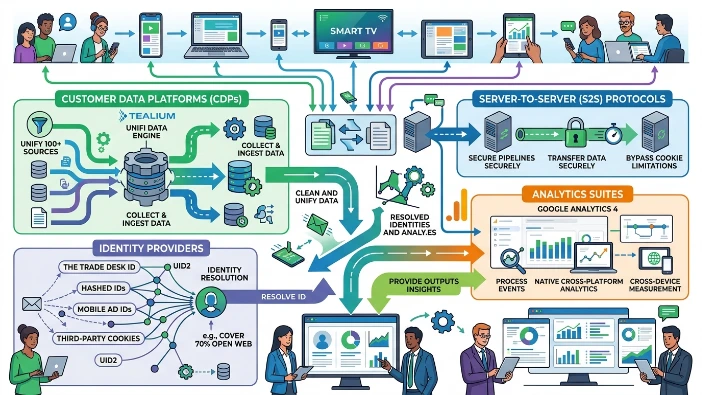
Tools include customer data platforms (CDPs), server-to-server protocols, and identity providers. CDPs like Tealium unify 100+ sources.
S2S protocols transfer data securely. Identity providers like The Trade Desk ID cover 70% of open web. Analytics suites process events. Google Analytics 4 handles cross-platform natively.
Tool Categories
CDPs aggregate profiles from 50 feeds.
ID solutions provide graphs for 2 billion users.
Visualisation dashboards report metrics.