
Strategic press distribution increases the visibility, credibility, and discoverability of a FinTech company by delivering verified business announcements to relevant media outlets. Consistent media exposure strengthens public information, supports investor research, and creates a documented record of company growth before funding discussions begin.
A bootstrapped FinTech company operates without external venture capital funding. Founders finance operations through personal investment, revenue, or retained profits. Limited marketing budgets often reduce visibility compared with venture-backed competitors.
Strategic press distribution is the planned publication and delivery of company announcements through relevant media channels. The objective is to communicate factual developments to journalists, industry publications, financial media, and the wider business community.
Venture capital firms evaluate more than financial performance. Investors examine market traction, leadership credibility, customer growth, regulatory readiness, and public reputation. Public information contributes to this evaluation.
Media visibility creates accessible evidence of company progress. Investors frequently review publicly available information before arranging meetings. Published announcements simplify this research process.
Examples of announcements include:
- Product launches
- Regulatory approvals
- Customer acquisition milestones
- Partnership agreements
- Executive appointments
- Market expansion activities
Each announcement contributes to a measurable public record.
How does strategic press distribution support investor research?
Strategic press distribution creates verified, chronological business information that investors access during due diligence. Published announcements explain company development, operational milestones, leadership activities, and market expansion through publicly available sources that improve information transparency and reduce research complexity for investment teams.
Investor due diligence is the structured review of a company’s financial, operational, legal, and commercial position before investment.
Public information forms one part of this process.
What information do investors review?
Investors commonly examine:
- Company website
- News coverage
- Executive interviews
- Press releases
- Industry publications
- Regulatory filings
- Customer announcements
Consistent announcements reduce information gaps.
For example, a FinTech startup announcing its payment platform launch, its first enterprise customer, and regulatory registration across separate announcements provides a documented timeline of business development.
Each announcement adds context.
Each publication strengthens historical documentation.
Each milestone becomes easier to verify.
What makes a press announcement valuable to financial journalists?
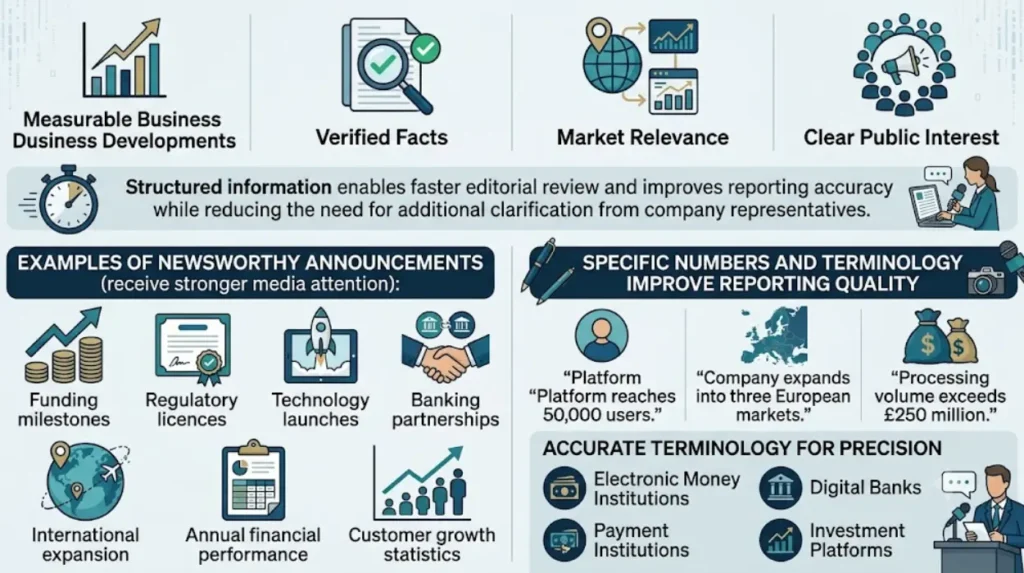
Financial journalists select announcements containing measurable business developments, verified facts, market relevance, and clear public interest. Structured information enables faster editorial review and improves reporting accuracy while reducing the need for additional clarification from company representatives.
Newsworthiness refers to the characteristics that make information suitable for publication.
Business announcements generally become newsworthy when they include measurable developments.
Which announcements receive stronger media attention?
Examples include:
- Funding milestones
- Regulatory licences
- Technology launches
- Banking partnerships
- International expansion
- Annual financial performance
- Customer growth statistics
Specific numbers improve reporting quality.
For example:
- “Platform reaches 50,000 users.”
- “Company expands into three European markets.”
- “Processing volume exceeds £250 million.”
Quantified information provides stronger context than general statements.
Journalists also value accurate terminology.
For example, distinguishing between electronic money institutions, payment institutions, digital banks, and investment platforms improves reporting precision.
How does consistent communication strengthen company credibility?
Consistent public communication shows we’re operating smoothly and documents important developments over time. Regular announcements provide a clear, transparent business history that investors, journalists, analysts, and commercial partners review when assessing organisational maturity and long-termexecution.
Credibility develops through evidence.
Published announcements become part of the company’s public record.
A single announcement rarely communicates long-term progress.
Multiple announcements across several business stages provide stronger documentation.
Which milestones build a credible public history?
Examples include:
- Product development
- Regulatory compliance
- Customer onboarding
- Revenue growth
- Geographic expansion
- Technology improvements
- Leadership appointments
Each announcement documents measurable progress.
Investors prefer businesses with visible operational development rather than isolated publicity events.
Chronological communication demonstrates organisational consistency.
This historical record also assists journalists preparing background research before interviews or feature articles.
What role does timing play in strategic press distribution?
Publication timing determines when business information becomes available to journalists, analysts, investors, and industry audiences. Coordinated timing improves information accuracy, supports regulatory communication schedules, and creates consistent public disclosure across important organisational milestones.
Timing influences media attention.
Business announcements released alongside major operational developments receive greater contextual relevance.
Examples include:
- Product launches
- Market entry
- Regulatory approval
- Annual reporting
- Partnership announcements
Each event provides a logical publication opportunity.
Why does coordinated disclosure matter?
Financial communication often involves multiple disclosure activities.
Examples include:
- Regulatory submissions
- Corporate reporting
- Public announcements
- Investor communications
Publishing information in a coordinated sequence improves consistency.
Businesses operating within regulated financial sectors follow established disclosure procedures to maintain accurate public information.
Readers exploring:
Which communication elements improve press distribution quality?
High-quality press distribution depends on factual writing, structured formatting, accurate terminology, supporting data, and verified company information. These elements improve editorial efficiency, reduce ambiguity, and support consistent reporting across financial, technology, and business publications.
A structured announcement enables faster review.
Editors process large numbers of submissions every day.
Clear organisation improves readability.
Essential communication components
A well-structured announcement normally includes:
- Accurate headline
- Concise summary
- Business context
- Verified statistics
- Executive quotation
- Supporting background
- Company information
- Contact details
Each section serves a specific purpose.
Supporting data strengthens factual reporting.
For example:
- Customer numbers
- Transaction volume
- Geographic presence
- Regulatory registration
- Product availability
Specific information improves accuracy.
Undefined marketing language reduces editorial value.
Clear definitions improve understanding.
How does strategic press distribution contribute to long-term visibility?
Strategic press distribution creates a searchable archive of business information across multiple publications. This expanding public record improves long-term discoverability, supports market awareness, and provides investors with consistent access to documented organisational developments throughout different growth stages.
Search visibility depends upon published information.
Each announcement contributes additional indexed content.
Over time, this produces a broader digital footprint.
Search engines identify structured business information through published pages.
Industry analysts also review archived announcements.
Which audiences benefit from long-term visibility?
Examples include:
- Venture capital firms
- Financial analysts
- Journalists
- Banking partners
- Enterprise customers
- Industry researchers
Each audience performs independent research.
Public announcements simplify information discovery.
Archived business information also assists historical analysis.
Researchers compare company development across several years using publicly available records.
This documented history strengthens factual understanding.
How does strategic press distribution fit into a broader fundraising strategy?

Strategic press distribution supports fundraising by documenting business progress before investment discussions begin. Public communication complements financial reporting, customer evidence, regulatory documentation, and operational performance while improving information availability for external stakeholders conducting independent evaluation.
Fundraising involves multiple activities.
Press distribution represents one communication component.
Other important elements include:
- Financial statements
- Product demonstrations
- Customer references
- Market analysis
- Regulatory documentation
- Business strategy
- Executive leadership
Each component contributes different evidence.
Public announcements reinforce operational achievements.
For example, a company announcing regulatory approval, commercial partnerships, and customer growth establishes publicly accessible milestones that align with broader fundraising documentation.
Businesses planning regulated investment launches often examine:
What practical lessons can bootstrapped FinTech founders learn from strategic press distribution?
Strategic press distribution demonstrates the importance of factual communication, consistent milestone reporting, accurate disclosure, and long-term public documentation. These practices improve business transparency, strengthen historical records, and support informed evaluation by investors, journalists, researchers, and commercial stakeholders.
Bootstrapped FinTech companies compete in highly regulated markets.
Visibility depends upon documented progress rather than promotional messaging.
Public announcements communicate measurable developments through verified information.
Effective communication begins with identifying significant milestones.
Examples include product launches, regulatory approvals, commercial partnerships, customer growth, leadership appointments, and market expansion.
Each milestone becomes part of the company’s documented business history.
Consistent publication creates chronological evidence of organisational development.
Journalists benefit from structured information.
Explore More Expert Insights:
Why Regulatory Compliance and Data Accuracy Matter for Vulnerable Financial Startups
Understanding the Impact of High-Authority Business Backlinks on Struggling FinTech SEO
Investors benefit from transparent research.
Industry analysts benefit from accessible historical records.
Strategic press distribution therefore serves an educational role within the broader business communication process. It explains company progress through factual reporting, strengthens public understanding of operational development, and contributes to a transparent information environment that supports informed investment evaluation across the United Kingdom’s growing FinTech sector.