
Thought leadership content presents expert knowledge, original perspectives, evidence, and practical insights around a defined industry topic to establish authority and influence informed audiences across relevant media channels.
Thought leadership content differs from promotional copy. It focuses on expertise rather than direct product selling. Common formats include expert articles, executive opinion pieces, industry analysis, research-led commentary, and data-driven perspectives.
For UK brands, publication involves more than producing a strong article. The content requires editorial positioning, audience relevance, publication selection, compliance checks, formatting, and coordinated distribution.
The objective is consistent visibility across relevant media environments. A structured publishing process helps maintain the central argument while adapting the presentation to different publication requirements.
Readers exploring how this content contributes to wider authority can also review:
How Thought Leadership Content Builds UK Brand Authority for a broader understanding of the topic.
How does thought leadership content get prepared for publication?
Thought leadership content is prepared by defining the audience, selecting a credible topic, developing evidence, structuring an expert viewpoint, checking editorial requirements, and creating publication-ready copy for relevant UK media outlets.
Preparation starts with the subject. A strong topic addresses a specific industry issue rather than a general promotional message.
The content then establishes the expert perspective. This includes a clear position, supporting evidence, relevant examples, and practical conclusions.
How is the topic selected?
Topic selection depends on audience relevance, industry importance, search demand, current business issues, and the expertise available from the contributing organisation.
For example, a UK fintech company can address open banking adoption, payment security, financial regulation, or customer trust. A property business can focus on commercial development, planning policy, construction costs, or regional property demand.
The topic needs a defined audience. Business editors, industry professionals, investors, decision-makers, and consumers each require different levels of technical detail.
How is the content structured?
A typical thought leadership article contains:
- A specific headline
- A concise introduction
- A clearly defined industry issue
- Expert analysis
- Supporting facts or research
- Relevant examples
- Practical implications
- A concise conclusion
This structure improves readability and gives publishers a clear editorial narrative.
What makes the content publication-ready?
Publication-ready content follows the target outlet’s editorial requirements. These requirements include word count, headline format, tone, image specifications, author information, links, disclosure requirements, and formatting.
Content also requires factual checking. Statistics, company claims, market figures, dates, and quotations need verification before publication.
How are 15 UK sites selected for thought leadership publication?
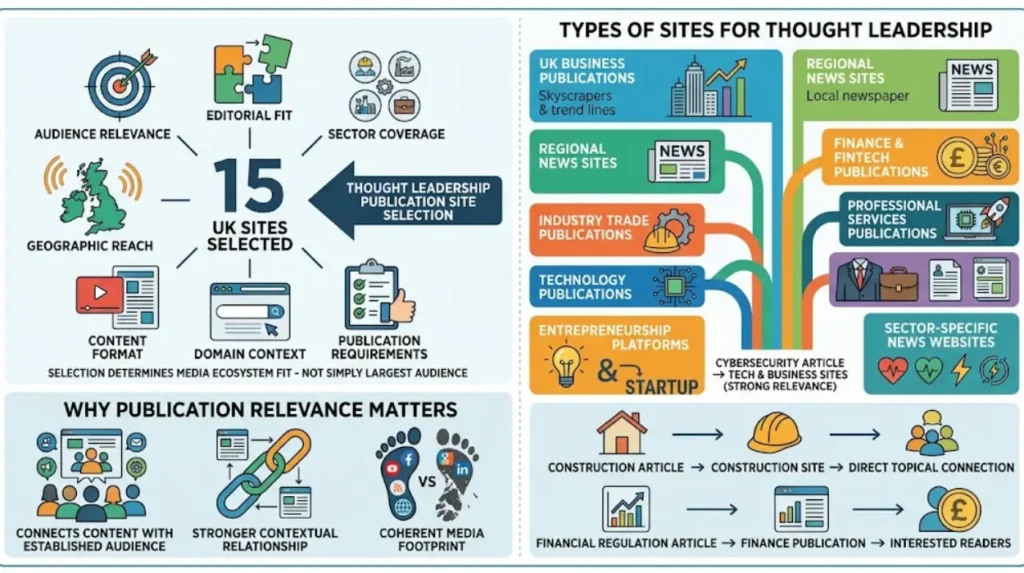
Fifteen publication sites are selected according to audience relevance, editorial fit, sector coverage, geographic reach, content format, domain context, and publication requirements rather than simply selecting sites with the largest audiences.
Site selection determines where the article fits within the wider media ecosystem. A national business publication serves a different purpose from a regional newspaper or specialist trade outlet.
A multi-site publishing strategy therefore uses different publication categories.
What types of sites can publish thought leadership content?
Relevant categories include:
- UK business publications
- Regional news sites
- Industry trade publications
- Finance and fintech publications
- Technology publications
- Professional services publications
- Entrepreneurship platforms
- Sector-specific news websites
For example, a cybersecurity article has stronger contextual relevance on technology and business publications than on unrelated lifestyle websites.
Why does publication relevance matter?
Relevance connects the content with an established audience. It also gives the article a stronger contextual relationship with its subject.
A construction-focused article published on a construction industry site has a direct topical connection. A financial regulation article published through a finance-focused publication reaches readers already interested in the subject.
This approach creates a more coherent media footprint than publishing identical material across unrelated websites.
What happens during the editorial review process?
Editorial review checks the article for relevance, accuracy, structure, readability, compliance, promotional language, factual claims, and publication standards before the content is approved for distribution across selected media sites.
Editorial review is a quality-control stage. Publishers assess whether the article matches their audience and content standards.
The review also identifies claims that require clarification. Statements involving market size, regulation, statistics, company performance, or industry trends require supporting evidence.
How are promotional elements controlled?
Thought leadership requires an editorial focus. Excessive sales language reduces its suitability for publication.
Brand references therefore remain relevant to the subject. The article focuses on the issue, expertise, and information rather than repeated calls to purchase a service.
For example, an executive discussing UK artificial intelligence regulation can explain operational implications, workforce requirements, and compliance challenges. Repeated product descriptions do not form the core of the article.
How are compliance requirements handled?
UK publishers apply their own editorial and commercial content policies. Sponsored or commercially arranged content also requires appropriate labelling where applicable.
Disclosure protects transparency between the publisher, brand, contributor, and audience.
How is one thought leadership article distributed across 15 sites?
A central article is prepared as the core asset, then distributed through a coordinated publishing process that matches the content with 15 relevant sites while maintaining consistent facts, positioning, authorship, and brand information.
Distribution starts after the content passes preparation and review.
The publishing team identifies the appropriate outlets from the selected media list. Each publication receives the required materials in its preferred format.
What is adapted for different publications?
Adaptation can include:
- Headline formatting
- Introduction length
- Author biography
- Image dimensions
- Metadata
- Link placement
- Disclosure wording
- Publication-specific formatting
The central argument remains consistent. Adaptation prevents technical publishing requirements from creating unnecessary inconsistencies.
For example, one publication can require a short author biography while another uses a longer contributor profile.
Does every site publish at the same time?
A 15-site campaign can use coordinated scheduling. Exact publication timing depends on editorial calendars, approval processes, content queues, and publication requirements.
A coordinated schedule helps maintain a clear campaign window. It also makes media monitoring easier because coverage appears within a defined period.
What role does content syndication play in multi-site publication?
Content syndication distributes an approved piece of content through multiple publication channels, creating broader exposure while preserving the core subject, expert viewpoint, factual information, and campaign positioning across each participating outlet.
Syndication and individual editorial publication are not identical processes.
Syndication involves distributing existing content through additional channels. Editorial publication involves a publisher selecting and presenting content within its own editorial environment.
The distinction matters for SEO and attribution. Search engines can encounter similar versions of the same article across multiple websites.
A controlled distribution strategy therefore needs clear canonical, attribution, linking, and duplication considerations where applicable.
How does syndication support media visibility?
Syndication increases the number of media environments where the expert perspective appears. It also creates a broader record of the campaign.
For example, a UK business leader publishing research about SME cybersecurity can reach business audiences, technology readers, regional audiences, and specialist professionals through different publication categories.
What benefits does publishing thought leadership on 15 sites provide?
Publishing thought leadership across 15 relevant sites expands expert visibility, creates multiple media touchpoints, strengthens topical relevance, supports brand recognition, and places the same authoritative viewpoint in front of distinct UK audiences.
The value comes from coordinated relevance rather than the site count alone.
How does multi-site publication increase visibility?
Fifteen publications provide multiple opportunities for audiences to encounter the same expert viewpoint.
A business decision-maker can discover the article through a business publication. A sector professional can encounter it through a specialist trade website. A regional stakeholder can see related coverage through a local news platform.
This creates a wider distribution footprint.
How does it support brand authority?
Brand authority develops through repeated associations with useful expertise. Thought leadership provides the information layer behind that association.
Consistent authorship, subject expertise, factual evidence, and relevant publication environments reinforce the connection between the organisation and its chosen area of expertise.
This process works over a series of credible content assets rather than through one article alone.
How can it support SEO?
Thought leadership can contribute to search visibility through relevant mentions, referral traffic, branded search activity, and contextual links where publishers include them.
The SEO value depends on the quality and relevance of each publication. A large quantity of unrelated links does not provide the same contextual value as relevant media coverage.
Which UK businesses use multi-site thought leadership campaigns?
Multi-site thought leadership campaigns suit organisations with specialist expertise, research, executive knowledge, industry commentary, or complex subjects that require broader media visibility across defined UK business and professional audiences.
Several sectors have strong use cases.
Which financial businesses use it?
Fintech companies, financial services firms, investment businesses, and professional advisers can publish commentary about regulation, payments, digital banking, investment trends, and financial technology.
Which technology businesses use it?
Technology companies can address artificial intelligence, cybersecurity, cloud computing, enterprise software, data governance, and digital transformation.
Which professional services firms use it?
Consultancies, legal firms, accounting practices, recruitment businesses, and business advisers can publish expert analysis around changes affecting their clients and industries.
Which property and construction businesses use it?
Property developers, construction firms, architects, surveyors, and property advisers can discuss planning, development, sustainability, infrastructure, housing, and commercial property trends.
The common factor is specialist knowledge that provides useful information to a defined audience.
How can businesses evaluate a 15-site thought leadership campaign?
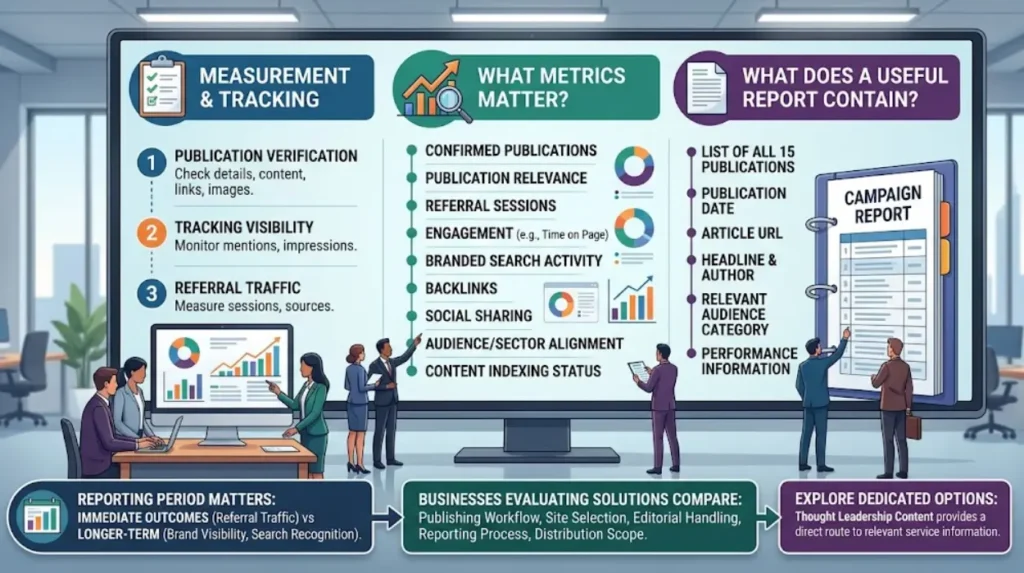
Businesses can evaluate a 15-site campaign by tracking publication completion, site relevance, audience fit, referral traffic, branded visibility, engagement, backlinks where applicable, and the consistency of expert positioning across all published placements.
Measurement begins with publication verification. Each placement needs to be checked for correct headline, author details, links, images, disclosures, and article content.
What metrics matter?
Useful metrics include:
- Number of confirmed publications
- Publication relevance
- Referral sessions
- Engagement from referral traffic
- Branded search activity
- Backlinks where applicable
- Social sharing
- Audience or sector alignment
- Content indexing status
The reporting period also matters. Some outcomes appear immediately through referral traffic. Brand visibility and search recognition require longer observation.
What does a useful report contain?
A campaign report lists each publication, publication date, article URL, headline, author, relevant audience category, and available performance information.
This creates a traceable record of the 15-site distribution.
Businesses evaluating a managed solution can then compare the publishing workflow, site selection, editorial handling, reporting process, and distribution scope. For organisations ready to explore a dedicated option,
Thought Leadership Content provides a direct route to the relevant service information.
What is the complete process for publishing thought leadership on 15 sites?
The complete process covers topic selection, audience definition, content creation, factual review, editorial preparation, site selection, submission, publication scheduling, quality checks, monitoring, and performance reporting across 15 relevant UK media outlets.
The process follows a defined sequence:
- Define the subject — Select a specific industry issue.
- Identify the audience — Establish the professional or consumer group.
- Develop the viewpoint — Build an evidence-based expert position.
- Create the article — Structure the content for readability and editorial relevance.
- Check accuracy — Verify facts, statistics, claims, and quotations.
- Select publications — Match the topic with 15 relevant sites.
- Prepare publication assets — Finalise headline, author details, images, links, and disclosures.
- Submit the content — Deliver the article according to each publication’s requirements.
- Monitor publication — Check each live placement for accuracy.
- Report results — Record publication details and available performance metrics.
This workflow turns thought leadership from a single content asset into a structured media publishing campaign.
Explore More Expert Insights:
How Sponsored Listicles Get Distributed on UK News
How Sponsored Video Gets Published Across 15 UK Sites
The central principle is consistency. The expert message remains factually consistent while the presentation follows each publication’s requirements. This creates a controlled 15-site publishing process with clear editorial, distribution, and measurement stages.