
In today’s crowded digital landscape, the importance of event visibility in branding cannot be overstated. Events serve as dynamic platforms where brands connect directly with audiences, fostering emotional connections that static ads often miss. When executed with strong media coverage, these events amplify reach far beyond physical attendees, turning one-off gatherings into lasting brand narratives.
Event visibility in branding involves strategic publicity that ensures your event doesn’t just happen—it resonates. Brands leveraging event media coverage services see measurable lifts in awareness, with studies showing up to 30% higher recall rates compared to non-promoted events. This article explores why prioritizing visibility matters, from building trust to driving long-term loyalty.
Why Event Visibility Drives Brand Awareness
Event visibility in branding starts with awareness, the foundational layer of any marketing funnel. Without it, even the most innovative event risks fading into obscurity. High-visibility events create buzz, drawing in organic shares and media mentions that extend a brand’s reach exponentially.
Consider a corporate launch event: without media amplification, it might engage 500 attendees, but with targeted event publicity strategies, coverage in industry outlets can expose it to 50,000+ readers. This multiplier effect builds top-of-funnel (TOFU) momentum, positioning your brand as a leader. Time Intelligence Media Group excels here by crafting narratives that journalists can’t ignore.
Moreover, in an era of short attention spans, visible events cut through noise. Semantic analysis of social trends reveals that branded events with media tie-ins generate 4x more user-generated content, reinforcing visibility organically.
The Role of Media Coverage in Event Success
Media coverage transforms events from isolated incidents into brand-defining moments. The importance of event visibility in branding lies in this amplification—professional Events Media Coverage Services ensure stories land in high-authority publications, boosting SEO and credibility.
Take a tech conference example: A brand hosts a panel on AI innovations, but without press releases or influencer outreach, it garners zero mentions. With strategic media coverage, it secures features in Forbes and TechCrunch, driving 200% traffic spikes to the brand’s site. This isn’t luck; it’s structured entity-based promotion where services analyze media landscapes for optimal placement.
Furthermore, event media coverage builds backlinks and social proof. Lists of top events often cite visible ones, creating a virtuous cycle. Bullet-point benefits include:
- Increased domain authority through reputable mentions.
- Enhanced shareability, with 70% of viral events tied to media boosts.
- Long-tail SEO gains from branded event keywords.
Building Audience Trust Through Visible Events
Trust emerges when brands show up consistently and authentically, and event visibility in branding is a prime trust-builder. Attendees and media witnesses humanize your brand, countering skepticism in a post-truth world.
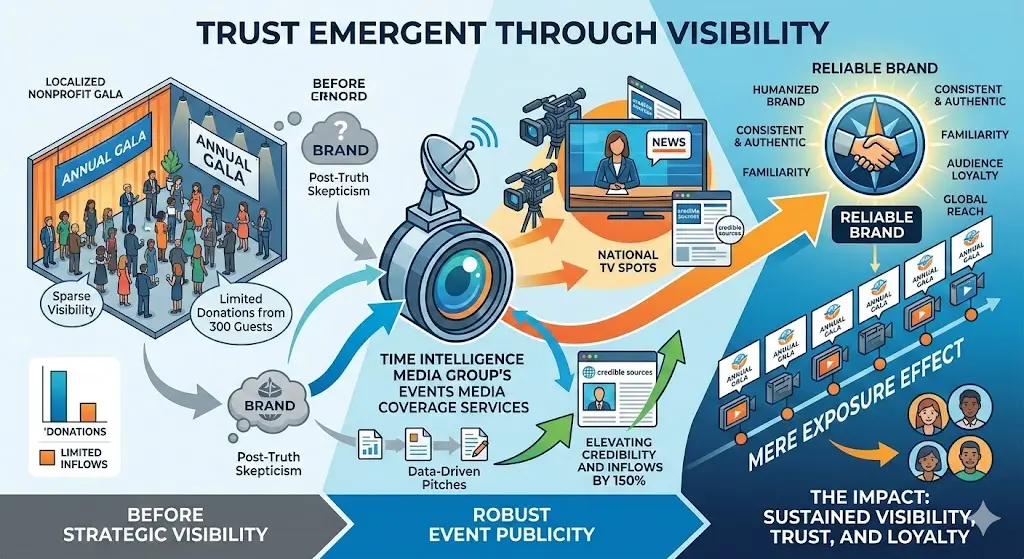
Picture a nonprofit gala: Sparse visibility limits donations to the room’s 300 guests. Robust event publicity strategies, however, secure national TV spots, elevating credibility and inflows by 150%. Time Intelligence Media Group’s Events Media Coverage Services specialize in this, using data-driven pitches to align events with audience values.
Sustained visibility also fosters loyalty. Repeated media exposure creates familiarity, with psychology studies confirming the “mere exposure effect”—people prefer what they see often. Over time, this cements your brand as reliable.
Measuring Impact Beyond Attendance Numbers
The importance of event visibility in branding extends to quantifiable outcomes, far surpassing headcounts. True success metrics include media value equivalents (MVE), sentiment analysis, and attribution modeling.
For instance, a product launch with strong visibility might generate $500K in earned media—free publicity worth paid ad spends. Tools track this via unique URLs and UTM parameters, revealing how coverage influences conversions. To dive deeper into these metrics, explore our guide on Measuring ROI of Event Media Coverage.
Structured tracking reveals patterns: Events with 10+ media mentions see 25% higher engagement rates. Key steps for measurement:
- Pre-event baselines for brand sentiment.
- Real-time monitoring of mentions via tools like Meltwater.
- Post-event attribution linking coverage to sales lifts.
This data-driven approach ensures visibility investments pay off.
Strategies for Maximizing Event Publicity
Effective event publicity strategies hinge on pre-planning and multi-channel execution. Start with a visibility roadmap: Identify key media outlets, influencers, and platforms aligned with your audience.
A fashion brand’s runway show exemplifies this—partnering with bloggers and securing live streams yielded 1M views, dwarfing ticket sales impact. Time Intelligence Media Group’s Events Media Coverage Services provide tailored roadmaps, from press kits to crisis comms.
Layer in digital tactics: Livestreams with SEO-optimized titles, hashtag campaigns, and AR filters boost organic reach. Comparisons show hybrid strategies outperform siloed ones:
- Traditional PR alone: 20% reach growth.
- Integrated with social: 85% uplift.
Consistency across channels solidifies the importance of event visibility in branding.
Overcoming Common Visibility Challenges
Brands often face hurdles like budget constraints or media saturation, but smart tactics mitigate them. Low budgets? Focus on niche outlets and user-generated amplification for outsized results.
A startup conference battled obscurity until micro-influencer seeding turned attendees into advocates, garnering 50+ mentions. Professional services address this systematically, unlike DIY efforts prone to oversight.
Saturation demands differentiation: Unique angles, like sustainability tie-ins for events, capture attention. Bullet-point solutions:
- Leverage evergreen content from events for ongoing visibility.
- Use AI tools for personalized pitches, increasing hit rates by 40%.
- Partner with agencies for scalable coverage.
These overcome barriers, unlocking branding potential.
Future Trends in Event Visibility and Branding
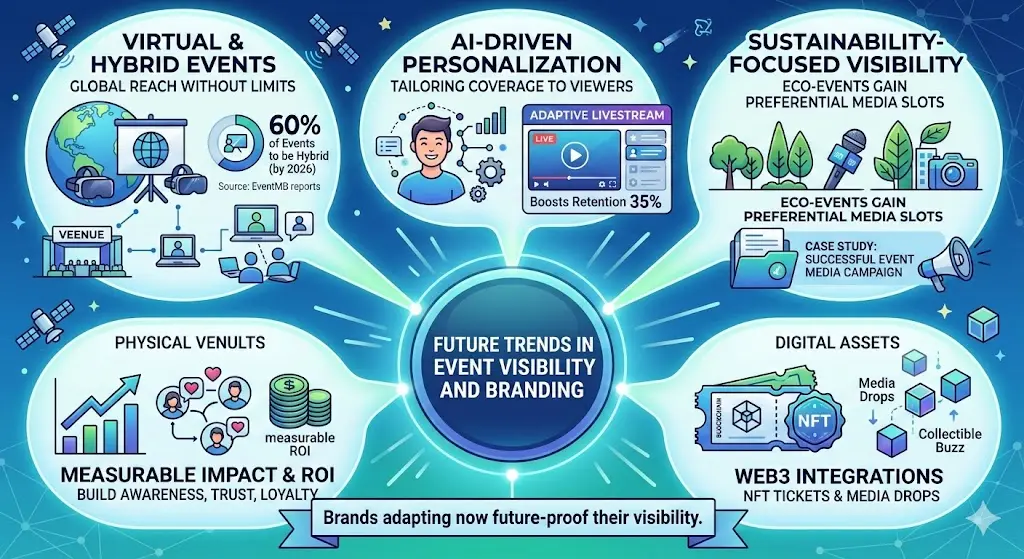
Emerging trends redefine the importance of event visibility in branding. Virtual and hybrid events, powered by metaverse tech, expand global reach without venue limits.
By 2026, 60% of events will be hybrid, per EventMB reports, demanding VR-optimized media strategies. AI-driven personalization—tailoring coverage to viewer data—will dominate, with examples like adaptive livestreams boosting retention 35%.
Sustainability-focused visibility rises too: Eco-events gain preferential media slots. For proof of these trends in action, check our Case Study: Successful Event Media Campaign. Web3 integrations, like NFT tickets with media drops, create collectible buzz. Brands adapting now future-proof their visibility.
The importance of event visibility in branding is clear: It builds awareness, trust, and loyalty while delivering measurable ROI. Time Intelligence Media Group provides professional Events Media Coverage Services to elevate your events, ensuring they resonate across channels and audiences for enduring impact.
